


UNI-BASED REVIEW: Ateneo Entablado’s ‘Santa Juana ng mga Katayan’
“This translation of the sprawling Bertolt Brecht play can be a test of patience, but it maintains urgency in its comprehensive critique of capitalism.”
Watching a dramatization of economic theory over the course of three hours might not sound like the most entertaining escape for some, but that’s part and parcel of Bertolt Brecht’s approach to theater. The German playwright encouraged critical thinking over passive consumption, and Ateneo Entablado’s Santa Juana ng mga Katayan—a Guelan Varela-Luarca translation of Brecht’s Saint Joan of the Stockyards, which in turn is a retelling of the story of Joan of Arc—is as much an illustration of the inherent inhumanity of capitalism as it is a character-driven tragedy.
In line with Brecht’s trademark techniques, the production is framed as a performance. The actors and crew are first seen as themselves, getting on stage to prepare for the drama ahead: that of Juana, a member of a Christian charity, learning of the unjust practices of the meat-packing industry under the control of the devious Pedro Sakmal. It’s a demanding show that can occasionally be a test of patience, but it maintains an impressive sense of urgency as it assembles a comprehensive argument for the need to dismantle these capitalist structures.
The supply chain
At first, Wika Nadera’s thrust stage—covered in rusting steel and the furnishings of a slaughterhouse—seems to present the opposition between the corporate decision-makers stationed at an upper balcony and the workers who man the factory floor. But as the play progresses, we’re made to see the set (and the relationship between these factions of people) as horizontal. Everyone is part of the same supply chain in the same dingy building, and cast in the same shadows and queasy yellow lights (designed by Aldrie Valmonte), all while the squealing of pigs sounds out around them. The show progresses through the collective actions of these groups of people, who frequently sing songs or chant their lines in unison as protest.
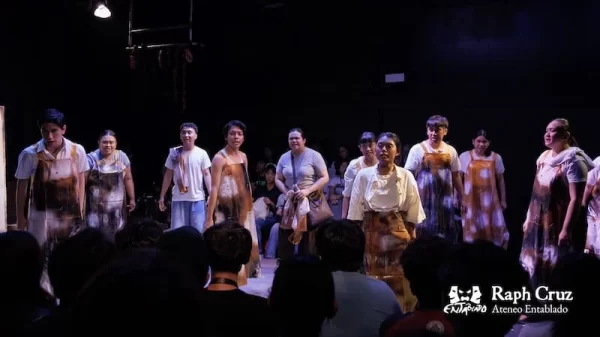
The ensemble of Santa Juana ng mga Katayan; Photo Credit: Raph Cruz
As dark as this might make Santa Juana sound, however, there’s an often humorous, satirical quality to the production reflected in several of its more expressive design elements. Characters who have something important to say or who become the subject of scrutiny are illuminated by a moving spotlight. Towards the end, a saintly robe is revealed to be made of scrap and bearing images from consumer brands. Other visual touches, such as the labeling of props (Sakmal’s checkbook, for example, is labeled by a large piece of paper that says “checkbook”) emphasize that this is all just a performance whose content we’re supposed to scrutinize rather than blindly accept as entertainment.
Wicked and divine
This isn’t to say that the actors in Santa Juana aren’t supposed to take the drama of the performance seriously. In fact, the ensemble manages to thread the needle between the demands of naturalistic character-acting and facilitating the material’s more self-aware, satirical ideas with plenty of physicality and good humor. And in the title role, Tini Flores (alternating with Kelsey Bravo) projects an immediate, disarming innocence that softens the weight of the room whenever they walk in. But far from being an unimpeachable paragon of virtue, Juana is still portrayed as naïve more than anything else—her earnest belief that one can change the world by appealing to people’s better nature is inevitably exploited as a weakness.
Even the play’s antagonist isn’t simply a cartoon villain of pure evil. If anything, Sakmal is easily swayed by emotion and just as exhausted of the exploitative system that he nevertheless keeps feeding. But Roldine Ebrada (alternating with Lee Gosuico) makes sure not to play the character as sympathetic. Instead, his Sakmal is a sleazy coward who bends to the whims of others and is still, somehow, surprisingly funny and immensely watchable. And it’s a credit to directors Delphine Buencamino and Issa Manalo Lopez that all these contradictions form a coherent whole, with a sense of humor that doesn’t distract from or cheapen the seriousness of the themes but makes them easier to comprehend.
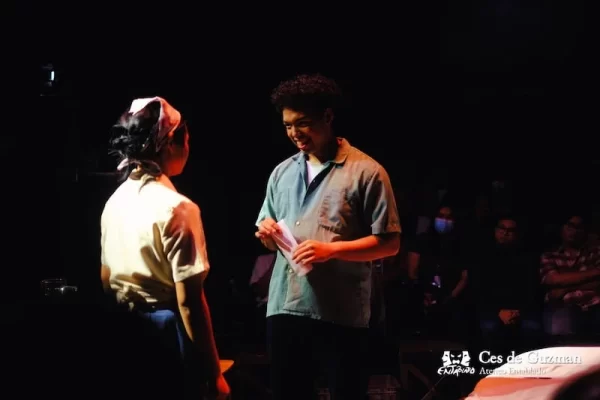
Roldine Ebrada as Sakmal; Photo Credit: Ces de Guzman
The cycle continues
With that said, this material is undeniably challenging and begins to feel somewhat overwhelming as it reaches its final stretch. By design, Santa Juana is meant to illustrate repetition as the market crashes and appears to build back up over and over, but even this begins to yield diminishing returns. Buencamino and Manalo Lopez attempt to explain and visualize these economic concepts to varying degrees of success—but most effectively in a scene where the show pauses and the actors break character to clarify to each other what exactly is going on in the story. This is a welcome intervention, not only for its usefulness but because it has the audience reckon with the limits of their own understanding and desire to learn more.
Whether one already fully grasps the ideas presented here or not, Buencamino and Manalo Lopez still maintain an urgency to the drama. Brecht’s script and Varela-Luarca’s translation emphasize the need to think outside the parameters set by those who abuse them, to reject the rules of the game already stacked against the underprivileged. But there is also a warning here, as Juana’s righteousness and the sacrifices she makes are co-opted even by those she once deemed allies: that capitalism is inherently unsustainable without the use of violence, suppression, and manipulation. And all it takes for people to ignore this and accept this reality as normal and unchangeable is a sympathetic story about an unwilling victim.
This reviewer watched the 7:30 PM, April 21 show.
Tickets: P560–1000
Show Dates: Apr 21 – May 3 2026
Venue: Fine Arts Black Box, Old Communications Building, Ateneo de Manila University, Quezon City
Running Time: approximately 3 hours (with a 15-minute intermission)
Company: Ateneo Entablado
Creatives: Bertolt Brecht (Playwright), Guelan Varela-Luarca (Translation), Delphine Buencamino (Direction), Issa Manalo Lopez (Direction), Ness Roque (Dramaturgy), Wika Nadera (Set Design), Tata Tuviera (Costume and Make-Up Design), Aldrie Valmonte (Lighting Design), Nica del Rosario (Music, Sound Design), Matthew Chang (Music, Sound Design), Jada Bartolome (Projection Design), Lora Batomalaque (Technical Direction)
Student Creatives: Katriel Garcia (Assistant Direction), Kaiser Cortina (SFX Design)
Student Cast: Tini Flores, Kelsey Bravo, Roldine Ebrada, Lee Gosuico, Erin Ramirez, Dani Quinto, Paul Felias, Philippe Reyes, Ron Abustan, Melvin Calubiran, Mik Cadag, Embry Nucum, KD San Juan, Rej Atin, Claudette Galgana, Jam Asombrado, Sam Saquilayan, Czrille Canonigo, Biya Maja, Therese Catapang

Comments