

REVIEW: Emerging Stars Unveil Rare Masterpieces at International Dance Day Gala
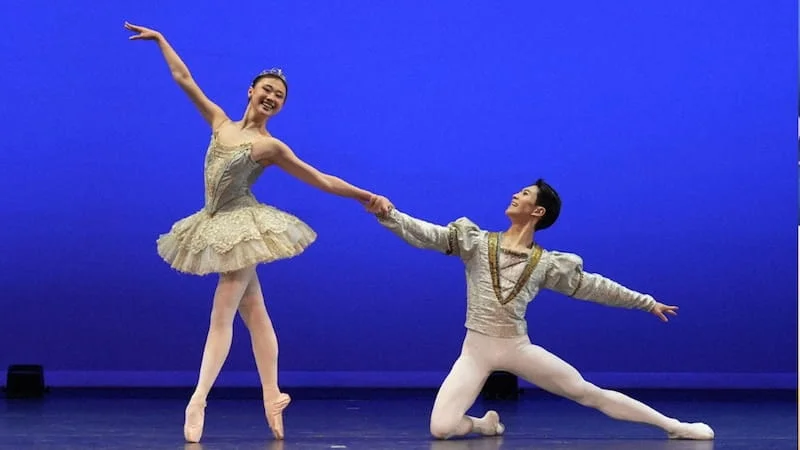
The International Dance Day program at Samsung Theater packed a punch from the start, opening with a mixed bill of rarely seen works performed by emerging dancers already operating at an elite level. Under the direction of Sascha Radetsky, the American Ballet Theatre Studio Company returned to Manila with a program that reflects the stylistic breadth and history of its parent company, American Ballet Theatre.
Radetsky has built a lasting connection with Filipino audiences. He has mentored local dancers who later joined the main company and has led workshops for underserved communities, while showing an easy familiarity with local culture. This visit continues that relationship with a program that moves across classical and contemporary styles, spanning different eras and choreographic voices.
The evening does more than showcase talent. It sets a standard for local companies to expand their programming. Dancers grow when they work with different choreographers, gaining range and depth through varied techniques and artistic approaches. The production also highlights the role of patronage, with several works made possible through benefactors.
What follows is a closer look at the program.
LA BAYADERE GRAND PAS DE DEUX
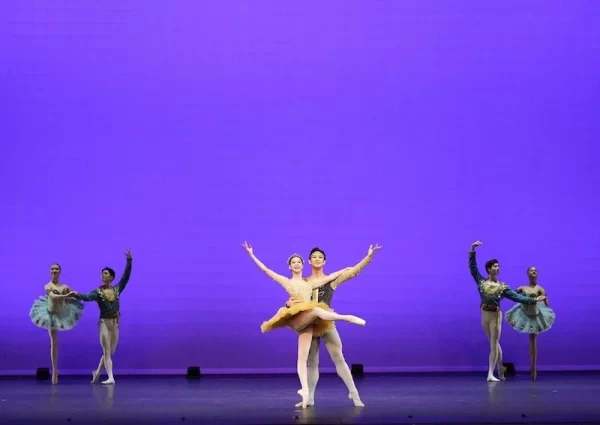
La Bayadere Grand Pas de Deux; Photo Credit: Jyllan Bitalac
The Grand Pas de Deux from La Bayadère shows how Marius Petipa builds a scene around order and display. Set during the betrothal of Gamzatti, the rajah’s daughter, to the warrior Solor, the structure follows old school Russian sequence. A slow duet establishes the relationship, followed by individual variations, and a fast coda that gathers momentum, all arranged in a formal, balanced design.
Kiera Sun’s Gamzatti dances with authority. Her leg extensions unfurl like silky ribbons and her arabesques stay steady. She holds her balances with ease and moves through turns and traveling steps with clean, continuous lines.
Younjae Park’s Solor keeps the focus on control. In his cabrioles (legs beat in mid-air) the legs scissor together with the sharp precision of a compass needle, striking the air before settling into a landing as smooth as a breath
Geonhee Park and Xavier Xué sharpen the energy of the coda with a series of fast, upright interlacing of the legs. Their jumps snap together in midair like flint striking, and rebound quickly. The footwork gives the final section a ticking rhythm underneath the lead dancers.
Chloe Hoffmann and Delfina Nelson-Todd help shape clear formations as the corps opens and closes around the leads, keeping the stage balanced.
CORNBREAD
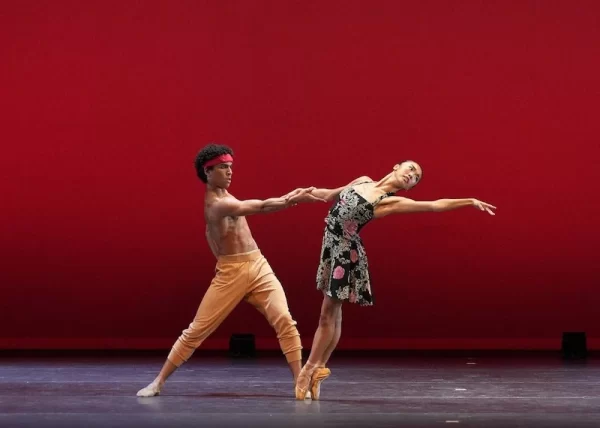
Cornbread; Photo Credit: Jyllan Bitalac
The program shifts from the formality and symmetry of La Bayadère to Twyla Tharp’s Cornbread, a work driven by momentum and uneven, almost tossed-off phrasing. The music by the Carolina Chocolate Drops draws from African American string band traditions, built on fiddle, banjo, and sharp rhythmic accents rather than long melody lines. That pulse shapes Tharp’s movement, which favors grounded steps, quick directional changes, and a conversational use of the body.
The piece becomes a showcase for Kayla Mak and Elijah Geolina, ABT Studio company alumni. Their movement shifts between ballet technique and a more relaxed, off-center style, with sudden turns, dropped weight, and moments where the head and torso throw back against the direction of travel, giving the dancing a loose but controlled edge.
Mak and Geolina’s solos run in one continuous line of surprises, mixing intricate steps, sharp body shapes, multiple turns and quick footwork. The limbs stretch and release with an easy looseness, then snap back into focus through clean pirouettes that reset the rhythm before the movement pushes forward again.
The audience is surprised at the level of finish from Mak and Geolina, both apprentices of the American Ballet Theatre. Their dancing carries a polish and control that already reads at soloist level, the entry-level standard expected from first-rate companies.
CERULEAN SKIES
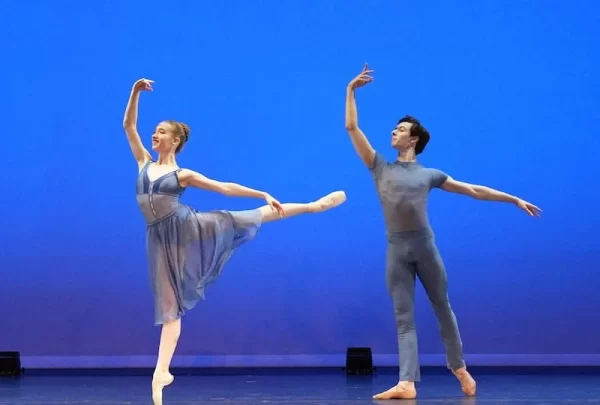
Cerulean Skies; Photo Credit: Jyllan Bitalac
This commissioned work by Brady Farrar stands out as a lively showcase for the group—Delfina Nelson-Todd, Kiera Sun, Audrey Tovar-Dunster, Matteo Curley Bynoe, Younjae Park, and Xavier Xué. An alumnus, now a member of ABT, Farrar brings strong musical timing to his choreography, set to the piano works of Frédéric Chopin.
In one solo section, a bright, driving piano line sets the pace, and the ballerina responds with fast, precise footwork that matches the sharp accents of the music. Each change of direction follows the shifts in the piano phrases, so the movement is pulled directly by the score. When the music moves into longer, more lyrical passages, the choreography opens with it. The dancer stretches her arms fully and lets the movement sweep, matching the warmth of the piano lines.
Farrar’s choreography moves between crisp, staccato passages and smooth, flowing sections. The dancers adjust their energy without breaking focus, tightening when the music grows dense and softening when it relaxes. What stands out is the young choreographer’s restraint. He does not overload the dancers or force unnecessary effects. Instead, he builds material that suits them, allowing each performer to move with ease and clarity.
THE NUTCRACKER PAS DE DEUX
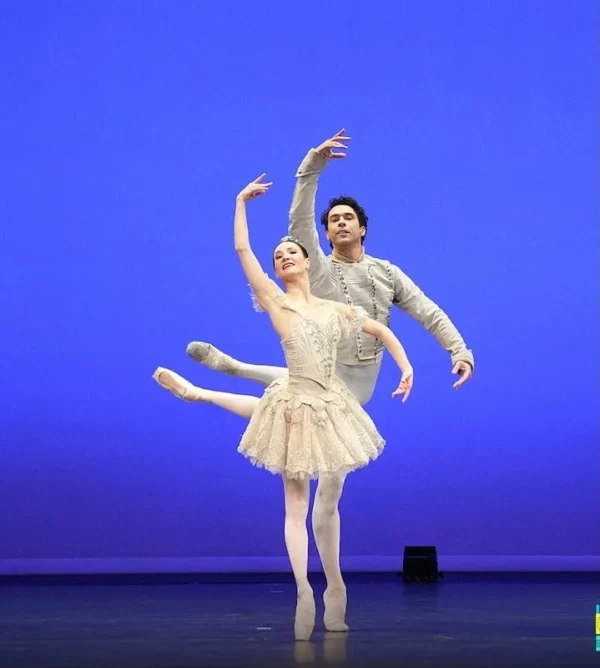
The Nutcracker Pas de Deux; Photo Credit: Jyllan Bitalac
We see a “new classic” in Alexei Ratmansky’s Nutcracker Grand Pas de Deux. During his 14-year tenure as artis- in-residence at the American Ballet Theatre, Ratmansky reshaped the company’s repertoire by combining classical technique with a more natural, character-driven style.
This pas de deux focuses on the adult versions of Clara and the Nutcracker Prince, rather than the familiar Sugar Plum Fairy and her Cavalier. By doing so, it keeps the finale tied to Clara’s journey instead of shifting into a separate showcase from the Land of Sweets. The choreography avoids showy display for its own sake and instead unfolds as a direct exchange between the two dancers, gradually turning into a romance. It works as a continuation of Clara’s coming of age. Ratmansky replaces formal presentation with a closer look at growth and emotional change.
ABT principal dancer Christine Shevchenko keeps her performance elegantly restrained, avoiding excess decoration in favor of clean line and control. Thomas Forster matches her with attentive partnering, moving between secure lifts and lighter, more playful exchanges. Their connection allows the story to develop through movement rather than virtuosic displays.
GRAND PAS CLASSIQUE
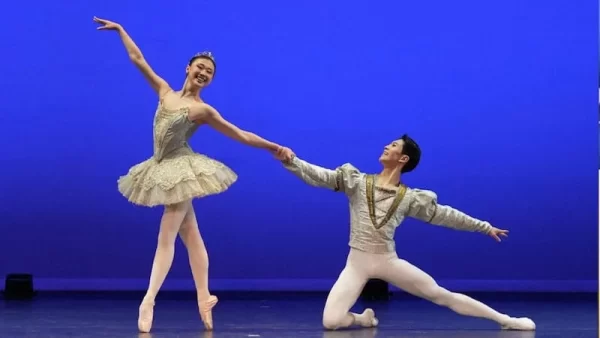
Grand Pas Classique; Photo Credit: Jyllan Bitalac
Victor Gsovsky, a Russian-born ballet choreographer and pedagogue who worked in Europe in the 20th century. His Grand Pas Classique, created in 1949, is a distilled test of classical technique. It draws from the 19th-century tradition associated with Petipa but stands on its own as a technical showcase rather than part of a story ballet. The choreography demands speed, precision, and control. Fast pointe work, sharp footwork, sustained balances, and large jumps follow one another without pause.
Geonhee Park stands out in the series of quick interlacing jumps, where his legs snap together in quick beats midair, then land and immediately push him into the next leap. The effect is of a dancer using the floor like a springboard, turning each landing into a new launch. Sooha Park follows with rising développés, each extension held with control before finishing in a fast, whipped turn. The clarity and speed of the execution pull the audience into the rhythm and draw spontaneous applause.
HUMAN
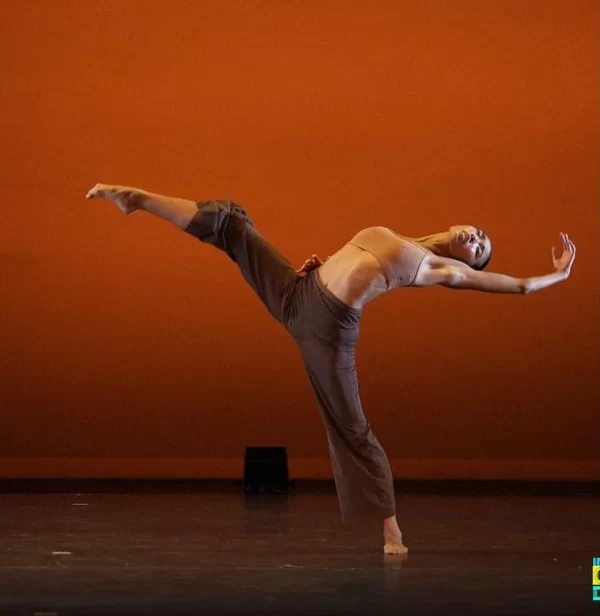
Human; Photo Credit: Jyllan Bitalac
Dancer-choreographer Yannick Lebrun’s solo for Kayla Mak is dedicated to “everyone fighting for peace and freedom.” The movement begins in the torso and reaches the limbs a fraction later, so nothing arrives instantly. Each action appears held for a moment before release, building tension even in simple gestures.
The choreography stays low and wide, moving through grounded transitions rather than lifted steps. Without the usual rise and fall, the movement becomes a continuous unfolding between beats instead of landing on them.
The arms do not settle into fixed positions. They shift into uneven shapes, pausing briefly before moving again, redrawing the space with each change. The result is a constant pull between stillness and release.
Kayla Mak holds the stage with strong control and a grounded presence. Small shifts in her weight carry clear emotional force, as if she is in direct conversation with gravity. The performance stays intense but contained. Her uneven shapes and careful control of tension and release show a dancer fully inhabiting the essence of each movement.
VARIATIONS FOR THREE
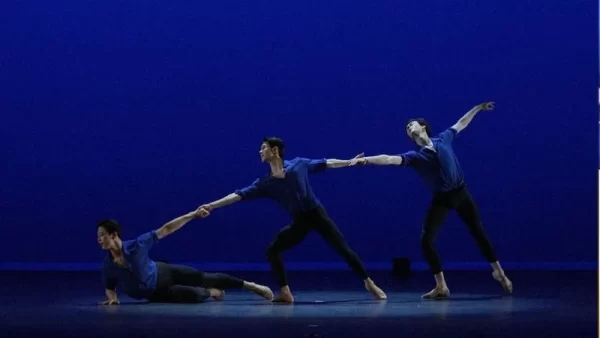
Variations for Three; Photo Credit: Jyllan Bitalac
Variations for Three is a contemporary neoclassical work choreographed by ballerina Tiler Peck and performed by Geonhee Park, Younjae Park, and Xavier Xué, with each dancer given space to show individual virtuosity.
Peck builds the choreography as a precise response to Niccolò Paganini’s violin score. Every step, from turning sequences, glides to supported jumps, lands like a punctuation in the music. The dancers match the sharp shifts in the violin line so closely that the movement becomes a direct physical tracing of the score.
The trio’s charm lies in the boys’ playful showmanship as they trade rapid footwork for explosive aerial turns. Their final pose is a choreographed nod, a synchronized bow where they sweep their arms toward the third dancer to acknowledge his turn in the spotlight. He responds with a grin, then pushes through a sharp sequence of flexed-foot steps before spinning into a rush of turns in the air. He finishes by dropping to his knees and giving a light, knowing salute back to the others. The moment breaks the formal frame with humor while staying fully within the technique.
SYLVIA PAS DE DEUX
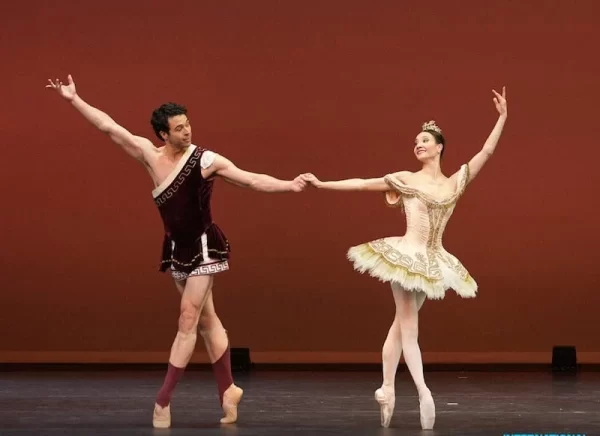
Sylvia; Photo Credit: Jyllan Bitalac
Sylvia is a highlight of the British neoclassical tradition, where intricate footwork and supported turns meet a sense of romantic, mythic drama. Watching Christine Shevchenko and Thomas Forster brings to mind the original Margot Fonteyn and Michael Somes, for whom Frederick Ashton created the ballet in 1952.
Ashton drew inspiration from the 1876 version of Sylvia and reshaped it with his own musical phrasing. The most recognizable moments are the supported pirouette that resolves into a side bend, the serpentine arm movements, and the ballerina leaning into her partner’s chest in a low arabesque. These were closely identified with Fonteyn.
The duet is built on Ashton’s flowing style of partnering, refined musicality, and high-catch lifts. The ballerina glides through the stage with smooth, continuous support, including lifts that keep her upright through the thigh. The dance stays closely tied to the music, shaped by the melodic line of Léo Delibes.
Shevchenko and Forster bring out this British style with soft upper-body phrasing and a restrained, polished quality that favors clarity and grace over technical display. Forster supports without drawing attention, allowing the movement to flow while the music by Léo Delibes sets the pace. Thus, the dancing holds its elegance and control throughout.
BERNSTEIN IN A BUBBLE
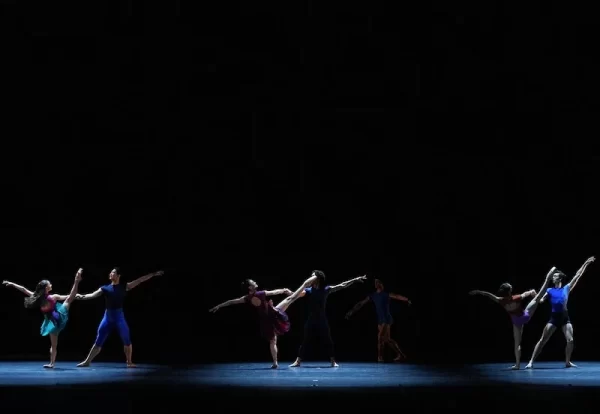
Bernstein in a Bubble; Photo Credit: Jyllan Bitalac
Alexei Ratmansky’s Bernstein in a Bubble (2021) captures the jazz-infused spirit of Leonard Bernstein’s Divertimento by turning its sharp shifts in rhythm and mood into movement that constantly changes direction.
Ratmansky works with an uneven number of dancers to keep the stage unpredictable. With no fixed symmetry or balanced pairings, the group keeps reshaping itself, which mirrors the irregular phrasing of the music and its sudden changes in energy.
The choreography responds directly to that structure with broken, syncopated movement and quick changes of pace. Dancers shift suddenly in direction, interrupt phrases, and match the jagged quality of the score. There is also a strong sense of humor in the staging. At one point, the women open their legs in crab-like shapes at the peak of a lift. In another section, the men sway their torsos like pendulums while a dancer cuts through this with fast, whipping turns, her speed sharply contrasting with the wider, slower motion around her.
As the music moves from brassy bursts to softer, blues-like passages, the choreography shifts from large, loose group patterns to smaller intimate duets. Ratmansky treats Bernstein’s score like a map of changing human behavior. Whether it’s a quick dance that captures the frenetic energy of a woodwind line or a slow, grounded movement that echoes a bluesy cello, the choreography makes the invisible qualities of the music physically tangible.
This reviewer watched the 7:30 PM, April 22 show.
Tickets: P1,435.90 (Price Zone 1), P1,063.60 (Price Zone 2), P850.90
Show Dates: April 22-26
Venue: The Theatre at Solaire
Running Time: approx. 2 hours with a 15-minute intermission
Producer: Ayala Land
Creatives:
Sofia Elizalde (ABT Global Council and Steps Dance Studio Founder)
American Ballet Theatre: Susan Jaffe (artistic director), Barry Hughson (executive director)
American Ballet Theatre Studio Company: Sascha Radetsky (artistic director), Claire Florian (managing director), Yan Chen (rehearsal director) Audrey Latif (production manager)
La Bayadere (Pas d’Action):
Choreography: Marius Petipa
Staging: Sascha Radetsky and Yan Chen
Music: Ludwig Minkus
Costumes: Theoni V. Aldredge
Cornbread:
Choreography: Twyla Tharp
Staging: Kaitlyn Gilliland
Music: The Carolina Chocolate Drops
Costumes: Santo Loquasto
Lighting: originally by James F. Ingalls
Cerulian Skies:
Choreography: Brady Farrar
Music: Frédéric Chopin
Costumes: Elevé Dancewear
Lighting: Audrey Latif
The Nutcracker Pas de Deux
Choreography: Alexei Ratmansky
Music: Peter Tchaikovsky
Costumes: Richard Hudson
Grand Pas Classique:
Choreography: Victor Gsovsky
Staging: Sascha Radetsky and Yan Chen
Music: Daniel-Francois Auber
Human:
Choreography: Yannick Lebrun
Music: Blick Bassy (“Ngwa”)
Lighting: Audrey Schultz
Variations for Three:
Choreography: Tiler Peck
Staging: Elijah Geolina and Daniel Guzmán
Music: Niccoló Paganini
Costumes: styled by Tiler Peck
Lighting: originally by Clifton Taylor
Sylvia Pas de Deux:
Choreography: Frederick Ashton
Music: Léo Delibes
Costumes: original designs by Robin and Christopher Ironside, additional designs (revival) by Peter Farmer
Bernstein in a Bubble
Choreography: Alexei Ratmansky
Staging: Jeanette Delgado
Music: Leonard Bernstein
Costumes: Moritz Junge
Lighting: Brad Fields
Cast:
ABT Principal Dancers: Christine Shevchenko, Thomas Forster
ABT Apprentices: Kayla Mark, Elijah Geolina
ABT Studio Company: Maximilian Catazaro, Matteo Curley Bynoe, Ptolemy Gidney, Delfina Nelson-Todd, Geonhee Park, Sooha Park, Younjae Park, Kiera Sun, Audrey Tovar-Dunster, Xavier Xué
ABT Studio Company Trainee: Chloé Hoffman
La Bayadere (Pas d’Action):
Kiera Sun (Gamzatti), Younjae Park (Solor), Chloé Hoffmann, Delfina Nelson-Todd, Geonhee Park, Xavier Xué
Cornbread:
Kayla Mak and Elijah Geolina
Cerulian Skies:
Delfina Nelson-Todd, Kiera Sun, Audrey Tovar-Dunster, Matteo Curley-Bynoe, Younjae Park, Xavier Xué
The Nutcracker Pas de Deux:
Christine Shevchenko and Thomas Forster
Grand Pas Classique:
Sooha Park and Geonhee Park
Human:
Kayla Mak
Variations for Three:
Geonhee Park, Younjae Park, Xavier Xué
Sylvia Pas de Deux:
Christine Shevchenko and Thomas Forster
Bernstein in a Bubble
Chloé Hoffmann, Sooha Park, Audrey Tovar-Dunster, Matteo Curley Bynoe, Elijah Geolina, Younjae Park, Xavier Xué
Comments