


REVIEW: ‘The Moon and the Bakunawa’ touches on something real
There is something immediately evocative about the image at the heart of The Moon and the Bakunawa: A Dementia Carer Story: a celestial body slowly being consumed. In Filipino folklore, the Bakunawa is a serpent said to swallow the moon. Here, that myth is positioned as a metaphor for dementia. It is a compelling frame for a deeply human story.
But while the production is thoughtful in its staging and sincere in its intentions, it doesn’t quite make that metaphor as closely cohere with the story transpiring on stage. It struggles to anchor its emotional weight where it matters most: in the relationship at its center.
Striking stage
Directed by Roobak Valle, the show unfolds entirely within Mamay’s bedroom—a contained, intimate space that reflects the increasingly insular world of a woman living with dementia. Julio Garcia’s production design situates a warm bed at the center, flanked by a coat rack and a chest, with exposed wooden shelving forming the outline of a house behind them.
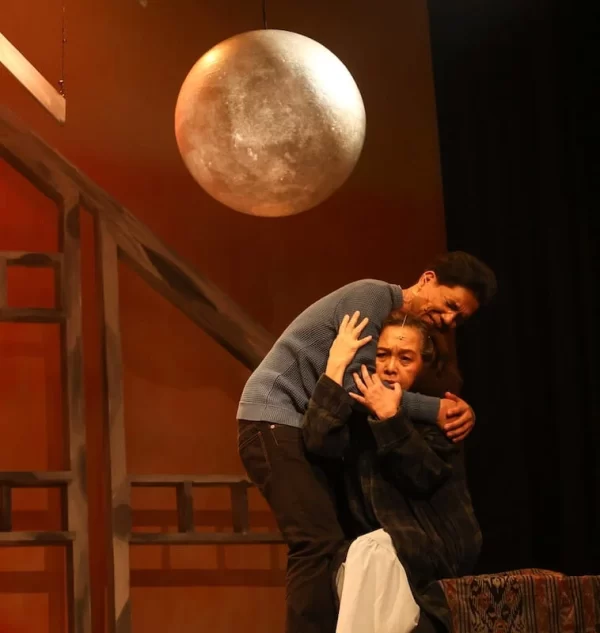
Divina Cavestany as Mamay, Phil Panganiban as Tonyong; Photo Credit: Myra Ho
Overhead, circular lights hang, with one large orb standing in for the moon. Roman Cruz’s lighting works in tandem with Valle’s direction, clearly delineating moments when Tonyong steps out to narrate versus when he is present within the scene. When the Bakunawa enters the narrative, projections by Joee Mejias visualize the serpent swallowing the moon. Taken together, these elements create a cohesive staging that is clear, considered, and at times striking.
Nuanced themes
Nitoy Chan Jr.’s writing similarly shows moments of sensitivity and texture. The play follows Mamay and her son Tonyong who has served as her full-time caregiver for eight years in Perth. Their interactions map the day-to-day realities of dementia caregiving. There are also touches of cultural specificity that ground the piece: Mamay speaking in Ilonggo, the use of the lullaby “Ili-Ili Tulog Anay,” and the integration of Filipino mythology into Tonyong’s recollections of childhood.
Yet for a work that foregrounds the Bakunawa as a central metaphor, it feels underdeveloped. The myth appears at key moments, and is visually reinforced through projections, yes, but it functions more as an occasional motif—interesting, but ultimately decorative.
Emotional distance
Where the production most clearly falters, however, is in performance. In a two-hander that hinges entirely on the relationship between mother and son, belief in that relationship is vital. Divina Cavestany, as Mamay, delivers a performance that is grounded and affecting. She captures the gradual erosion of memory with specificity, moving fluidly between lucidity and disorientation, and finding moments of humor and tenderness even within the confusion.
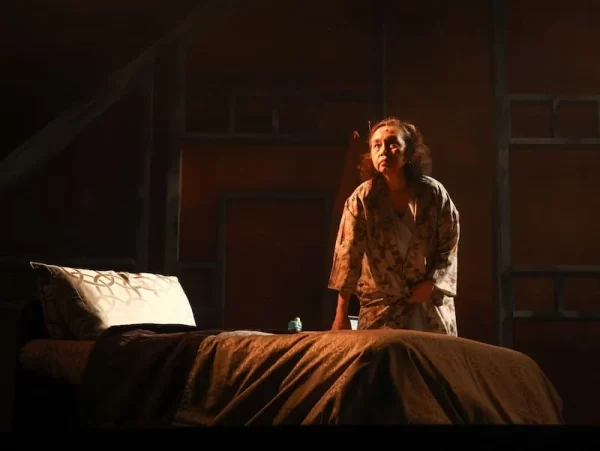
Divina Cavestany as Mamay; Photo Credit: Myra Ho
Phil Panganiban, as Tonyong, struggles to meet her on the same level. His performance often comes across as mannered, lacking the interiority and lived-in quality necessary to make the caregiving dynamic feel real. This becomes especially pronounced given the emotional demands of the role. Tonyong is not just a narrator but the audience’s primary point of entry into the story—a son navigating exhaustion, love, resentment, and duty. Without a convincing sense of inner life, the character never fully grounds the play, and the emotional stakes remain at a distance.
Fil-Australian Story
This distance is felt even as the play touches on genuinely resonant themes. It gestures toward the uneven burden of caregiving among siblings, and the quiet resentment that can build when one child is left to shoulder the responsibility. There is also a nuanced thread around Tonyong’s queerness, with Mamay expressing both unspoken awareness and a simple desire that her son not end up alone.
For audiences watching in Metro Manila, the play’s setting in Perth introduces another subtle layer of distance. The financial and infrastructural realities of caregiving—so often defining factors in the Philippine context—are largely absent here. Tonyong’s sacrifices are framed in terms of the life he has put on hold, including a potential career as a playwright, but the material precarity that would typically shape such a situation is not foregrounded. The challenges remain, but they exist within a context that feels comparatively buffered, which may affect how fully the stakes register for a local audience.
Sincere and thoughtful
Dementia itself looms over the play like an ever-present force—unseen, but constantly felt. It is, in a sense, the Bakunawa of the story: something that consumes, distorts, and cannot be defeated, only lived with. The production circles this idea, returning to it in fragments and images.
The Moon and the Bakunawa: A Dementia Carer Story is a sincere and thoughtfully mounted production that engages with difficult, deeply human material. It has the components of something affecting: a strong central performance in Cavestany and a clear directorial vision. But without a co-central performance that rises to the occasion—and without fully integrating its most compelling metaphor—it’s a work that doesn’t fully arrive at its emotional depth.
This reviewer watched the April 17, 7PM show.
Tickets: Php 1000, Php 1500, Php 2000
Show Dates: April 18, 19, 25, 26, 2026
Venue: Jayne Offemaria-Abuid Auditorium, AIMS Tower, Roxas Blvd, Pasay City
Running Time: approx. 1 hour and 15 mins (no intermission)
Producer: Sining Maritimo
Creatives: Nitoy Chan Jr. (writer), Roobak Valle (director), Julio Garcia (production designer), Roman Cruz (lighting designer), TJ Ramos (sound designer / engineer), Joee Mejias (projection designer), Sheik Completado (technical director)
Cast: Divina Cavestany, Arlene Abuid-Paderanga, Phil Panganiban, Remus Villanueva

Comments