

UNI-BASED REVIEW: FEU Theater Guild’s ‘Bangaw’
“Though its intense approach can become numbing, this musical adaptation of William Golding’s ‘Lord of the Flies’ boasts striking visual design and a ferocious ensemble.”
Given how seminal William Golding’s Lord of the Flies is, its dystopian critique of colonialism may not necessarily be as shocking today as it once was. In the 1954 novel, a plane full of British schoolchildren crashes on an island in the midst of war, and the society they attempt to establish quickly descends into savagery. FEU Theater Guild’s musical adaptation, entitled Bangaw, now finds itself being staged in a time when geopolitical conflict, war, and genocide is much more widely broadcast and made to look normal to an increasingly desensitized public.
To its credit, the production rises to this challenge by making its violence and chaos feel like a freshly-opened wound, through striking visual design and ferocious, physical performances by the ensemble. At the same time, the overwhelming nature of the show’s approach also can’t help but drown out the finer details of story and character that should be giving a more defined shape to the themes being explored. It’s bold, demanding work that’s all the more impressive on a university stage, but its viciousness could still be tamed and its points made sharper.
Monsters in the dark
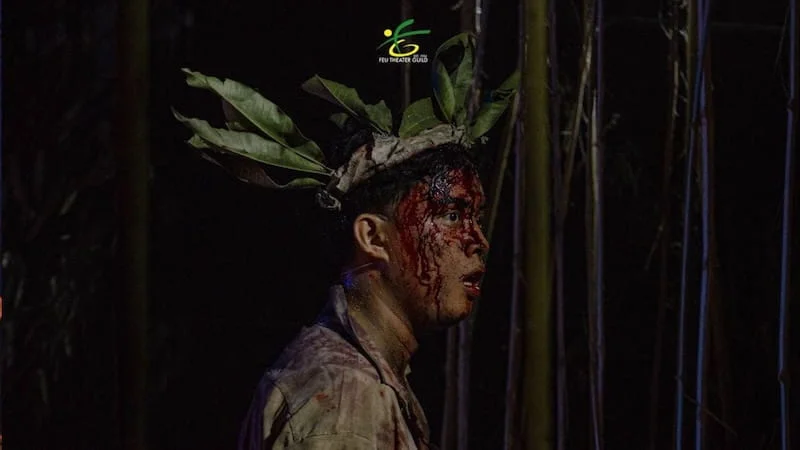
Just as Golding begins his novel with the characters already stranded, Bangaw greets the audience with its 20-person ensemble already on stage, wordlessly facing outwards, flashlights in hand slowly scanning the crowd. The FEU Center for the Arts Studio has been converted into a large, square sand pit, bordered by thin strips of wood not unlike the bars of a cage (set dressed by Kane Stephanie Hombre and Valerie Tolete). The actors’ school uniforms (from costume seamstress Margarita Barrameda) are already in tatters. And as the musical progresses, sand, sweat, seawater, blood, and war paint all mix together—the characters’ dishevelment becoming a tragic reflection of the violence taught to them by the adults waging a war outside.
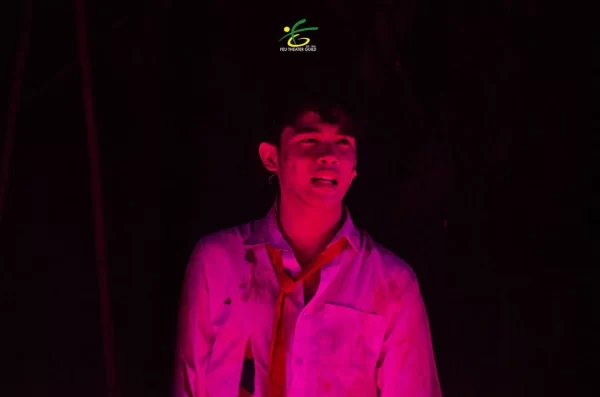
Sam Siasoyco as Raf; Photo Credit: FEU Theater Guild
Interestingly, much of Nash Dansent Desoyo’s lighting design primarily makes use of shadows. This doesn’t just make the suggestion of a monster hiding in the darkness more plausible but makes the implication of any bloodshed even more horrifying, leaving to our imagination the kind of barbarism these kids are capable of when pushed to their limits. When lights do become prominent, they don’t function as markers for time of day or geographical orientation so much as they become psychological in nature. When the characters mention that months have already passed on the island, you believe it—so endless are their predicaments that the rising and setting of the sun blur together into one long haze.
Ideas in search of story
In adapting the novel, Dudz Teraña (also serving as director) and Gold Villar-Lim keep Bangaw buzzing around Golding’s themes of the fragility of order and of authority established through fear and violence. The schoolchildren are no longer all male, privileged, and British but hail from diverse personal and socioeconomic backgrounds—steering the text from satire on colonial superiority into cautionary tale on multicultural societies imploding under inefficient leaders and egomaniacal strongmen. Vince Lim’s music strips these ideas down to urgent, primal percussion and plenty of chanting and rapping. The few elaborate melodies here almost seem meant to feel detached from the rest of the score, wandering in futile search of a peaceful place to land.
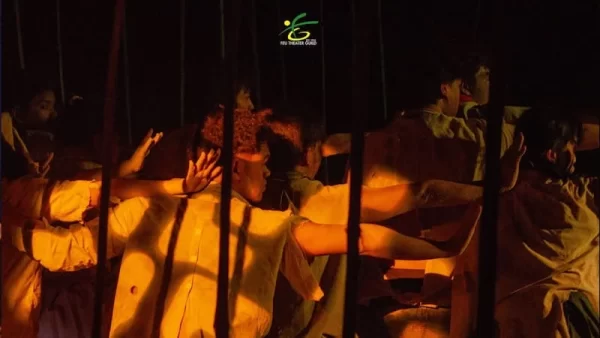
the ensemble; Photo Credit: FEU Theater Guild
As interesting as Bangaw’s grand design is, however, it’s hard to latch on to the specific details of this narrative. This is partly due to spoken lines frequently being muffled by the sand-filled theater or by the volley of improvised dialogue thrown around by the ensemble (though Kristian Mark Samson’s sound design does otherwise create convincing scenes of panic). But the script also places so much focus on the entire group falling into disarray that individual characters don’t always get to assert their specific purpose in the story. Significant events that should build up conflict (the dying out of the signal fire, or the sighting of the aswang) are left vaguely sketched out, the plot becoming a string of loosely connected moments.
Island of bodies
Bangaw is very much a show about the immediacy of the experience it delivers, but this approach also creates a sort of numbing effect. Because there isn’t as clear a sense of character and story progression driving the musical forward, all of its intensity risks becoming tedious by the end. Its occasional moments of broad humor come off like too much of an overcorrection, while its ending feels like just another unfortunate tragedy in a long list of equally tragic events rather than a climax that should carry the weight of a concluding statement.
Even with these choices, and with individual performances at times being too mannered for the surrounding chaos, the production is at its most inspired when the ensemble moves as one body. Teraña and Joseph Torres’ choreography has these performers flailing around and literally dragging themselves through the dirt for the entire show, drawing a sustained energy and precise rhythm from one another as they leap and shout like animals. In some scenes, they lock limbs to form knotted foliage and rocky terrain; in others, such as when the innocent Simone (a chillingly frightened Julia Nicole Ramas) is hunted by the entire mob of children, they seem to spawn endlessly from the darkness. Just in the images these young actors create with their bodies, they capture humanity’s ability to cooperate—and the pride and fear that so often consume our better nature.
This reviewer watched the 6 PM, February 26 show.
Tickets: P100 – P700
Show Dates: Mar 5 – Apr 24 2026
Venue: The FEU Center for the Arts Studio, FEU – East Asia College, Sampaloc, Manila
Running Time: approximately 1 hour and 40 minutes (without intermission)
Company: FEU Theater Guild
Creatives: Dudz Teraña (Direction, Book, Choreography), Gold Villar-Lim (Book and Lyrics), Vince Lim (Music), Joseph Torres (Choreography)
Student Creatives: Kirstan Erin Wayne Orbegoso (Assistant Direction), Margarita Barrameda (Costume Seamstress), Kane Stephanie Hombre (Set Dresser), Valerie Tolete (Set Dresser), Beatrize Villareal (Props Master), Kristian Mark Samson (Sound Design), Nash Dansent Desoyo (Lighting Design)
Student Cast: Sam Siasoyco, Aldin Covarrubias, Dave Bambang, Jharelle Villalobos, Edrud Madalan, Heleina Li, Julia Nicole Ramas, Ma. Francine Galvez, Marjorie Uson, Trisha Jane Nilayan, Dianne Andallo, Maria Ysabel Delos Reyes, Althea Sibulo, Margarita Barrameda, Melenne Hokase, Julian Rafael Anabo, Lorenze Moral, Miguel Galpo, Kevin Ricaforte, Shawn Tarala, Kirstan Orbegoso, Renz Dotillos, Justin Abalos, Janae Maxiel Dionisio, Ayessa Raymundo, Bjorn Pestaño, Charlene Libo-on, Shekinah Resurreccion, Zoe Sisam, Marc Ducut, Johann Umali, John Andrei Cruz, Kristian Samson, Cris Jay Cabides

Comments