

REVIEW: In ‘Tales of the Manuvu’, A Tribal Story Dances to a ’70s Groove
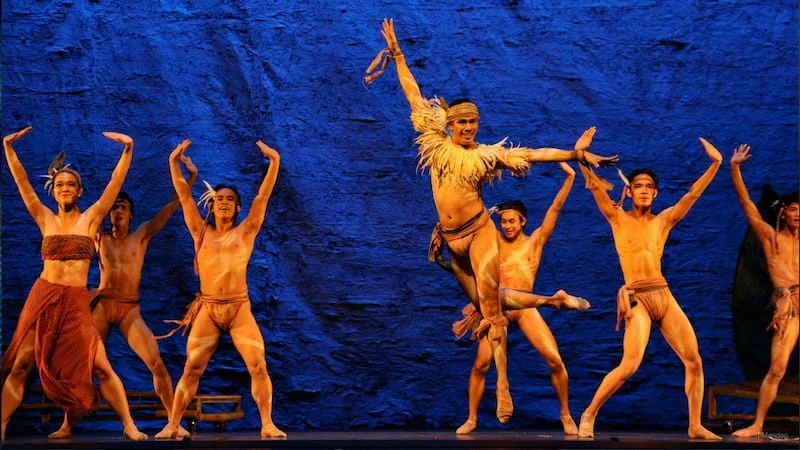
In Tales of the Manuvu, the dancers ride the music like a ’70s groove incarnate. Hips twitch, shoulders shimmy, elbows swing, fingers snap. Every movement locks into the score’s punchy accents..
For those who think the work feels time-warped, it is a study in Philippine dance history. Premiered in 1977, it arrived at a turning point. Codified, grounded modern dance was loosening as contemporary dance began absorbing ballet, jazz, martial arts and even everyday movement. The piece casts National Artist for Dance Alice Reyes not as a conventional choreographer but as a visionary of the decade. At a time when Filipino audiences favored ballet, she insisted on an earthy, expressive physicality.
Yet she knew how to hook a crowd. She threaded in pointe work and whipping turns for the women, along with a la seconde turns for the men, those crowd-pleasing rotations done with one leg extended straight out to the side. She layered jazz and modern vocabulary on top. The result was a hybrid that caught the swagger and experimentation of the era.
Reyes shaped the work as a rock opera drawn from the Manuvu account of the beginning of time, a story from Central Mindanao recorded by social anthropologist Arsenio Manuel. It unfolds in a utopian world ruled by Manama, the good god, and Ogassi, the trickster; tracing the creation of the First Man and the First Woman; the world’s gradual decline, and the community’s final stand against Makarallig, the destructive giant.
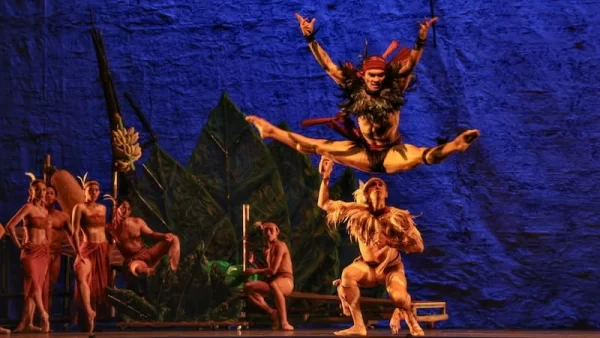
Confrontation between Ogassi (Ejay Arisola) and Manama (John Ababon); Photo Credit: Ernest Mandap
It likewise retells an ancient lore of the sky which once hung close to the earth, within reach of humankind. But when the world grew too chaotic and noisy, Manama withdrew in exasperation, ascending with the sky itself. It is staged on a bamboo platform lifted heavenward by the theater’s flying system.
JAZZ-TINGED SCORE
The 2026 revival, mounted in collaboration between Alice Reyes Dance Philippines (ARDP) and the University of the Philippines, introduces this landmark work to a new generation of audiences. Baby boomers and Gen X-ers will feel the nostalgia as the dancers channel the raw, kinetic pulse of the ’70s.
Movement harks to urban jazz of the era, full of jerks, isolations, shoulder slides, flexed hands, and hips swinging backward on the groove. Group sequences snap into tight, syncopated patterns before spilling into expansive stretches that open the stage. Every gesture lands precisely with the funk-infused, jazz-tinged score, producing a performance that vibrates with energy.
The music by Dero Pedero and Afterbirth, newly arranged in 2026 by Michael Guevarra, leans fully into a 1970s jazz-funk sound with the pulse and swagger of a rock anthem. Tightly structured for dance, the drums and electric bass lay down a steady, mid-tempo heartbeat that grounds the dancers’ movements. The wah-wah electric guitar adds bite and rhythmic drive to solos, while the saxophone threads smooth, soulful melodies through the mix. Wooden indigenous percussion brings earthy texture, and the kulintang rings with a clear, ethereal layer. Layered strings lift the sound, and soaring rock-operatic vocals sweep through the performance, giving the music an epic, propulsive, and exhilarating drive.
LIVELY TENSION
ARDP dancers express a high-octane fusion of contemporary fluidity and rock opera theatricality. Every sharp turn, synchronized kick, traveling leap, arm balance, expansive gestures and grounded floor movement translate the narrative of struggle and triumph into raw, physical energy.
Since the pandemic, John Ababon as Manama and Earl John Arisola as Ogassi have shown noticeable maturity on stage. Ababon traces Manama’s journey from naïveté to confidence and understanding. Arisola turns Ogassi into a cocky, provocative force. Together, they generate a lively tension that drives the story forward.
Renzen Arboleda as the First Man moves with boyish verve; every leap and swing carries youthful energy, underpinned by precise technique. His timing is sharp, and even the smallest gestures feel intentional. Francine Beltran as the First Woman is controlled. While her performance lacks Arboleda’s spark, she brings composure and clarity throughout.
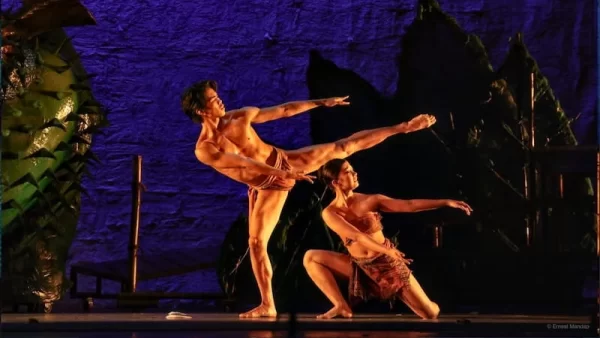
Renzen Arboleda (First Man), Francine Beltran (First Woman); Photo Credit: Ernest Mandap
Among the diwata, many dancers are lithe and expressive, such as Krislynne Buri, but Monica Gana stands out for the depth and polish that come with experience, her presence anchoring the ensemble with poise and nuance.
This commitment to excellence extended beyond the dancers. Reyes amplified her vision through collaborations with other artists, most notably National Artist for Literature Bienvenido Lumbera, who wrote the libretto. A nationalist, Lumbera drew on folk forms while weaving in contemporary political meaning. Reyes’ company operated under the Cultural Center of the Philippines, the patronage of First Lady Imelda Marcos. Hence, it was daring of her to work with someone openly critical of the Martial Law regime. The partnership sharpened the piece, weaving subtle cultural and political threads into a turbocharged dance.
Reyes was equally fearless in her storytelling. In the ‘70s, only theater would experiment on sexual themes while dance remained conservative. The episode, Uod na Kakapa, traces the first stirrings of sexuality, symbolized by the worm—a pulse of life moving just beneath the surface in indigenous origin stories. Onstage, this awakening plays out through close partnering rather than explicit hip grinding. Male dancers embodying the Uod hover over women on the floor, legs pumping and bodies coiling in sinuous, interlacing patterns. The charged movements evoke desire and the beginnings of human union, stylized rather than literal.
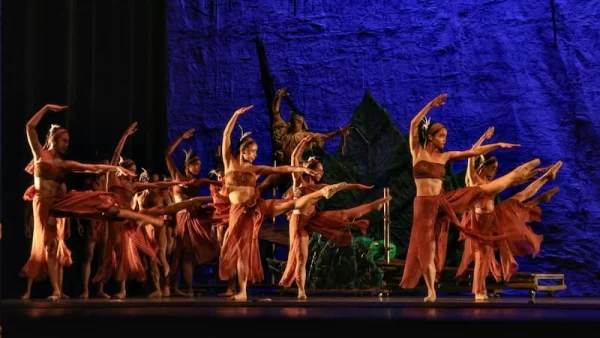
Diwatas with Monica Gana (far right); Photo Credit: Ernest Mandap
The production’s mythic resonance stretches to Makarallig, the powerful giant. In Mindanao folklore, he is a raw, overwhelming force conquered only by wit. On stage, he rises as a towering effigy in a barong, a politician consumed by ego and greed, making myth hit just as hard today as it would have decades ago.
ECLIPSING THE DANCE
Although I enjoyed the nostalgia of the ’70s, amplified by the vibrant score, I couldn’t shake an uneasy feeling. Were the singing counterparts—Ado Villanueva (Manama), Greg de Jesus (Ogassi), Joshua Cadelina (First Man), Toni Carm Santos (First Woman)—and the UP Concert Chorus inadvertently drowning out the dancers?
My suspicions were confirmed. My seatmate Ernest, a Franco-Filipino multihyphenate artist, muttered that the sound was blaring and lacked subtlety. I teased that he’s just more European in refined aesthetics. After all, Filipino culture thrives on high-decibel noise. After the show, a seasoned dancer confided she felt sorry for hardworking ARDP. To her, it had become more a rock opera singing showcase, with the dancers lost amid the blaring volume and the darkened stage.
Several factors contributed. I sat in the first row and was blasted by side lighting. As a veteran of photo shoots, I know side light is great for dramatic shadows on faces, but here it did a disservice. The dancers’ emoting and discipline were eclipsed many times, while the singers were bathed in bright, unrelenting light. Likewise, seeing the dancer connect with his or her singer counterpart would have made the character feel fully alive and unified on stage.
Then my eyes flitted back and forth between the performers and the English translations for the lyrics, flashed on both sides of the stage instead of the standard surtitles, the text above it, adding to the visual confusion.
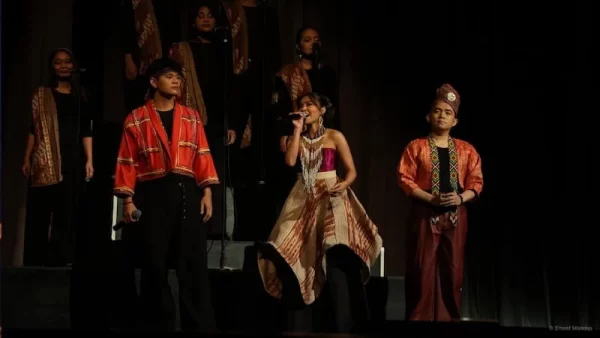
Ado Villanueva (Manama), Toni Santos (First Woman), Joshua Cadeliña (First Man); Photo Credit: Ernest Mandap
Because the lighting favored the giant guyabano, the centerpiece and symbol of life, and the side text was so distracting, I barely noticed the intimate moment between First Man and First Woman.
Tales of the Manuvu could reach its full potential with smoother scene transitions and clearer staging. For example, it was never visually obvious that Manama’s bees were stealing seedlings and topsoil from Ogassi’s kingdom as noted in the program. The little girls perched on dancers’ shoulders looked more like bees in cosplay swiping candy from a convenience store than agents of conflict. We saw some trees were being moved from Ogassi’s kingdom but couldn’t make the connection.
In the final confrontation, why weren’t the torches carried by the bearers lit to heighten the fight against Makarallig? Small choices like these could have sharpened the narrative stakes and clarified the mythic action.
With better use of Loy Arcenas’ set designs and props, Tales of the Manuvu could shine even brighter. Clearer development of the final confrontation, seamless transitions between scenes, nuanced and flattering lights on the dancers could make the story resonate even more, perhaps even as a mirror of what’s happening today.
Still, I wholeheartedly recommend Tales of the Manuvu. After all, this is one of the reasons why Alice Reyes earned her National Artist award.
This reviewer watched the 3:00 PM, February 28 show. Tales of the Manuvu will be staged at the Proscenium Theater in Rockwell, Makati on March 28 and March 29.
Tickets: Free admission
Show Dates: February 27 and 28, 3 PM and 7 PM
Venue: University Theater, UP Diliman
Running Time: approximately 1 hour and 15 minutes
Producer: Alice Reyes Dance Philippines
Creatives: Alice Reyes (director and choreographer), Bienvenido Lumbera (librettist), Dero Pedero (composer), Afterbirth (additional music), Aaron Veloso (2026 English translator), Michael Guevarra (2026 musical arranger), Loy Arcenas (sets and costume designer), Barbara Tan-Tiongco (2026 lighting designer), Lester Reguindin (2026 restager)
Featured Cast:
Manama: Ado Villanueva, Joshua Cadeliña (singer); John Ababon, Renzen Arboleda (dancer)
Ogassi: Greg de Leon, Almond Bolante (singer); Erl Sorilla, EJ Arisola (dancer)
First Man: Joshua Cadeliña, Ado Villanueva (singer); Renzen Arboleda, James Galarpe (dancer)
First Woman: Toni Carm Santos, Christy Lagapa (singer); Krislynne Buri, Francine Beltran (dancer)
with the UP Chorus

Comments