

REVIEW: ‘Mabining Mandirigma’ turns dense history into gripping musical drama
Tanghalang Pilipino’s Mabining Mandirigma remains an ambitious and theatrically compelling work, one that takes on the dense, nuanced politicking of a formative and volatile moment in Philippine history. Written by Nicanor Tiongson, with music by Joed Balsamo and directed by Chris Millado, the musical has no shortage of ideas, textures, and theatricality.
Thick of it
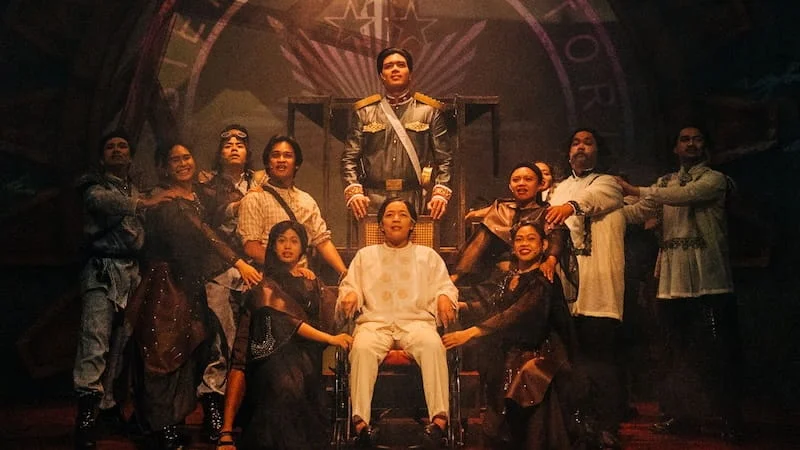
In this staging at the CCP Black Box, the production’s high octane creativity come thick and fast: it is steampunk, anachronistic, musical, and built around the gender-swapped casting of Shaira Opsimar as Apolinario Mabini. It is a lot to take in, and for audiences coming in cold, it can at times feel like too much is arriving too quickly.
Tiongson’s dense text is one of its biggest challenges but is a mark of its high ambition. Mabining Mandirigma is clearly trying to dramatize a politically complex era: the period after the Bonifacio-led himagsikan, the early days of Emilio Aguinaldo’s tenure, and the transition of the Philippines from Spanish to American control. But the musical’s text is so packed–and the sound conditions in the CCP Black Box not always so forgiving–that delivery and sound mixing sometimes garble crucial lines, with the music occasionally overpowering the lyrics and singing.
It is, in many ways, a production that rewards returning audiences, as well as viewers who already have some familiarity with the history it is staging. Otherwise, one may find oneself trying to decipher the events through a barrage of theatrical choices rather than through the material itself.
Shared spotlight
The show does attempt to tell Mabini’s story, but often, Mabini emerges less as the singular center of the musical than as a participant (if crucial) in a much larger political struggle. At times, it feels closer to an Emilio-and-Apolinario musical than a Mabini musical.
Aguinaldo being at the forefront of the proceedings has much to do with the sheer force and completeness of David Ezra’s performance as Emilio Aguinaldo. Seen through modern lenses, Aguinaldo is hardly a lauded figure. While the show does not exactly hail the man as a misunderstood hero of the era, Ezra does give us an Aguinaldo caught between impossible pressures: managing infighting within his cabinet and congress, fighting the Spanish while staving off the Americans, and grappling with the requirements of political legitimacy for a nascent nation. Ezra manages to carry that internal conflict with remarkable clarity and weight.
This has the side effect of making Mabini feel somewhat dwarfed by the narrative around him. Opsimar is fantastic in the title role and remains a singular musical talent, and Ynna Rafa is likewise excellent as young Mabini, but the material itself often seems more interested in the wartime politicking and diplomatic struggle than in fully centering Mabini, his story, or even his point of view.
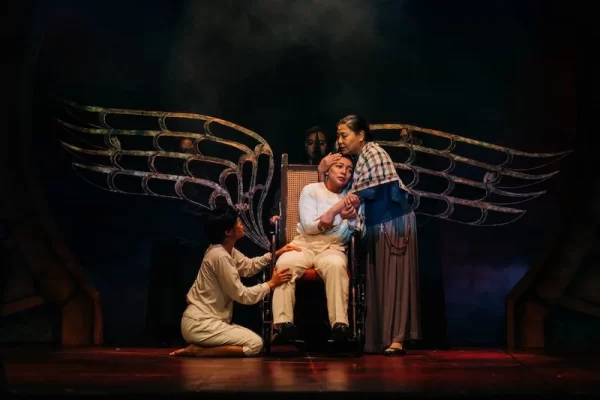
L-R: Ynna Rafa, Shaira Opsimar, Tex Ordoñez-De Leon; Photo Credit: May Celeste/ Tanghalang Pilipino
The supporting performances also make a strong impression. Tex Ordoñez-De Leon brings presence to Dionisia, Mabini’s mother, while Gelo Molina as Pepe, contributes another dimension to the title character’s persona. Just as notably, the ensemble is great throughout: MC Dela Cruz, Roby Malubay, Jonathan Tadioan, Marco Viaña, Earvin Estioco, Lhorvie Nuevo-Tadioan, Mark Lorenz, Anya Evangelista, Sarah Monay, Rey Correjado, Heart Puyong, Murline Uddin, and Sofia Sacaguing bring vitality and texture to a production that depends heavily on collective energy. Their work helps animate the world of the show and sustain its momentum, especially in a musical this packed with exposition, commentary, and spectacle.
High commitment
The question of why Mabini is played by a woman remains, for this writer, a choice of pure creativity for its own sake, rather than impactful or even meaningful. But production is more successful in its other theatrical choices. Millado’s direction is consistently interesting, finding ways to keep the piece visually and rhythmically alive even as it deals with historically dense material. The musical numbers are dynamic and varied, sustaining theatrical interest through shifts in tone, movement, and staging. Denisa Reyes and Richardson Yadao’s choreography helps give the show energy and shape.
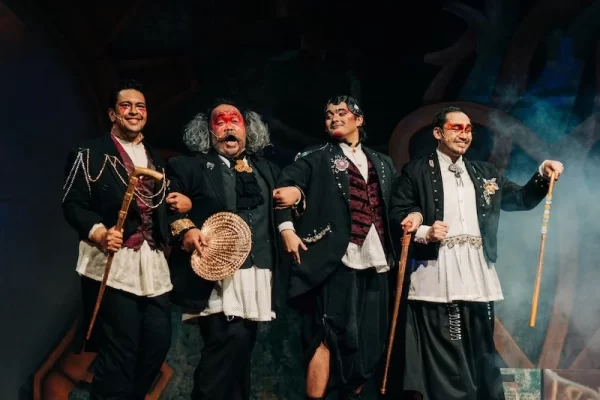
the Ilustrados L-R: Roby Malubay, Jonathan Tadioan, MC Dela Cruz, Marco Viaña; Photo Credit: May Celeste/ Tanghalang Pilipino
TJ Ramos’s sound and musical arrangement supports the breadth of Balsamo’s score even if the balance does not always serve the text as well as it should. Some of the second-act numbers are especially enjoyable, with “Damn, Damn, Damn” standing out as particularly fun to watch and listen to. The second act also allows the personal friendship between Aguinaldo and Mabini to come to a head, and Opsimar and Ezra are especially strong there, grounding the larger historical drama in something recognizably human.
Toym Imao’s set design gives the show a strong commitment to its chosen aesthetic, while James Reyes’s costumes help thread together the production’s mix of period evocation and stylization, incorporating elements such as barong-inflected looks, GI Joe-like military costuming, and top hats for foreign characters. Roman Cruz’s lighting design and the projection design by GA Fallarme and JM Jimenez further reinforce the production’s visual world, adding shape and texture to a piece already thick clear in its steampunk aesthetic.
Very political
Like other Tanghalang Pilipino hero musicals, Mabining Mandirigma closes by eulogizing its fallen hero, but this one goes a step further by having the ensemble explicitly connect the lessons and ills of Mabini’s time to whatever remains topical in the present. The impulse is to hammer down the production’s political urgency which was never in doubt. As a result, one comes away feeling that if the material were less dense, more accessible, and staged with greater clarity, it would not need to reiterate its points quite so insistently.
Even so, Mabining Mandirigma is a good production: intelligent, visually engaging, musically rich, and powered by excellent performances, particularly from Shaira Opsimar and David Ezra. But for all its ambition, it is a musical that sometimes risks losing its central figure inside the very historical complexity it is so eager to honor.
This reviewer watched the 8PM, March 06 show.
Tickets: Php 1,800 – Php 2,000
Show Dates: March 6 to March 29, 2026
Venue: CCP Black Box, CCP Complex, Malate, Pasay City
Running Time: approx. 2 hours and 45 mins (w/ 15 min intermission)
Producer: Tanghalang Pilipino
Creatives: Nicanor Tiongson (Playwright), Joed Balsamo (Music), Chris Millado (Direction), Toym Imao (Set), Denisa Reyes (Choreography), Richardson Yadao (Choreography), James Reyes (Costume), TJ Ramos (Sound and Musical Arrangement), Roman Cruz (Lighting Design), GA Fallarme (Projection Design), JM Jimenez (Projection Design), CJ Despuez (Technical Direction), Toni Go-Yadao (Associate Direction), Justin Santiago (Associate Projection Design), Daniel Gregorio (Costume Associate), Bianca Lopez-Aguila (Voice Coach)
Cast: Shaira Opsimar, Arman Ferrer, David Ezra, Tex Ordoñez-De Leon, Gelo Molina, MC Dela Cruz, Roby Malubay, Jonathan Tadioan, Marco Viaña, Ynna Rafa, Earvin Estioco, Lhorvie Nuevo-Tadioan, Mark Lorenz, Anya Evangelista, Sarah Monay, Rey Correjado, Heart Puyong, Murline Uddin, Sofia Sacaguing

Comments