

UNI-BASED REVIEW: FEU Theater Guild’s ‘Moryon’
“Though some unconventional choices get in the way, authentic performances and a tactile world make this Japanese occupation-set play a tense, uniquely told thriller.”
University theater companies aren’t obliged to maintain a strict auteurial voice, so it’s exciting to see FEU Theater Guild, or FTG (and, more broadly, the works of its artistic director Dudz Teraña), carve out an identity distinct from other student theater organizations. Immersiveness, hyperrealism, and spectacle have become trademarks of their productions and those staged by FEU alumni theater group BoxStage Manila. And FTG’s new play, Moryon—an adaptation of Guy de Maupassant’s short story “Mother Sauvage,” but set in Marinduque during the Japanese occupation—is something like a greatest hits collection of the company’s defining characteristics.
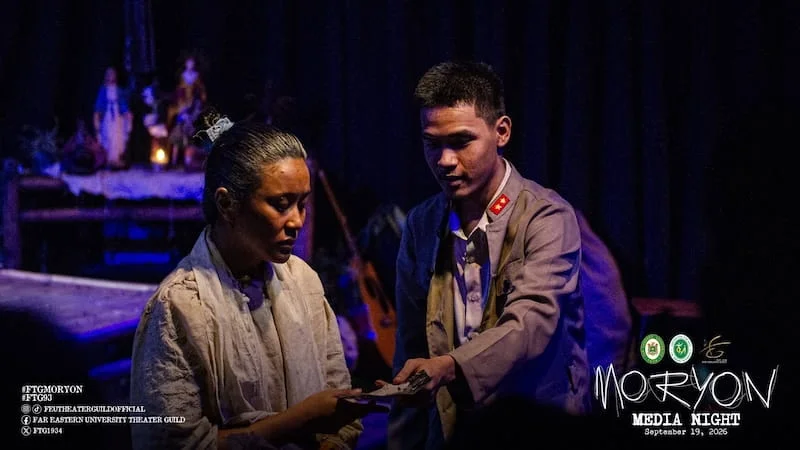
The production follows Caridad (played by Maria Ysabel Delos Reyes, alternating with Maria Alexandra Mayano), a woman wracked with immense grief who finds herself having to welcome four Japanese soldiers into her rural home. Just as the story is, in part, an exploration of the pieces of her identity, so does the play become an exercise in mixing together various narrative devices as a continuous exploration of FTG’s theatrical voice. The show is mostly successful: some of its choices get in the way of the storytelling, but authentic performances and a fully tactile world make this a tense, uniquely told thriller.
Nowhere to hide
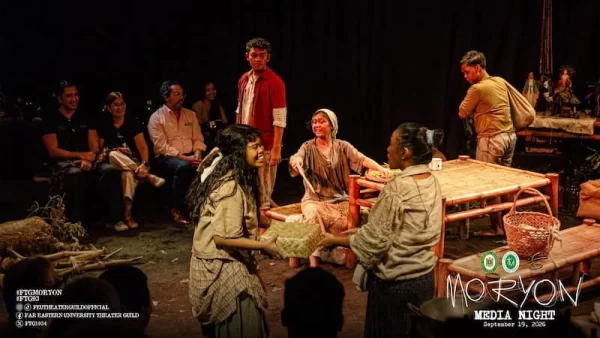
Walking into the FEU Center for the Arts Studio has become an experience in itself, with Althea Sibulo’s earth-filled set immediately feeling like a lived-in corner of the world. There are benches and a wood table, a log surrounded by coconut husks, a cooking area with functional equipment, an altar to various Christian images, and a well—facets of Caridad’s life, labor, and trauma that are eventually intruded upon with the arrival of the Japanese. As Moryon proceeds, water is routinely dumped by the bowl to the earth below, muddying the ground for the actors to step on. Tension builds from the environment alone, and clear, balanced sound design means everything is heard; there is nowhere to hide.
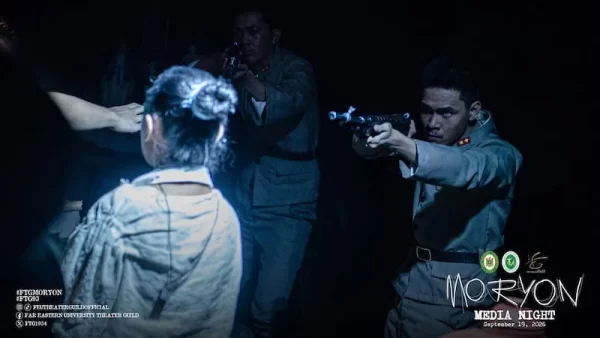
The spell that’s cast by the set’s naturalism is deliberately broken by Caridad’s memories. These intrude into the action almost like jump scares, signaled through piercing sound cues and sudden shifts in Sophia San Diego’s lighting. It’s a surprisingly effective touch that keeps the viewing experience on a knife’s edge and emphasizes how shattered Caridad is beneath her stoic demeanor. But San Diego never cuts away to these flashbacks; her lighting simply isolates Caridad, locking her in her own head while events continue to play out around her. And later on, the set is lit in eerie reds and flashing lights, the violence of the war and the bloody Japanese occupation having fully flooded the protagonist’s mind.
Compromises for survival
Writer-director Dudz Teraña adapts Maupassant’s original work as a generally straightforward story of survival. But the most interesting wrinkle to the plot is that three of the soldiers who arrive seem to be otherwise decent young men following orders and doing what they think is best for their country—not unlike Caridad’s son who left home to become a guerrilla fighter. Moryon never attempts to make excuses for the atrocities committed by these invaders, but it does find potent drama in these characters who are trying to find compromises for survival. The character of Esteban (Dave Bambang, alternating with Aldin Covarrubias) exemplifies this, having become a translator and guide for the soldiers, reluctantly placing Caridad in the crossfire.
The show attempts to grow beyond its initial premise through flashbacks and religious themes that cast a constant shadow over the story. However, by the end, these additional layers still feel like partially-formed ideas in comparison to the primal immediacy of the main plot. Caridad’s past with her family, as well as the Marinduqueño practice of Moryonan during Holy Week, provide context to the rest of the narrative but don’t necessarily come full circle. There is still a sense that the play would have proceeded with just as much visceral force even without knowing about the incident at the well, or without its light discussions of Lenten customs.
Rhythms of language
Similarly, certain devices that Teraña employs here are striking but don’t seem to carry much intent once Moryon has settled into its main conflict. For example, early scenes where Caridad chatters away with her friends are done in rapid-fire, overlapping dialogue—conveying a sense of homely comfort, before contrasting with the silence that fills the room when the soldiers arrive. And language continues to play an important role as Esteban filters out the anger from Caridad’s words when he translates them for the Japanese. But at certain points, this use of cross talk and translation feels more ornamental than purposeful, the production falling into a more predictable rhythm where the audience waits for clearer meaning to emerge from the confusion.
Otherwise, Teraña’s direction proves highly suspenseful. He plays things matter-of-factly but with that feeling of a bomb about to go off at any moment, as the ground gets muddier and as the scent of cooked food wafts from Caridad’s pans. And Delos Reyes’ lead performance is a portrait of numbness from a life of constantly being beaten down, until she inevitably snaps. She and the entire student ensemble accomplish a staggering feat, committing to all the exact rhythms and emphases of the Marinduqueño dialect and the Japanese language. It becomes easy to forget that these actors aren’t even professionals yet when they show so little hesitation in exploring dirtier, more uncompromising parts of the human experience.
This reviewer watched the 6 PM, October 10 performance.
Tickets: P150–700
Show Dates: October 1–November 28, 2026
Venue: FEU Center for the Arts Studio, FEU – East Asia College, Sampaloc, Manila
Running Time: approximately 1 hour and 30 minutes (without intermission)
Company: FEU Theater Guild
Creatives: Dudz Teraña (Playwright, Direction), Abegail Brion (Marinduqueño Dialect Coach)
Student Creatives: Kirstan Orbegoso (Assistant Direction), Althea Sibulo (Set Design), Justin Abalos (Costume Design), Margarita Barrameda (Costume Design), Martin Mesina (Technical Direction), Luke Escabillas (Music), Sophia San Diego (Lighting Design), Dave Bambang (Japanese Language Coach)
Student Cast: Maria Ysabel Delos Reyes, Maria Alexandra Mayano, Dave Bambang, Aldin Covarrubias, Janae Maxiel C. Dionisio, Shawn Christopher P. Tarala, Julian Rafael R. Anabo, Margarita Barrameda, John Andrei S. Cruz, Edrud Adriyel T. Madalan, Marjorie E. Uson, Arvin Jade Javier, Ashley Kate C. Zamora, Kirstan Orbegoso, Samuel Josh T. Siasoyco, John Gabriele R. Lazaro, Kevin Acheles Q. Ricaforte, Melenne Andrea L. Hokase, Cane-Jharelle Villalobos, Kristian Mark A. Samson, Cris Jay B. Cabides, Charlene F. Libo-on

Comments