

REVIEW: ‘A Number’ reveals a father’s multiple failures
“JC Santos delivers three distinct, compelling performances in ‘A Number’, making the play’s questions of identity and inheritance palpable. His directorial debut, however, struggles to bring clarity to Caryl Churchill’s elliptical storytelling, diminishing the force of its tragedy about a father’s failures.”
When Caryl Churchill’s A Number premiered in 2002, human cloning was still among science fiction’s more unsettling possibilities. Twenty-four years later, amid anxieties over artificial intelligence and digital replication, its premise of a man discovering that some twenty copies of him exist feels almost quaint. There is even something of a period quality to WHYNoT and The Necessary Theatre’s staging, with its mirrored surfaces and cosmic, kaleidoscopic overhead imagery recalling an earlier vision of the technological future.
Yet for all its questions about cloning, A Number is more immediately concerned with a father who believes he can start over after failing his son.
Second chances
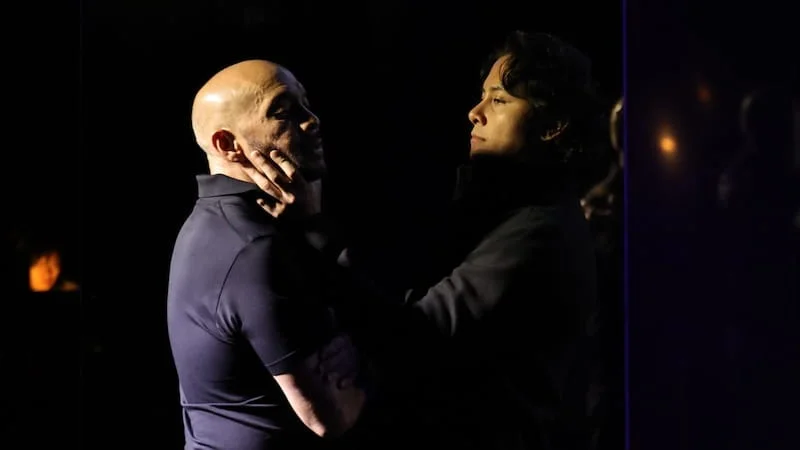
Bart Guingona plays Salter, whose son Bernard (JC Santos) discovers that he is one of several genetically identical individuals. The revelation sends Bernard into an existential crisis, but Salter responds with nonchalance, even amusement, entertaining the possibility of suing those responsible for the additional clones, or suggesting that Bernard meet them.
His practical suggestions seem almost callously indifferent to his son’s distress, an early indication of Salter’s unwillingness to recognize the emotional consequences of his decisions.
The play eventually reveals that Bernard is himself a replacement, making him the second Bernard. Salter had neglected his original son, the first Bernard, and sent him away, subsequently arranging for a genetically identical child to be created and raised as another son.
There is something self-serving about treating fatherhood as a project that can be abandoned and restarted, as though raising another child might absolve Salter of what he did to the first.
Three lives
Santos is particularly effective at conveying how differently his genetically identical characters have been shaped by their lives.
His Bernard 2, with loose hair and a haphazardly arranged tie, is visibly unsettled by his discovery. Santos gives him a persuasive human immediacy, making the extraordinary premise feel like a genuinely distressing personal revelation.
As Bernard 1, Santos adopts a more severe bearing, with slicked-back hair and a trench coat lending him an almost conspicuously sinister appearance. The styling is perhaps too emphatic, suggesting an antagonist before the play has fully disclosed the circumstances that shaped him.
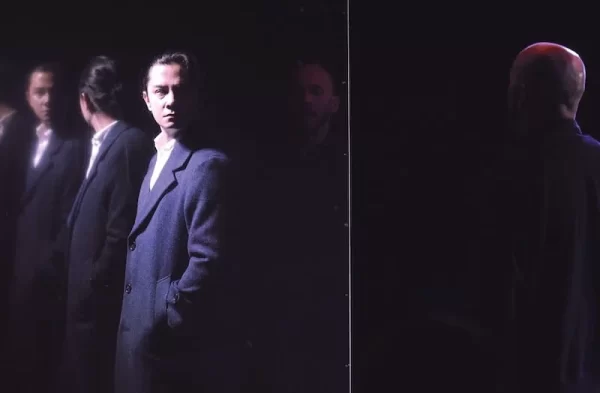
L-R: JC Santos, Bart Guingona; Photo Credit: WHYNot
Yet Santos finds subtler distinctions in the performances themselves. Churchill’s fragmented, elliptical dialogue, full of interruptions, repetitions, and unfinished thoughts, creates an intriguing sense of familial resemblance between Salter and the Bernards. They seem to share a vocabulary, even a manner of constructing and avoiding meaning.
Santos makes something of this resemblance. Bernard 2, raised by Salter, appears to have absorbed aspects of his father’s manner, while Bernard 1, despite his troubled childhood, also seems to carry traces of him.
The contrast is clearest in Michael Black, another clone whom Santos plays with a markedly lighter disposition. Dressed in a bright red sweater, Michael possesses an ordinary contentment absent from the Bernards. His ease suggests a life unburdened by the relationship that has damaged the other two men.
Lost in ambiguity
Guingona plays Salter with a comparatively even, detached delivery, which occasionally suits the character’s evasiveness and apparent indifference. But his measured cadence and relatively uniform articulation do not always distinguish Salter’s deflections from his more consequential admissions.
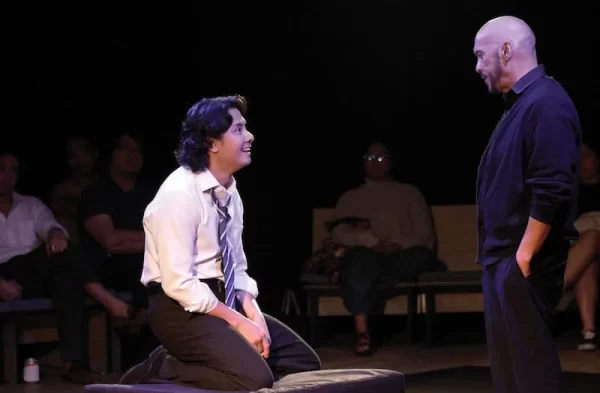
L-R: JC Santos, Bart Guingona; Photo Credit: WHYNot
Churchill deliberately withholds straightforward exposition, revealing Salter’s past through fragmented conversations and conflicting accounts. Yet Santos, in his directorial debut, does little to clarify the crucial information buried in these exchanges.
The circumstances of Bernard 1’s childhood can be difficult to establish, while the later revelation of what became of the two Bernards leaves their respective fates insufficiently clear.
The problem is not Churchill’s refusal to explain everything, but the production’s challenge at making essential developments intelligible. Ambiguity can invite interpretation; confusion about what has actually happened can prevent it.
No more second chances
This becomes particularly consequential in the final encounter between Salter and Michael Black. Having lost both sons, Salter appears to seek some connection with another man who is genetically identical to them but untouched by their shared history.
Michael’s ordinary contentment offers little of what Salter seems to want. He cannot replace the sons Salter has lost, nor provide another opportunity to repair his failures.
Santos makes this contrast apparent through his performance, but the production’s lack of narrative clarity diminishes the force of what conclusion he wants to impart.
For all its technological speculation, A Number arrives at a more recognizable tragedy: a father who mistakes the opportunity to begin again for the possibility of making amends. The science may allow him to make another son, but it cannot make him a better father.
This reviewer watched the 7 PM, Oct 8 show.
Tickets: ₱2,800
Show Dates: October 9–18, 2026
Venue: WHYNoT, 4/F Karrivin Studios, Makati City
Running Time: approx. 1 hour (no intermission)
Producer: WHYNoT, The Necessary Theatre
Creatives: Caryl Churchill (playwright), JC Santos (director), Miguel Uy (production design)
Cast: Bart Guingona (Salter), JC Santos (Bernard 1, Bernard 2, Michael Black)

Comments