


REVIEW: The mystifying ‘Saglit Lang’ deconstructs the essence of theater
“Infinite Cantina’s challenging new production has clear passion and an unexpected emotional payoff, even if the journey there can be difficult to grasp.”
If anyone happens to hold the belief that classical theater and contemporary fringe productions stand on opposing ends of a spectrum, Infinite Cantina’s Saglit Lang presents them as equally valid expressions of the same ideal. On top of the play being largely made up of references to and excerpts from classical works, its narrative is also more figurative than literal—as an unnamed Bata (played by BJ Crisostomo, alternating with Rico del Rosario) stumbles into an abandoned theater and meets a Maestro (Ron Capinding) who teaches the young man the value of performance.
The resulting show is a unique and unusual tribute to theater and the mentors who have kept its practice alive throughout the generations. Its emphasis on presenting classical plays without providing their full context ends up conflicting with the pedagogical nature of its story, and risks making these works harder to access rather than making a stronger case for their being essential. And yet the production’s sheer passion for its subject matter (coupled with a moving performance by Capinding) allows it to break through to powerful emotional territory nonetheless.
Realm of imagination
The world of Saglit Lang isn’t meant to evoke a specific time and place; all we know is that the young man seeks solace from suffering and that the theater is his oasis. The show is modestly constructed, with Lawyn Cruz’s set—an intimate space enclosed in flowing cloth, not unlike an old circus tent—accommodating a parade of DIY costumes designed by Santi Obcena. Everything occurs within this sort of liminal space, especially as Juls Castro’s dreamlike projections and Kyle Confesor’s vaguely distant sound take us outside of reality and closer to the realm of imagination. Director Anton Juan keeps the interactions between Bata and Maestro feeling like verses from a parable, which only makes the sudden shock of realism by the end that much more effective.
With that said, for a production about the limitless expression that theater can offer, the excerpts from classical plays performed by the two characters are handled in similar ways that eventually begin to blur them together. Even with the use of various props, costumes, and shadow puppets, most of the excerpts eventually settle into the same, somewhat staid tone. The clearest exception to this is the show’s rendition of William Shakespeare’s A Midsummer Night’s Dream, which has several audience members participate through a bit of playful improv work. Here, the joy of theater-making is fully extended to those watching, making the Maestro’s lessons feel truly vital.
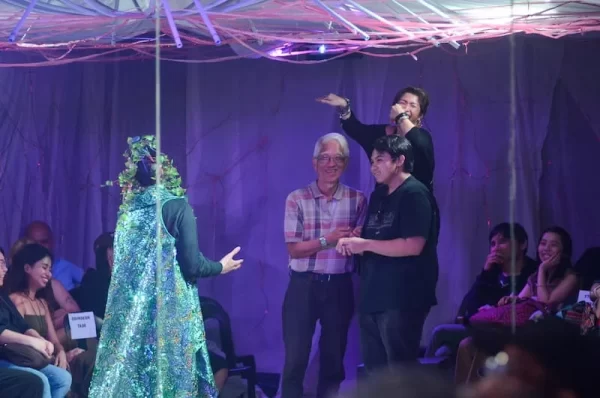
Improv in A Midsummer Night’s Dream excerpt; Photo Credit: Irvin Arénas
Actors on actors
And as this mentor and teacher, Capinding clearly takes to heart all the authority, responsibility, and anxiousness for the future that the role calls for. His Maestro arrives not as a wizened sage but as a fierce guardian of the theater arts. But for all his powerful monologues and the childlike wonder that emerges when he performs the classical excerpts, Capinding saves his best work for last. In Saglit Lang’s final scenes, the Maestro is faced with the notion of his own mortality and the reality that his capacity for performance will one day fail him. The tears that escape Capinding’s eyes are almost too real—resentment, disappointment, and a seed of hope that he’s done all he can to educate the next generation.
In comparison, Crisostomo (who also serves as the show’s playwright) can’t quite communicate the same weight or complexity of emotion in his performance. Whether intentionally or not, the Bata character doesn’t really get to define his own inner life, and always exists in relation to the Maestro. Still, Crisostomo and Capinding display impressive stamina as each new classical excerpt asks them to pivot into different roles. And when taking on these other texts, the two actors don’t filter them through the Bata and Maestro characters. Rather, Crisostomo and Capinding approach every role with reverence, totally transforming as if they were actually here to stage Shakespeare, Sophocles, or Samuel Beckett.
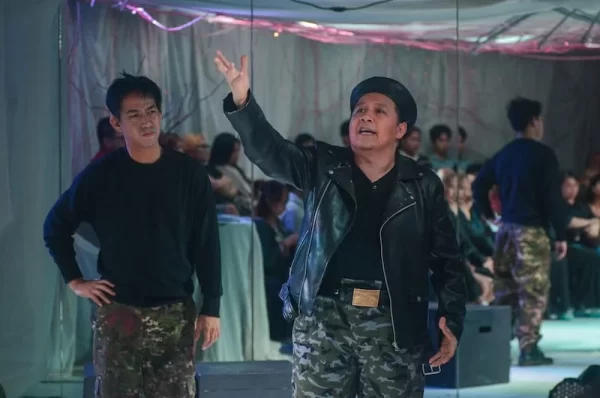
L-R: BJ Crisostomo, Ron Capinding; Photo Credit: Irvin Arénas
True connection
Crisostomo’s script clearly comes from a personal place, and the passion with which it articulates the power of the art form is evident from its earliest scenes. Here, theater is defined as any meaningful connection between two people, and as the process of constantly seeking truth in one’s emotions and experiences. To think of any art as a practice of radical empathy is a proudly romantic perspective, but it’s one that resonates as a worthy ideal to strive towards, especially as the Maestro laments how access to theater has become limited only to those who can afford it. This point about the gatekeeping of theater could have led to a richer discussion, but it’s understandable if this was beyond the production’s immediate goals.
However, while it’s admirable that Saglit Lang champions a diverse canon of classical works, the fact that the play presents entire scenes from these works without explanation for their being chosen—letting them “speak for themselves”—seems to run counter to the Maestro’s (and the production’s) goal of educating the Bata character. Classical theater often can speak for itself, but surely the role of a Maestro shouldn’t only be limited to showing his students and the audience examples of great work. Still, as challenging as it can be to grasp what the Maestro’s methods actually are, it’s clear that a connection is being forged all the same. And maybe there’s no real way to put that into words.
This reviewer watched the 8 PM, April 17 show.
Tickets: P800
Show Dates: Apr 17–26 2026
Venue: The Mirror Theatre Studio, SJG Centre, Makati City
Running Time: approximately 2 hours (with a 15-minute intermission)
Company: Infinite Cantina
Creatives: BJ Crisostomo (Playwright), Anton Juan (Direction), Irene Romero (Lighting Design), Lawyn Cruz (Set Design), Santi Obcena (Costume Design), Kyle Confesor (Sound Design), Juls Castro (Projection Design)
Cast: Ron Capinding, BJ Crisostomo, Rico del Rosario

Comments