

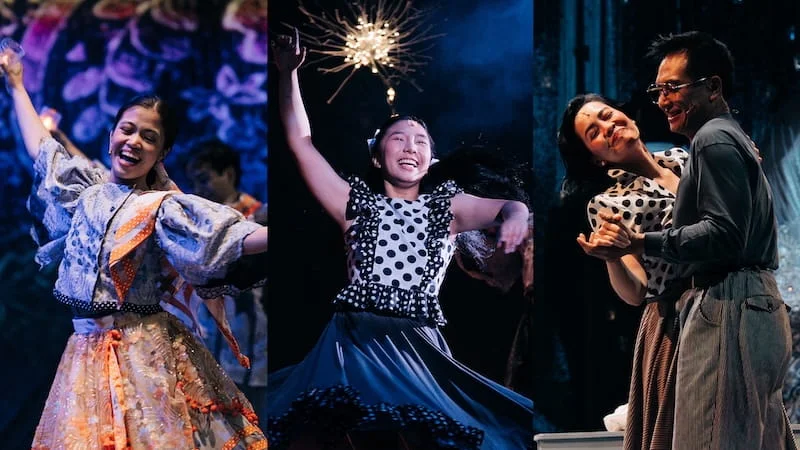
REVIEW: ‘Sayaw ng mga Ilaw’ is a beautifully designed martial law account for all ages
“More than a story for children, Tanghalang Pilipino’s new musical is a sophisticated if somewhat overstated adaptation with stunning visual design.”
There is an assumption that children’s stories have to be sanitized in order to be appropriate for their target audience. But rather than prevent kids from seeing or hearing about any kind of mature subject matter altogether, it’s perhaps more important to guide them in understanding the difficult things that already surround them and affect the world they live in. Tanghalang Pilipino’s Sayaw ng mga Ilaw, a musical adaptation of Cheenlo Marlo Sayuno’s 2024 illustrated children’s book, shares this belief—following a family’s experiences surrounding the 1981 Manila Film Center tragedy, but with a child’s point of view at its center.
In a manner of speaking, this isn’t a production for kids so much as it’s a production intentionally designed to be appreciated by audiences of all ages, including kids. It doesn’t mince words or pull its punches, and it’s still directed and performed with as much sophistication and seriousness as any account of Ferdinand Marcos’ dictatorship deserves. The show’s dialogue and lyrics may overstate its themes and figures of speech, but stunning visual design allows this narrative to be told in an efficient, multifaceted way.
Edifice complex
Even before the musical begins, Marco Viaña’s set already tells a story: the stage is covered in billowing cloth, the curtains flowing into the train of a massive Filipiniana terno. This ghostly monument dominates the whole production as an embodiment of Imelda Marcos’ edifice complex—supposedly a proud signifier of Filipino culture but ultimately hollow within. At the beginning of the show, the family of young Laya (played by Wincess Jem Yana, alternating with Annika Co) cautiously navigates the similarly empty promise of the formal end of martial law. But as 169 construction workers are either killed or buried following an accident at the Manila Film Center, their world—expressed through the set—reveals itself as a fearsome, amorphous mass.
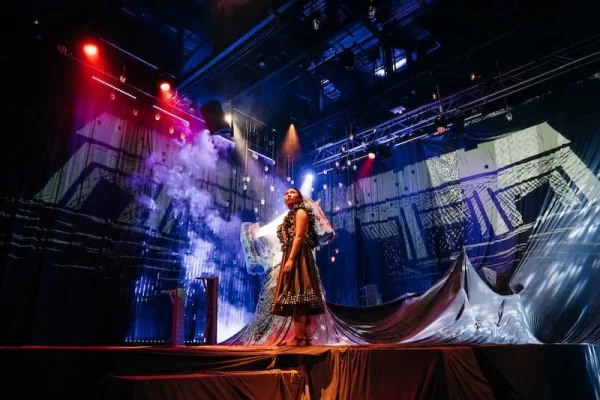
Wincess Jem Yana as Laya; Photo Credit: Tanghalang Pilipino / May Celeste
Clothing becomes a recurring motif, with Viaña’s modest but striking costumes eventually serving as a reminder of lives lost and justice denied, as shirts are hung from the ceiling in opposition to the giant terno. Much of Sayaw ng mga Ilaw‘s production design becomes structured around these images of absence and things being under construction. Benches and wooden poles are integrated into Al Bernard Garcia’s (at times nerve-wracking) choreography, and pandanggo candles mirror the lights of a city rushing to build its façade of progress. Even Justin Santiago’s projections create a hazy view of the burgeoning metropolis around the family, and D Cortezano’s lights help create a sense of movement and collapse during larger, movement-based set pieces.
Repetition and reflection
It’s clear that Sayaw ng mga Ilaw can’t be easily labeled as a “children’s story,” but the tragedy of this narrative is still tastefully interpreted by playwright Juan Ekis. His script tackles the Manila Film Center incident head-on while expanding it into a chronicle of a family’s shattering and political awakening. However, the writing does tend to repeat itself in its use of stars and dancing as central metaphors. Without much variation or progression in the use of these images from scene to scene, the characters also don’t always feel like they’re actively growing so much as they simply arrive at their respective end points. And yet the musical still succeeds as a reflection on families torn apart by other, more powerful families who have kept their own dynasties alive with impunity.
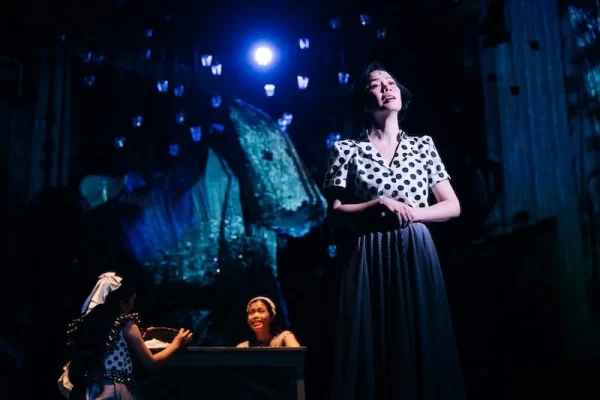
Shiela Valderrama as Nanay Lucia; Photo Credit: Tanghalang Pilipino / May Celeste
Krina Cayabyab’s elegant, rousing score knows to take its time with its generous vocal parts, never feeling the pressure to quicken its pace. Lyrically, however, some of the songs do also begin to seem redundant, especially with a few numbers being placed close together within the show’s brief runtime. It must also be said that the press preview was affected by sound issues that resulted in the music frequently drowning out the actors, though these problems should easily be ironed out. Even so, the beauty of Cayabyab’s score comes through, expressing both gentleness and righteous indignation in direct, no-nonsense fashion.
A fraught history
What also comes through in Sayaw ng mga Ilaw‘s performances is that young people are not magically detached from the violent realities around them. Yana avoids cloying stereotypes and precociousness as Laya, channeling anger and confusion toward herself more than anything. As Laya’s parents, Noel Rayos and Shiela Valderrama are often in-the-dark and on-edge, uncertain about their safety but choosing to keep up calm, happy faces for their children—with Valderrama in particular delivering terrific, crystal-clear elegies with her singing. But most impressive is Ynna Rafa, playing older sister Kala as bright and idealistic, while also weighed down by fear and rage that have abruptly taken away her childhood. Her portrayal is the engine of the whole production and the site where all of its themes collide.
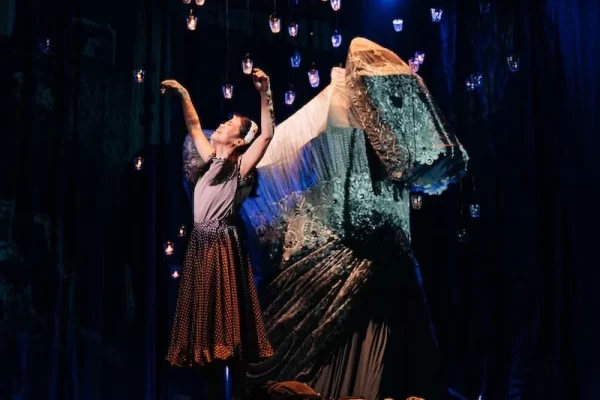
Ynna Rafa as Kala; Photo Credit: Tanghalang Pilipino / May Celeste
Director Jonathan P. Tadioan wrangles together these elements into a show that keeps character interactions straight to the point but really lets Garcia’s choreography sing. The dancing of the pandanggo sa ilaw is relatively simple but mesmerizing to watch, while other contemporary-influenced routines express plenty of pent-up tension. And by having the actors occasionally sit among and travel through the audience, Tadioan draws attention to the Tanghalang Ignacio Gimenez itself, located just a kilometer from the Manila Film Center. These buildings within the CCP Complex are fraught with a difficult history, and it’s heartening to see this production be critical of its own spaces, to ask us never to forget.
This reviewer watched the 8 PM, September 18 press preview.
Tickets: P1,800–2,000
Show Dates: September 18–October 11, 2026
Venue: Tanghalang Ignacio Gimenez, CCP Complex, Pasay City
Running Time: approximately 1 hour and 20 minutes (without intermission)
Company: Tanghalang Pilipino
Creatives: Juan Ekis (Playwright), Cheeno Marlo Sayuno (Author), Krina Cayabyab (Music), Jonathan P. Tadioan (Direction), Kat Batara (Dramaturgy), Al Bernard Garcia (Choreography), Marco Viaña (Set and Costume Design), D Cortezano (Lighting Design), Rafa Sumilong (Associate Lighting Design), Justin Santiago (Video Projection Design), TJ Ramos (Sound Design and Engineering), Jo Ann Requiestas (Technical Direction), Lhorvie Nuevo-Tadioan (Acting Coach), Anya Evangelista (Costume Design Assistant)
Cast: Wincess Jem Yana, Annika Co, Noel Rayos, Shiela Valderrama, Ynna Rafa, Earvin Estioco, Lhorvie Nuevo-Tadioan, Mark Lorenz, Heart Puyong, Sarah Monay

Comments