

REVIEW: When Ballet Gets a Little ‘KENKOY’
It is a banger of a program at Hyundai Hall, Areté, where four very different works moved from Grieg’s Baroque-inspired elegance to the comic-strip verve of Kenkoy. Alice Reyes Dance Philippines’ program brings together neoclassical refinement, high-risk contemporary movement, classic modern dance, and Filipino satire. At its best, KENKOY and other dances show how the performers can move between styles and theatrical worlds without losing the physical force of ballet.
HOLBERG SUITE
Edvard Grieg’s From Holberg’s Time, Op. 40, is an 1884 Romantic composer’s recreation of Baroque dance forms, an early example of the backward-looking impulse that would later be associated with neoclassicism. Adam Sage takes that same meeting of old forms and modern expression into ballet, creating a three-layered world in which classical technique, historical references, and modern physicality coexist.
The music itself gives the choreography its shape. Its expressive phrasing, with graceful ascending string lines and measured cadences, creates precise moments for suspension, breath, and release. Sage responds with clean neoclassical lines, crisp footwork, graceful leaps and elegant neoclassical partnering.
Sage draws on the formal character of Baroque dance through the way the dancers pose, walk, arrange themselves in symmetrical patterns, and relate to one another. The arms often frame the body rather than simply propel the movement, giving these passages a courtly quality. This suits Grieg’s score, which draws on dances such as the sarabande, gavotte and rigaudon.
At the same time, Sage brings these older forms into a much bigger physical vocabulary. The dancers use high leg extensions, expansive arabesques, deep spatial travel, modern partnering, athletic balances and sweeping movements. The choreography retains the formality of Baroque dance while giving them the physical scale of ballet today.
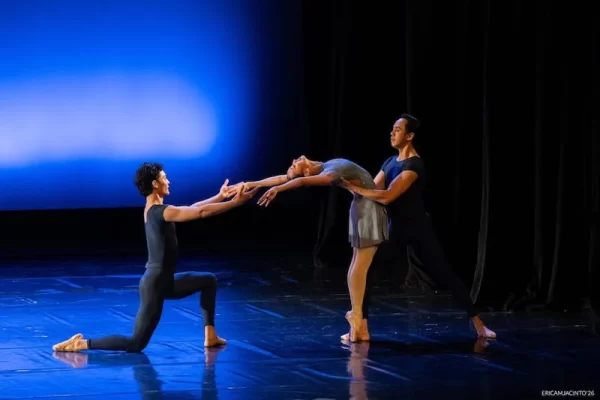
L-R: Dustin Igares, Francia Alejandro, John Ababon; Photo Credit: Erica Feliz Marquez-Jacinto
This modernity is particularly apparent in the male role. The danseurs don’t just lift and support. In a trio, the exchange between the ballerina and the two danseurs feels organic, with the men almost becoming extensions of her body. One holds her hand to guide an arabesque promenade while the other catches the line to anchor it. She then whips around, melting into a dramatic vertical six-o’clock arabesque. As one partner slides her foot down to the floor into a split, the other carefully drags her in a smooth trajectory across the stage.
In other sections, the partnering is reinforced by the spatial interplay of the ensemble. The dancers move in unison and then break into delicate counterpoint, echoing the conversational quality of Grieg’s strings.
Lighting design by D Cortezano and his associate Andrei Fabricante takes a very different approach from the warm front lights often used in traditional dance productions. The ballet opens in vibrant fuchsia before shifting into a deep, saturated blue that carries much of the work. The change creates a sharp visual reset between scenes and alters the mood as the ballet unfolds.
Within the blue palette, the stage takes on a striking gradient, fading from a soft violet-dark overhead to an electric blue at floor level. The glossy floor reflects the blue upward, extending the dancers’ lines and making the stage appear larger.
Rather than picking out the dancers with strong highlights and shadows, the cool wash turns them into silhouettes. A figure stands out against the indigo, while darker costumes merge into the shadows, helping define the relationships onstage without relying on a literal story. Above them, the exposed lighting rigs glitter like tiny stars over the vast blue sea.
The deep twilight does sacrifice some facial expression, but that seems deliberate. Cortezano and Fabricante shift attention away from faces and toward the dancers’ bodies in space. Against the blue, they become moving forms, cutting across an expansive stage.
SOLILOQUY
Norman Walker’s Soliloquy is a legacy solo that immediately tests a danseur’s nerve. The work opens with a heart-stopping front fall, where the dancer plunges straight down like a falling plank before catching his weight entirely on his hands.
Danilo Dayo moves through the choreography with fluidity, effortlessly shifting shapes from a low, traveling lunge with arms slicing across the floor into a concentrated balance with one leg tightly wrapped over another. He turns with an extended line, balancing cleanly on a single weighted foot while his upper body twists and frames the music. The high point arrives in a series of suspended leaps that crash straight into floorwork, including a flight path landing seamlessly in a side split.
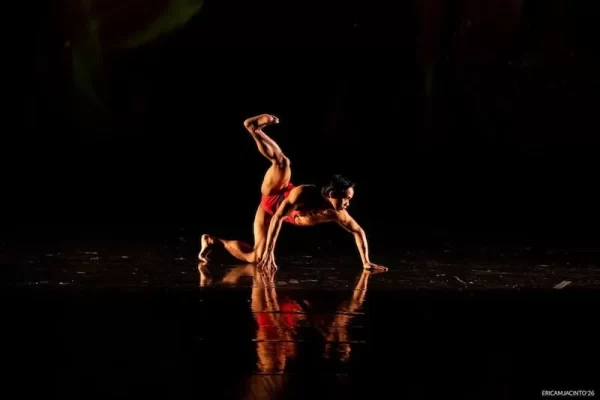
Danilo Dayo; Photo Credit: Erica Feliz Marquez-Jacinto
Dayo is a remarkably tidy dancer, making the transition from mid-air flight to the floor virtually invisible. Yet for all his polish, the performance misses the hard-edged bite and dramatic friction that defined Walker and the Martha Graham style. Too often, it plays as an immaculate showpiece rather than a journey with a narrative spine.
The lighting design for Soliloquy drops the lone Dayo into the middle of a blazing inferno. A massive backdrop explodes with animated, fiery tongues of orange and acid-green flame laced with glowing embers, turning the stage into a dark, pulsing crucible.
This volatile visual matches the high-wire risk of Norman Walker’s choreography. Instead of a clean, neutral studio wash, the fiery projection acts as an externalized psychological storm. It mirrors the sudden drops, visceral floorwork and driving tension of the solo, wrapping the performance in a raw, elemental heat that keeps the stakes dangerously high.
SOMEWHERE
Max Richter’s post-classical take on Vivaldi’s Summer hits with pulsing, urgent string patterns that lock into a driving rhythm. In Somewhere, choreographer Lester Reguindin turns the music’s shifts, from repeating patterns to swelling peaks, into movement that builds in breath and momentum.
The dancers meet that urgency head-on. Bodies shift constantly between tight vertical lines and deep, sweeping curves. Against a striking backdrop of male ensemble members standing tall and women scattered in low, arched positions on the floor, a single pair commands the space. Another dancer helps launch the ballerina into her partner for an overhead lift. She then reaches toward the ceiling in a sharp vertical line. In midair, she scissors her legs into a wide split before snapping them back together as her partner catches her and swings her around his body. Meanwhile, the other male dancer drops into a one-arm balance, his legs splitting through the air.
The female ensemble drops into sharp arches and deep backbends from their knees. The contrast between the towering vertical lines of the men with their angular arms and the floor-bound shapes gives the stage a shifting sense of height and weight.
Reguindin’s choreography brings athleticism and design together. The music’s recurring patterns and swelling passages shape the dancers’ pacing and movement. Grounded ensemble work runs alongside fast solo and partnering sequences, with several actions unfolding at once. Reguindin knows how to keep the eye moving, placing contrasting actions at different points onstage. Thus, the audience is constantly discovering something new without losing sight of the larger composition.
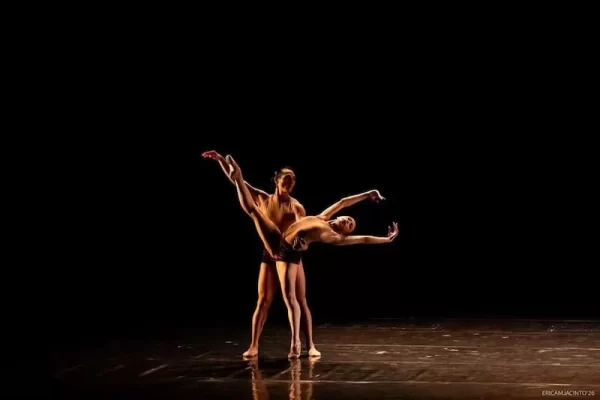
Ejay Arisola, Francia Alejandro; Photo Credit: Erica Feliz Marquez-Jacinto
Cortezano and Fabricante’s lighting cuts through the space with precision. A row of dancers stands in warm golden downlight, their silhouettes outlined against a neutral backdrop. The light catches the glossy floor, creating long reflections beneath them. In the stillness, a burst of focused light isolates a dancer in motion, making the figure glow against the darker stage.
In another sequence, the backdrop shifts to a glowing wash of fuchsia and magenta, bathing the stage in theatrical twilight. Exposed lights sparkle from the overhead rig like scattered stars. Below, the dancers are framed by the intense pink glow while a cooler light catches the glossy floor, reflecting and extending their low, arched shapes.
KENKOY
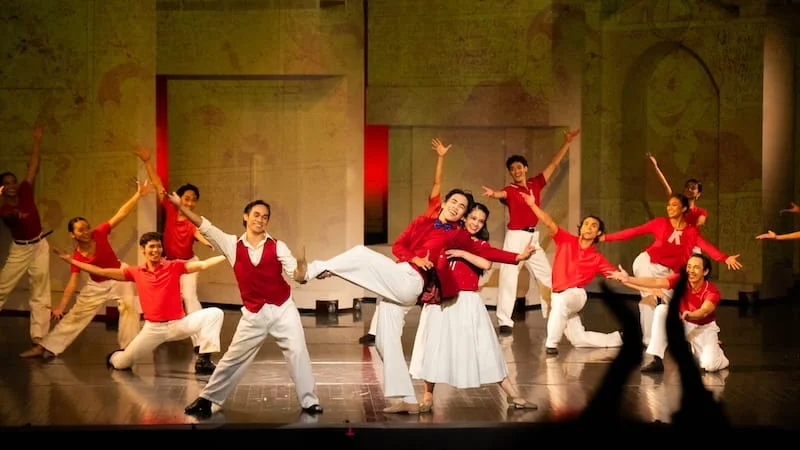
Stepping from illustrator Tony Velasquez’s 1920s comic strip onto the modern stage, Kenkoy uses dance, physical comedy, swing rhythms and satire to examine Filipino identity and colonial mentality. Set in the streets of old Manila, it follows the hapless but resilient Kenkoy as he competes with the heavily Americanized Tirso for Rosing’s affection, even trying to reshape himself according to Western ideals. His journey to America takes a darker turn at a carnival, where the seductive theater acts become a trap. He is turned into a performing monkey, the only human among the animals, a pointed metaphor for the loss of identity that can come with blindly imitating the West.
Returning disillusioned, Kenkoy is ready to discard the persona he has created until Rosing reminds him that his humor, vulnerability and resilience are what make him uniquely Filipino. A vision of his enduring legacy, from popular culture and comedy, shows how a comic character can embody generations of Filipino experience. Kenkoy moves from imitation toward self-recognition, culminating in the rallying cry, “Lahat tayo, Kenkoy!” (meaning funny, comical, quirky) and its celebration of Filipino identity.
ARDP artistic director and KENKOY choreographer Ronelson Yadao makes the most of the familiar movements, tying them closely to the characters and Guelan Varela-Luarca’s libretto. Krina Cayabyab’s score reinforces the period setting, drawing on mid-century styles including ragtime and jazzy blues. The production opens with bright, syncopated big-band swing, and Yadao translates the rhythm into loose, playful movement. The ensemble rolls through the choreography in unison, pumping their arms with precision and bouncing through jazzy shoulders and footwork.
A highlight is the men’s struggle to figure out what to do with their suits. Kenkoy and Binong wrestle with their trousers, trying to keep them up until Kenkoy discovers the belt. Yadao turns the simple act of getting dressed into a comic metaphor for Filipinos trying to fit themselves into Western ways. The men twist and overlap as they grapple with their clothes, first forming a linked line of blazers before breaking into a spinning circle of tumbling, rolling and scrambling bodies. The choreography makes their physical confusion part of the larger joke about adopting a foreign identity before figuring out how to make it their own.
What makes Yadao effective is his instinct for theatrical character. He gives each figure a distinct physical presence, then lets the movement carry the comedy, relationships and social satire. The choreography can be exuberant one moment and sharply comic the next, but it remains tied to the personalities onstage.
The casting is pitch-perfect. With his exaggerated facial expressions, the unhinged Renzen Arboleda looks like a cartoon character who stepped right off the comic strip. Yet his performance calls to mind Gene Kelly’s signature comedic style, merging high-energy choreography with physical clowning to turn clumsiness and over-eager bravado into pure kinetic joy. All he needs to do next is dance on walls.
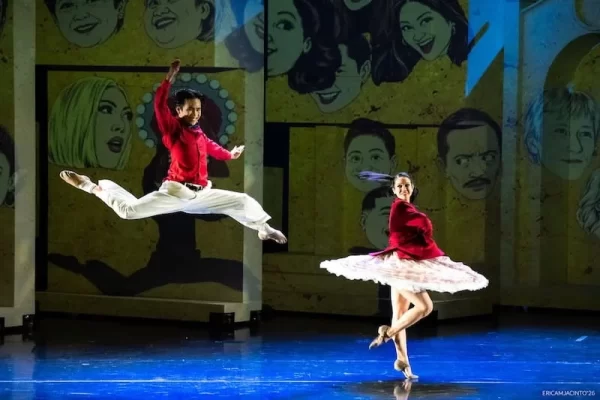
Renzen Arboleda as Kenkoy, Monica Gana as Rosing; Photo Credit: Erica Feliz Marquez-Jacinto
Monica Gana brings a gamine charm to Rosing, pairing it with her balletic precision. As Binong, Kenkoy’s sidekick, Dan Dayo matches his friend’s goofiness with outsized gestures, turning his technique into a punchline. Darylle Odejar’s long-limbed physique and restrained demeanor suit Tirso, the dapper, mild-mannered foil to Arboleda’s manic Kenkoy. Erl Sorilla anchors the carnival scenes as a commanding ringmaster.
Joyce Garcia’s video mapping establishes KENKOY’s visual language from the outset, treating the stage like a comic strip come to life. The deliberately faded comic imagery gives the production a sense of a world preserved from another era, while the projections become part of the storytelling. As the story unfolds, comic panels become settings, while speech balloons and other graphic elements punctuate key moments, including Kenkoy and Rosing’s first kiss. The effect connects the play’s satire and nostalgia to the visual language of the comic strip that inspired it.
The lighting design works in tandem with this approach. It stays bright for most of the production, allowing the audience to follow the story clearly and catch the characters’ expressions and comic reactions. Only toward the latter part does the lighting dim, shifting with the jazzy blues and piano music. Even then, the focus remains firmly on the characters, keeping the emotional and comic action at the center.
All told, Yadao’s work makes KENKOY a comic strip that refuses to sit still.
This reviewer watched the 2 PM, September 20 show.
Tickets: P1,200 (Orchestra) and P800 (Balcony)
Show Dates: September 18-20, 25-26
Venue: Hyundai Hall, Areté
Running Time: 1 hour and 40 minutes (including a 10-minute intermission)
Producer: Alice Reyes Dance Philippines
Creatives: Ronselson Yadao (artistic direction)
Holberg Suite- Adam Sage (choreography)
Soliloquy- Norman Walker (choreography)
Somewhere- Lester Reguindin (choreography)
KENKOY- Ronselson Yadao (choreography), Krina Cayabyab (music direction and composition), Joshua Cadeliña (assistant music direction), D Cortezano (production design, technical direction, lighting design), Andrei Fabricante (associate lighting design), Joyce Garcia (video projection), Adam Sage and Doreen Dofitas (costume design and coordination), Guelan Varela-Luarca (libretto), Jerry Respeto (dramaturgy)
Cast:
Holberg Suite– Monica Gana, Ejay Arisola, Erl Sorilla, James Galarpe, Darylle Odejar, Krislynne Buri, Francia Alejandro, Renzen Arboleda, John Ababon, Dustin Igares, Cielo Inday, Francine Beltran, Noeh Polinar, Danilo Dayo
Soliloquy– Danilo Dayo
Somewhere– Ejay Arisola, Renzen Arboleda, Erl Sorilla, John Ababon, James Galarpe, Darylle Odejar, Dustin Igares, Noeh Polinar, Danilo Dayo, Monica Gana, Krislynne Buri, Francia Alejandro, Cielo Inday, Francine Beltran, Cheska Vasallo, Karen Audal, Audrice Narrajos
KENKOY- Renzen Arboleda/ Ejay Arisola (Kenkoy), Monica Gana/ Francia Alejandro (Rosing), Danilo Dayo (Binong), Darylle Odejar/ James Galarpe (Tirso), Erl Sorilla/ John Ababon (Ringmaster), Francia Alejandro/ Monica Gana (Vaudeville Lead), Cielo Inday/ Darylle Odejar/ Francine Beltran/ Dustin Igares (Giants), John Ababon/ Erl Sorilla (Puppet Master), Ejay Arisola/ Renzen Arboleda (Puppet Male), Krislynne Buri (Puppet Female), Francia Alejandro, Monica Gana, Krislynne Buri, Cielo Inday, Francine Beltran, Cheska Vasallo, Karen Audal, Audrice Narrajos (Vaudeville), James Galarpe, Noeh Polinar, Dustin Igares, Cheska Vasallo, Karen Audal, Audrice Narrajos (Monkeys), Krislynne Buri, Francia Alejandro, Monica Gana, Cielo Inday, Francine Beltran, Cheska Vasallo (Corps)
Comments