

REVIEW: ‘About Us But Not About Us’ is a morally restless interrogation of love, power, and truth
“Desire, jealousy, and power collide in About Us But Not About Us, turning even intimacy into a site of tension and discomfort.”
About Us But Not About Us finds its strength onstage in its sustained restraint, allowing tension to accumulate gradually. In this stage adaptation of the 2022 film, the play transforms an intimate restaurant conversation into a sustained moral confrontation, using spatial restriction, language, and performance to examine how care can mask control, and how truth can be both confession and weapon. While the production’s restraint strengthens its psychological tension, some of its linguistic choices create emotional distance where volatility might have cut deeper.
Intimate and constricted space
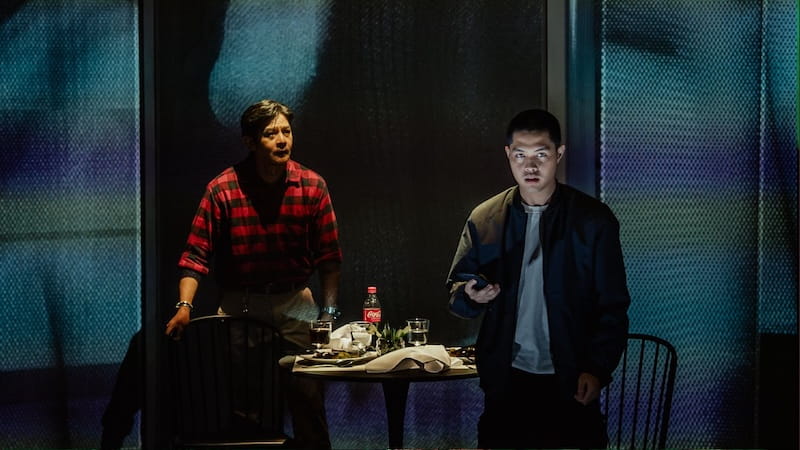
The play opens in a modest restaurant setting, where a small table sits at center stage and Eric (Romnick Sarmenta) meets his former student Lancelot (Elijah Canlas) after months of pandemic silence. Their exchange begins politely, almost cautiously, but it gradually reveals the weight of unresolved history. Directed by Tuxqs Rutaquio, the staging resists spectacle, relying instead on controlled blocking and John Batalla’s lighting to navigate between present conversation and past events. In one particularly effective sequence, a past confrontation unfolds alongside the present dinner, allowing the audience to watch a character absorb a truth he is only fully understanding in that moment. The simultaneity transforms recollection into live discovery, heightening the emotional impact without disrupting clarity.
Lighting transforms the upstage sliding doors into a fluid architectural device, redefining space without interrupting momentum. With subtle shifts, they move from restaurant walls to Eric’s condominium and the home he shares with Marcus. At times, these screens can appear transparent or opaque depending on the lighting and figures move behind the panels in partial silhouette, suggesting actions that one character recalls while another only begins to comprehend. This setup works well, particularly in transitions where memory overtakes the present.
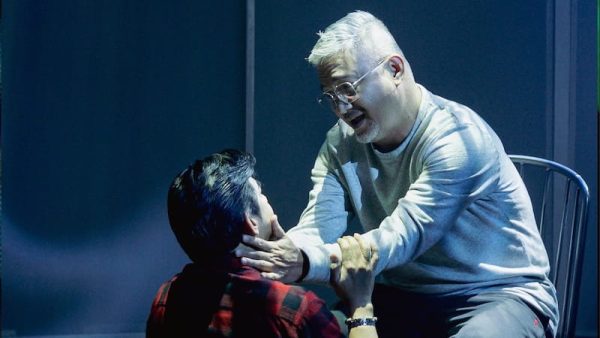
L-R: Romnick Sarmenta (Eric), Andoy Ranay (Marcus); Photo Credit: Sef Tafalla
The sliding door screens also serve as surfaces for projections—videos and text messages that externalize what cannot be spoken aloud. These digital fragments ground the story in its pandemic context while revealing the private exchanges that fuel suspicion and resentment.
Restaging a COVID-set narrative in 2026 risks feeling belated, yet here the pandemic proves structurally necessary. Lockdown conditions explain proximity: Lancelot’s extended stay in Eric’s condominium, the emotional dependency formed in isolation, and the intensification of private tensions. Watching it now, the audience notices how lockdown forces Eric and Lancelot together, blurring professional and personal boundaries and making their unequal power feel urgent and unsettling.
Care and control
The moral tension of About Us But Not About Us rests on how its characters blur the line between care and control, and the production depends heavily on whether its actors can sustain that ambiguity without forcing it. Sarmenta’s Eric is not played as a domineering professor or a covert predator. Instead, he presents a man who genuinely believes in his own decency. Even when confronted with the implications of housing a former student during lockdown, Eric frames his actions as protective and reasonable. As more details surface, the audience begins to sense the imbalance in the relationship more clearly than Eric appears willing to acknowledge. That gap—between self-perception and consequence—gives the character its unsettling weight.
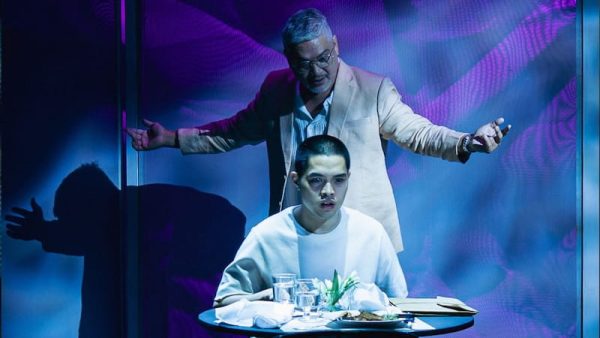
Top-Bottom: Andoy Ranay (Marcus), Elijah Canlas (Lancelot); Photo Credit: Sef Tafalla
Watching Marcus, the audience sees more than a confident, established writer—Andoy Ranay shows a character whose humor and bluntness mask real insecurities. His romantic attachment to Eric flickers against moments of pride, creating obvious tension. At the same time, every pointed dismissal of Lancelot, an aspiring writer, reminds the audience of the hierarchy between them, making the imbalance of power tangible. By balancing vulnerability with authority, Marcus’ presence keeps the audience aware of how admiration, reputation, and age can be wielded to dominate others.
Canlas delivers a portrayal of Lancelot that equally refuses easy sympathy. He initially appears as an earnest and impressionable student, but Canlas subtly layers the character with calculation, turning charm into an instrument of manipulation. His performance places the audience in a constant state of moral uncertainty, unsure whether to view Lancelot as a victim shaped by circumstance or as an active participant who understands the power he wields. By the end, no character remains morally intact, and the question of who is truly at fault becomes deliberately unstable. Through these layered performances, the staging compels the audience to confront their own judgments.
About us but not about us
Unlike in its original film, which allowed English and Filipino to coexist fluidly, the stage production commits entirely to English. This choice clearly situates the characters within elite academic and literary spaces in the Philippines. However, the uniform English also introduces a certain emotional polish. In scenes that hinge on betrayal and vulnerability, the language occasionally buffers impact. The characters articulate their pain with sophistication, but that sophistication can distance rather than expose.
The play positions literature simultaneously as a space of revelation, weaponization, and ambition. Marcus’ attempt to write a novel in Filipino becomes the central symbol of this tension: for him, it is an act of truth-telling; for Eric, a threat of exposure; and for Lancelot, a means to recognition. With this, the audience realizes each character sees the same event differently, tying to the production’s interrogation of truth.
About Us But Not About Us is a tightly controlled study of desire and authority. In watching these three men negotiate love, power, and rivalry, it trades easy answers for sharp, lingering discomfort.
This reviewer watched the 3:00 PM, February 21 show.
Tickets: PHP 2800 (Orchestra Sides), PHP 3360 (Orchestra Center), PHP 3920 (VIP)
Show Dates: February 14 – March 8, 2026
Venue: Power Mac Center Spotlight Blackbox Theater, Makati City
Running Time: 1 hour and 45 minutes with no intermission
Producer: The IdeaFirst Company (IdeaFirst Live!)
Creatives: Jun Robles Lana (Playwright), Tuxqs Rutaquio (Director), Perci Intalan and Jun Robles Lana (Executive Producers), Elmer Gatchalian (Producer/Dramaturg), Tuxqs Rutaquio (Set Designer), John Batalla (Light Designer), Tj Ramos (Sound Designer), Video Designer (Frances Valera), Mel Norman Cobrdor and Abijah Bautista (Videographer), JB De Leon and Sef Tafalla (Photographer), Arne Sarmiento (Poster Designer), Baha Vergara (Production Manager), Sheña Claire Maglasang (Deputy Production Manager), Karen Miguel (Assistant Production Manager), Kate Loreno (Stage Manager), Janji Gamboa (Deputy Stage Manager), Hyojin Kim and Axl Fernandez (Assistant Stage Manager), Renz Sevilla (Technical Director), Dexter Sy (Assistant Technical Director), Edz Lorica (Production Design Supervisor), Tops Peñafel (Light Board Operator), Dreu Fernandez, Carleen Calamba, and Arabelle Villanueva (Video Operators), Chao Villano Lilio, Jefferson Pamintuan, Antolin Morales (Hair and Makeup Artists)
Cast: Romnick Sarmenta (Eric), Elijah Canlas (Lancelot), Epy Quizon and Andoy Ranay (Marcus), Geraldine Malacaman-Villamil and Herbie Go (Dean Dimalanta), Jack Denzel Gaza (Waiter), Noel Rayos (understudy for Eric), and Jao Catarus (understudy for Lancelot)

Comments