

REVIEW: Dancers Probe Emotion and Heritage in ‘Five Solos’
In a city crowded with galleries and black box stages, WhyNot has built a reputation as a hub for art that resists easy labels. Tucked inside Karrivin Studios in Makati, it operates less like a conventional venue and more like an open platform where artists can test ideas in public. Design shares space with theater, sound art, visual arts, architecture, multimedia and movement. Collaborations form organically rather than being programmed.
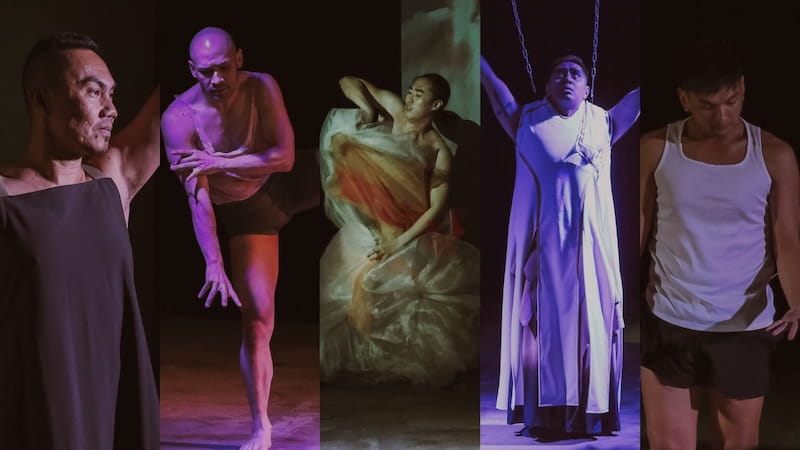
That spirit carried into concert Five Solos, conceived by Alvin Erasga, whose choreography blends contemporary movement with personal and cultural references. The program brought together several of the country’s most authentic male dancer-choreographers, each presenting an individual work while contributing to a shared atmosphere. Visual artist Bimpoman provided video and photographic elements, while the sound collective bower gra, together with Mudskipper and Ritzwel Red, created a layered sonic environment. Strings blended with electronic sounds, forming an ambient backdrop that let the dance take center stage.
For viewers unfamiliar with contemporary dance, the solos might appear abstract at first. Yet the movement draws from a lineage that reaches back to German expressionist dance in the 1910s, where emotion drives physical action and the body becomes an extension of inner life. Steps are not decorative or virtuosic. Motion emerges from instinct, tension, and release. Traditional ideas of beauty give way to distortion, grounded weight, and moments of stillness. Many performers work barefoot, free from a specific movement vocabulary, moving from physical or emotional impulse rather than fixed steps. The effect may feel unfamiliar at first but gradually becomes compelling as viewers adjust to the pace.
The works in Five Solos are deeply personal, with each artist turning inward for material. Instead of relying on strict technique, the dancers move through shifts of weight, breath, and momentum, as if the choreography is surfacing from the subconscious.
As It Melts. Another Blooms
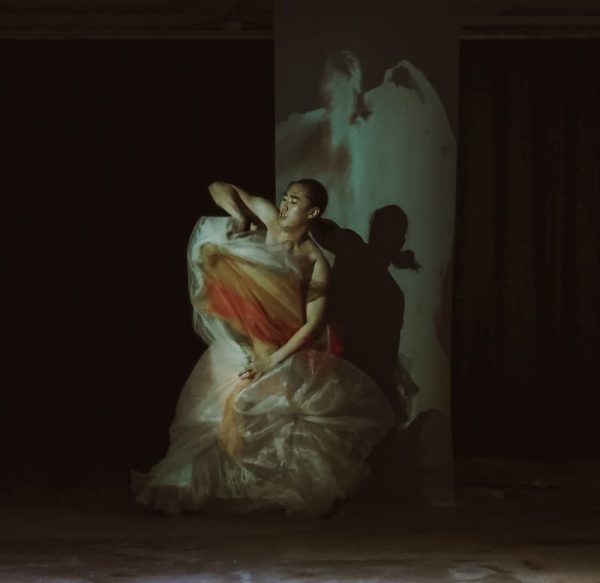
As It Melts, Another Blooms by Michael Barry Que; Photo Credit: Myra Ho
Michael Barry Que’s As It Melts. Another Blooms unfolds as a tribute to his late grandmother, Mommy Lily. He begins with a shadow sequence behind a translucent screen, gestures reaching and retreating with a sense of longing. The choreography stays inward and tensile. The spine rounds, the ribs collapse, and the body spirals almost imperceptibly as weight shifts through the pelvis. Movement yields to gravity rather than resisting it, with slow tension interrupted by sudden releases. His gestures suggest both cradling and constraint. Behind him, vertical screens glow with projections of white, green, and amber forms resembling melting ice, while a pool of violet light at center stage creates a halo that separates his grounded struggle from the shifting images above.
Que grips a white hooped skirt, referencing his lola, turning the dance into an exploration of texture, symbolism and shape. Skin rubs against concrete, fabric catches breath and light. The occasional curled posture feels embryonic, a body suspended between self-embrace and attachment and letting go. The sound environment follows that physical arc with piano tones that swell and recede. Surrounded by the room’s vastness, his folded body feels both vulnerable and intimate, as if each movement recalls a private memory. By the end, he holds roses, his grandmother’s favorite flowers, places them on the skirt, and allows a faint smile to surface, a gesture that reads as acceptance.
A Body in Negotiation
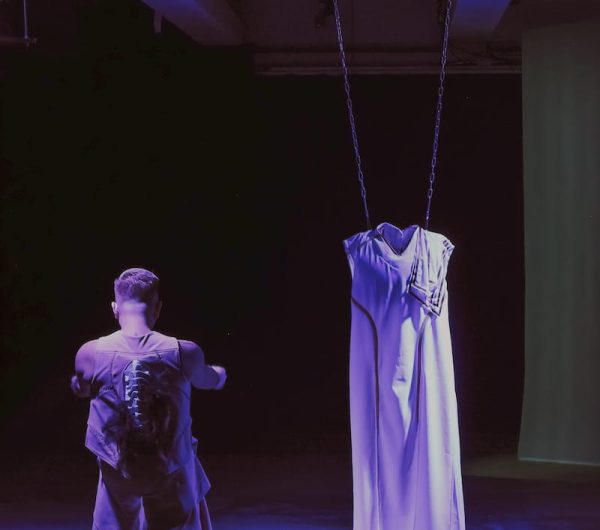
Prudenciado’s spine becomes the peg of the dance and costume; Photo Credit: Myra Ho
Rhosam Prudenciado’s A Body in Negotiation is a deeply personal exploration of his fraught relationship with his body following a 2015 diagnosis of degenerative spinal disease. The lower part of his spine is gradually failing. The five vertebrae in the lumbar region support much of the body’s weight and movement. Two of them, are no longer functioning properly, affecting strength, stability, and control in the lower back and legs. Surgeons have recommended fusion with titanium hardware, a procedure that could severely limit his ability to dance.
On stage, Prudenciado enters wearing a spinal support brace under loose layers, maintaining a composed façade even as the choreography conveys pain and tension. He moves in crouched circles, outstretched reaches, and wringing gestures that suggest both prayer and struggle. Screens behind him project human silhouettes in motion, amplifying his dialogue with the body. At the midpoint, he removes the brace–a raw gesture of defiance and a refusal to surrender the freedom of his movement. Later, he screams again, a burst born of fear for what his body might no longer do. It is also a release of the anxiety that has been building throughout the dance. The sequence captures the tension between limitation and desire, ending with a firm assertion that expression persists despite pain.
The work also reflects Prudenciado’s commitment to accessibility and a preparation for his future. Collaborating with sports scientist Robert Osorio, he developed techniques for dancers with limited mobility, including wheelchair users. These experiments led to Prudenciado’s Linear Fluidity style, which turns the body’s rigid, jointed structure into spirals, circles, and flowing patterns. It’s a flexible approach that lets movement follow instinct and energy, creating a vocabulary that works whether the dancer is strong, limited, or somewhere in between.
Excerpt from Offering
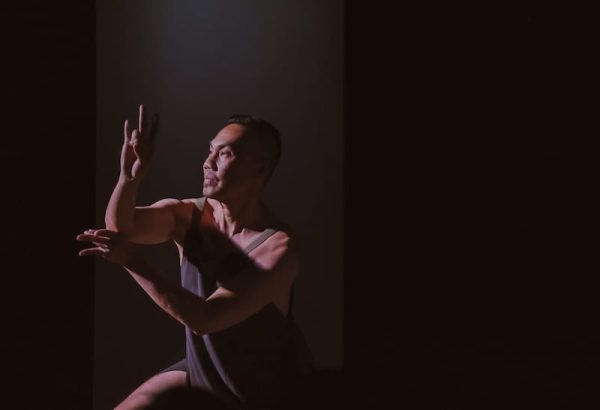
Offering by Alvin Erasga; Photo Credit: Myra Ho
Alvin Erasga’s Offering was created during the pandemic as part of a seven-part series. It unfolds in a space that feels like an underground gallery or industrial loft, raw and intimate. He wears an asymmetrical slate-grey gown shaped like a chasuble, the traditional vestment evoking ritual and religious ceremony. As he pivots, flashes of terracotta peek through the folds, adding warmth to the otherwise muted palette.
The choreography balances weight and precision. His gestures are sculptural, his hands tracing mudras and wringing motions that suggest prayer and ritual. He reaches for the ceiling, sinks to the floor, and circles slowly, movements that feel deliberate and measured, both grounded and transcendent. Moody lighting stretches shadows across the walls, leaving Erasga in a pool of violet intensity. Every turn, every hand gesture, feels like part of a silent liturgy, a private act of devotion.
The soundscape adds sharpness and rhythm. Metallic clicks and chimes punctuate the silence, echoing the gestures and the folds of the costume. The noises don’t overwhelm; they give structure to the movement, emphasizing each reach and pivot. The combination of sound, shadows, and ritualized movement frames the body, letting the performance communicate its gravity without words or grand gestures.
Lore
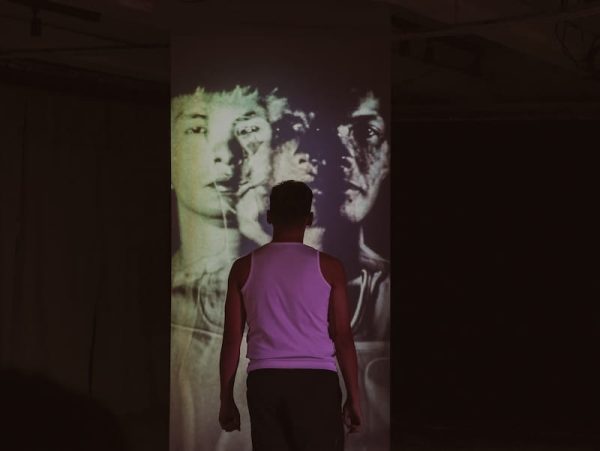
Al Garcia interacts with his image by Bimpoman; Photo Credit: Myra Ho
Al Bernard Garcia’s Lore combines ancestry and technology, using artificial intelligence as a choreographic tool rather than a visual effect. The work begins with questions about origin: Who are you? Where do you come from? Where is home?
Garcia trained in Philippine folk dance at the performing arts school before pursuing postgraduate dance studies in Taiwan. For three years, he lived with the Paiwan Indigenous community in the south, learning their language, songs, and movement practices. He noticed parallels between Paiwan cosmology and myths from Philippine groups including the Kankanaey, Bontoc, Bagobo, and Manobo, particularly stories of a sky world filled with ornaments and luminous objects belonging to deities. These parallels became the conceptual foundation of the piece.
On stage, Garcia narrates a sky myth in the Paiwan language with strong projection. Dressed in traditional Paiwan clothing, he carries a blue woven basket suspended from above and hangs garments from it, creating a celestial space where objects can be stored or retrieved. The basket functions as both home and repository, holding costumes that represent memory, history, and cultural knowledge. As the dance progresses, he removes each piece of costume with careful, ritualistic gestures.
Near the end, he climbs onto a small platform, upright and fully lit. Grounded movement gives way to stillness and elevation. Arms extend outward as he balances on the narrow surface. The shedding of costume suggests identity beyond outward signs, while the garments below remain as accumulated knowledge. In the final moments, he places the garments back into the basket, completing a cycle of gathering, preservation, and ritual.
The work closes on the idea that past and future, tradition and technology, converge in the body itself, which remains the most enduring home.
Excerpt from Under the Rock
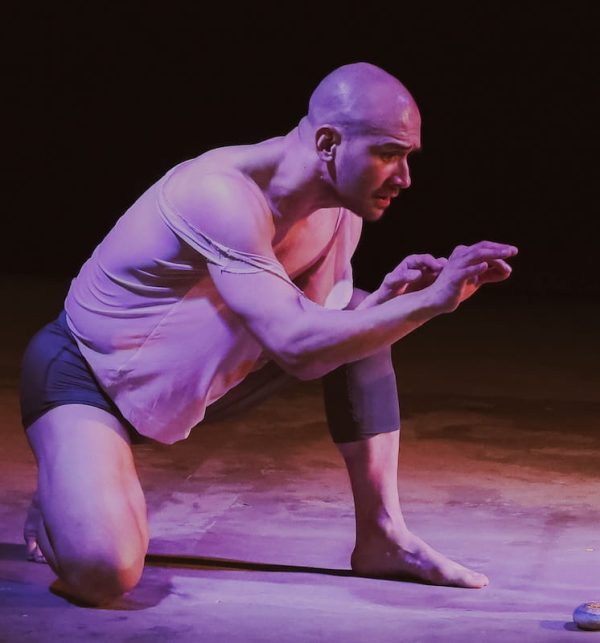
PJ Rebullida deals his fears of insects; Photo Credit: Myra Ho
PJ Rebullida’s Under the Rock is a study in the subconscious. Before the performance, audience members write words or short phrases on slips of paper. Rebullida doesn’t read them aloud but lets the notes guide his movement. One word—“mother”—became a starting point, shaping gestures that curl, reach, and wrap around the self. Rebullida’s anxieties, including a fear of bugs, emerge as contorted shapes, writhing motions, crawling, and swatting or shooing imaginary insects. He slips into a neutral-colored garment that acts like a second skin. Later, removing the fabric becomes a crucial gesture, a transformation into a new being after confronting the fears suggested by the notes.
The choreography negotiates constraint and emergence. He pulls the garment over his head and limbs, creating distorted silhouettes, hidden faces, and elongated torsos. Grounded spirals, lunges, and tense contractions give way to sudden extensions and arching curves. Tremors ripple through the body, slow folds shift into spasmodic jolts, and gestures expand to fill the space while reflecting the influence of the notes. Live strings—cello, viola, and violin—heighten the tension with dissonant textures that respond to the dancer’s shifts. The garment serves as both partner and barrier. When Rebullida finally removes it, the act signals rebirth, where the body stands unconstrained, carrying the traces of what has been faced and released.
Our Thoughts
I came with two friends who have been involved in theater since the 1980s. We agreed that each piece was powerful on its own, with choreographers showing clear intention in their movements even when these appeared spontaneous.
We did question the overall curation. Selecting strong individual artists is one thing, but curation also shapes how the works relate to each other. A performance benefits from a sense of progression, an arc that builds toward a satisfying conclusion. Ending with Under the Rock felt off. Its intense, inward-focused energy left little room for release. The tension remained high, gestures contained, and the audience had nowhere to settle. The piece closed the program rather than providing closure.
Music plays a similar role. Even when the artists call their sound “noise,” it needs direction to guide the audience and mark transitions. The sound artists succeeded in creating atmosphere for each dance, enhancing mood and tension. Still, a program needs a clear ending. Without it, the concert can feel uneven, and even the strongest pieces lose some impact depending on where they appear in the sequence.
Tickets: P800 (Regular), P500 (students)
Show Dates:February 20 at 8 PM, February 21 at 3 PM and 8 PM
Venue:WHYNoT, 4/F Karrivin Studios, Building A
Running Time: 1 hour
Producer: Co.ERASGA, LikhaPH, and WHYNoT
Creatives: Jon Romero (technicals and lights), Galiel (video spinner)
Offering– visual: Bimpoman; music: Emanuel Mailly; costume: Meagan Woods
A Body in Negotiation– visual: Bimpoman; music: WNBW by Patrick Roxas and Le sacred du printemps, PT.2 “Le Sacrifice”; introduction: Leonard Bernstein & New York Philharmonic
Under the Rock (excerpt)– visuals: Bimpoman; noise: Mudskipper, bower gra, Ritzwel Red
Lore– concept and performance collaborator: A.I.; outside eye: Aaron Kaiser Garcia; noise: Mudskipper, bower gra, Ritzwel Red; visual: Bimpoman
As It Melts, Another Blooms– visuals: Bimpoman; music: Secret No. 1 & Déjà Rêvé by DaniHaDani, Summer’s End by Benjamin Kling; costume: Carlo Valderrama
Cast: Michael Barry Que, Rhosam Prudenciado, Alvin Erasga, Al Bernard Garcia, PJ Rebullida
Comments