

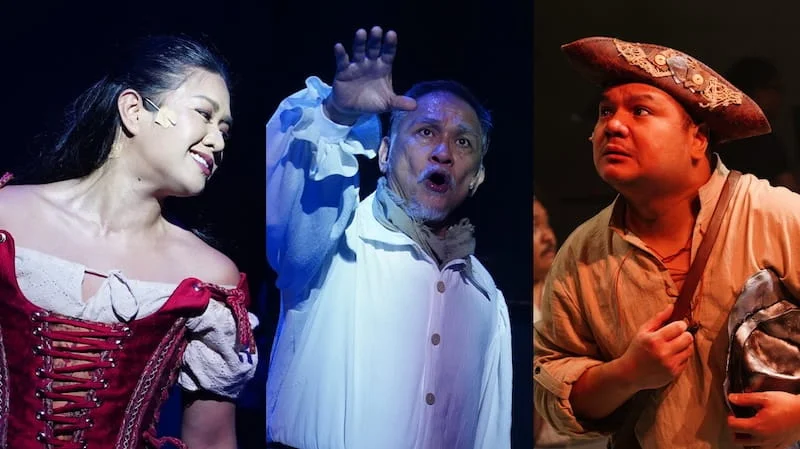
REVIEW: A rousingly performed ‘Man of La Mancha’ champions hope despite captivity
“Repertory Philippines’ latest production of this ‘Don Quixote’ musical overcomes its insufficiently explored ideas through soaring music and the sheer earnestness of its cast.”
Widely recognized as the first modern novel, Miguel de Cervantes’ Don Quixote remains a timeless satire on chivalric romances and a tragic piece of metafiction concerned with the very purpose of storytelling. Over 300 years later, Dale Wasserman’s teleplay adaptation I, Don Quixote was itself adapted into the musical Man of La Mancha, which maintains the self-referential spirit of Cervantes’ original; instead of the principal characters encountering people who have read Don Quixote, Cervantes has now become an active character on stage. Here, while awaiting trial before the Spanish Inquisition, the author puts on a performance of Don Quixote to plead his case to his fellow prisoners—with theater now serving as the artistic medium used to bring forth change.
With so much history and so many narrative layers to sift through, it’s impressive that Man of La Mancha still coheres at all. At the same time, new elements that have been added to Cervantes’ original novel—be it in Wasserman’s libretto or in this new production from Repertory Philippines—lead the show to some thorny places that it doesn’t fully explore. But with such rousing, dignified music and a cast full of assured, earnest performers, it’s hard not to be charmed by what’s ultimately a universal story about finding the courage to fight for a more righteous world.
Defiant imagination
To complicate Man of La Mancha’s version of reality even more, set designer Julio Garcia immediately establishes that this production doesn’t take place during the time of the Spanish Inquisition but much closer to present-day threats of militarized totalitarian regimes. We first see the ensemble behind a floor-to-ceiling chain-link fence, sitting on the sterile tiles of a nondescript holding cell. Garcia encloses them between panels and under a lighting fixture that are all askew—slanted in exaggerated angles that create the illusion of depth and an inherent disorientation.
But as the imprisoned Cervantes tells his story and invites the other inmates to open their imagination with him, the walls push back and lift off the ground, the orchestra revealed behind them. D Cortezano’s lights don’t let us forget that these people are still in captivity—blue and red sirens or the shadows of the chain-link fence occasionally pierce the illusion—but the introduction of more expressive colors coincides with the characters’ ability to now cross from their bleak reality to the possibilities of theater and fiction.
Before long, the entire ensemble become enthusiastic participants in Cervantes’ performance, and costume designer Hershee Tantiado has them change regularly between their casual clothing and the garb of a 17th-century romance book. These period outfits have a suitably worn, rustic quality to them, as if they really did come from a trunk of old costumes. And when Cervantes transforms into the fictional Alonso Quijana, who falls into the delusion that he is the knight-errant Don Quixote, the armor he dons is old and scrappy, a mark of both madness and purity of soul.
Playful solidarity
What director Nelsito Gomez does with these design elements is create a real sense of play among his actors and among the characters living inside Man of La Mancha. From the absurdity of their circumstances emerges good humor and self-aware silliness that gradually wakes them up to Cervantes’ more urgent ideas. Gomez puts full trust in his ensemble, never obscuring their performances with unnecessary flourish, and allowing us to trace when these prisoners are reluctantly playing along and when they’ve actually started becoming invested in the story they’re telling.
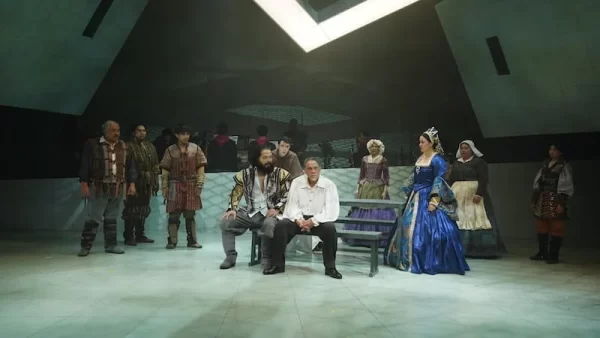
The cast of Man of La Mancha; Photo Credit: Photo credit: Krizhal Daryl Ordas of Indio
Creatives
Wasserman condenses Don Quixote into a brisk plot that still retains its key moments and much of the novel’s wit and folk wisdom. More importantly, Man of La Mancha understands that artists have historically been targeted by tyrants and dictators—channeling Cervantes’ criticisms of shallow chivalric romances into an affirmation of art as an invaluable tool for resistance and to restore hope. So while the story that the fictionalized Cervantes performs isn’t single-handedly capable of freeing the prisoners, it does provide them a common language and a renewed sense of solidarity through performance.
With that said, there are instances when the show’s unabashed idealism doesn’t feel like a sufficient enough response to the issues shown or evoked. As heartening as it is to see the prisoners come together, the parallels drawn between them and members of minority groups being indiscriminately arrested in the United States ultimately don’t go beyond surface-level. And the character of Aldonza/Dulcinea—now a real on-stage presence and not just an abstract idea—is still subjected to surprising brutality. Despite her newfound agency, Wasserman traps her in conditions that Quixote’s worldview doesn’t seem to have a clear solution for.
Madness becoming dignity
And yet, Quixote’s refrain of “The Impossible Dream” still resounds as a moving rallying cry. Farley Asuncion’s musical direction of Man of La Mancha’s score (with music by Mitch Leigh and lyrics by Joe Darion) is almost tactile with its emphasis on acoustic string instruments, and only occasionally hampered by uneven sound. The rhythms of these Latin-inspired compositions are used for both sweeping romance and more sinister scenes, and generous vocal parts allow several members of the ensemble to put their opera voices to great use.
Plenty of personalities emerge from the ensemble—Alfredo Reyes’ skeptical Carrasco, Tarek El Tayech’s merry innkeeper, Steven Hotchkiss’ levelheaded Padre—but it’s Marvin Ong’s humble squire Sancho Panza who manages to do the most with seemingly little. Ong never reduces the character into a bumbling sidekick for Quixote, keeping an innocence and simplicity about him that resists being seen as foolishness. When Sancho delivers the precious ode to his master, “I Really Like Him,” Ong captures the profound joy of being seen as worthy of adventure.
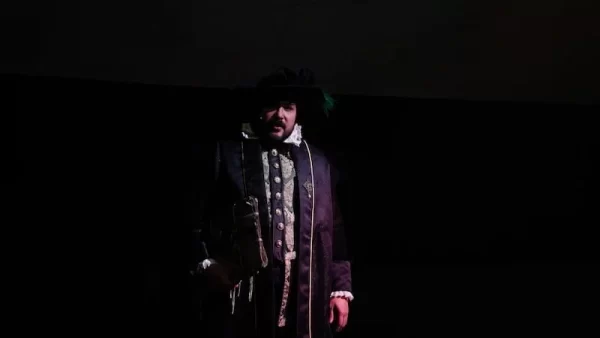
Alfredo Reyes as The Duke / Dr. Carrasco; Photo Credit: Photo credit: Krizhal Daryl Ordas of Indio Creatives
And even with Wasserman’s handling of the Aldonza/Dulcinea character, Katrine Sunga is the golden-voiced grounding anchor of Man of La Mancha, wrestling between her reputation as village wench and the virtuous ideal that Quixote sees in her. And as the Man of La Mancha himself, Nonie Buencamino throws himself into the role with a spry physicality, embracing the comedy with pride and self-assurance while maintaining an unshakable belief in Quixote’s heroism. When Buencamino finally delivers “The Impossible Dream,” you believe the resolve behind every word—his madness becoming dignity.
This reviewer watched the 8 PM, June 5 gala performance.
Tickets: P2,575–3,090
Show Dates: June 5–28, 2026
Venue: REP Eastwood Theater, Eastwood, Quezon City
Running Time: approximately 2 hours (without intermission)
Company: Repertory Philippines
Creatives: Mitch Leigh (Music), Joe Darion (Lyrics), Dale Wasserman (Book), Nelsito Gomez (Direction), Farley Asuncion (Musical Direction), D Cortezano (Lighting Design, Technical Direction), Hershee Tantiado (Costume Design), Julio Garcia (Set and Props Design), Kabaitan Bautista (Sound Design), Jim Andrew Ferrer (Choreography), Jenny Jamora (Intimacy Direction)
Cast: Nonie Buencamino, Marvin Ong, Katrine Sunga, Liway Perez, Tarek El Tayech, Mikkie Bradshaw-Volante, Alfredo Reyes, Steven Hotchkiss, Sarah Facuri, Julio Laforteza, Khalil Tambio, Dippy Arceo, Jasper Jimenez, JV Fulgencio, Alyanna Wijangco

Comments