

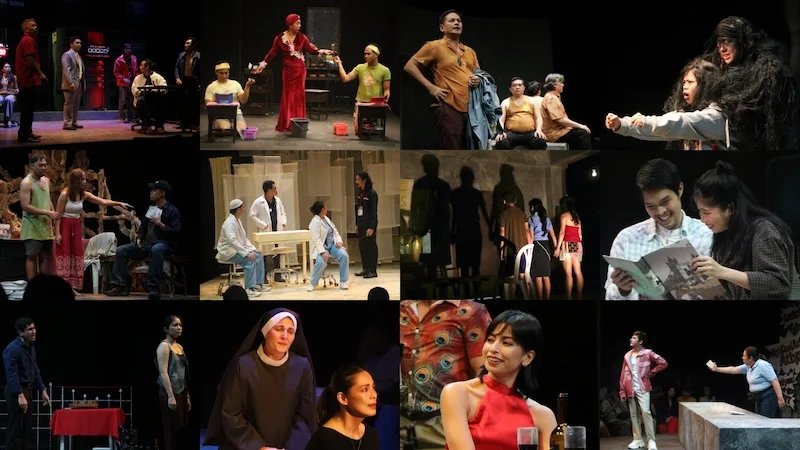
REVIEW: 12 Virgin Labfest XXI “Hubo’t Hubad” Plays
“Twenty-one years in and this festival isn’t showing signs of age as it gives an avenue for more up-and-coming playwrights, directors, and actors crossing from screen to stage.”
Twenty-one years in, and the Virgin Labfest still hasn’t lost the plot.
It has since grown into one of Philippine theater’s most essential annual events. With its 21st edition, it seems that their founding words of ‘untried, untested, unstaged’ is expanding beyond the playwright.
Now, it has become a genuine incubator not just for never-before-staged plays and up-and-coming playwrights, but also for directors to find their footing and now screen actors crossing over to the stage, and perhaps most importantly, for stories that likely wouldn’t find a way to be told anywhere else.
The aftereffect of such experimentation can be a mixed bag (and this year is no different), but that is now part of the winning formula of VLF as it continues to see packed shows, with plenty making the pilgrimage not just to watch what might be interesting, but all of what the festival has to offer.
This year’s offering stays true to the festival’s theme of “Hubo’t Hubad.” There’s plenty laid bare with each of these one-acts though to varying degrees of success:
Set A: Tengang Kawali
This first set is dubbed Tengang Kawali, an idiom for someone who deliberately ignores or doesn’t listen. The three plays show the damage that can be done when we stop listening.
In the first, Anthony Kim Vergara’s Password 123, Pilipinas 321, it comes off as the audience being the ones not paying enough attention as cyber crimes grow more sophisticated and organized. In Patayin ang mga Surot, Floyd Scott Tioganco presents to us a pair who, despite evidence, seem deaf to the truth of Duterte’s bloody regime until it becomes impossible to ignore. And the third, Elijah Felice Rosales’ Human Rights Story of the Year, involves two contemporaries who are so certain that they are are the ones in the right, that they aren’t open to the other’s point of view.
Password 123, Pilipinas 321 by Anthony Kim Vergara
Anthony Kim Vergara’s Password 123, Pilipinas 321 opens the festival with a terrifying, sophisticated portrait of what local organized crime looks like right now. What makes this one-act stand out is how meticulously Vergara shows us the interconnectedness of these crimes: online scams as just one thread in a much larger web, where data has displaced money as the true currency of the nefarious elite, and where troll farms may just be calculated distractions from the actual crimes being committed at an almost unfathomable scale, including election fraud. The writing is both clear and layered, the alarm bell ringing with the urgency of something that is happening to us right now, not some speculative future. Riveting, eye-opening stuff.
Creatives: Norbs Portales (director), Io Balanon (set designer), Monica Sebial (costume stylist), Sam Quizon (costume stylist), Matthew Chang (sound designer), Loren Rivera (lighting designer), Third Salamat (associate lighting designer), Tofie Falcon (video designer), Reggie Ondevilla (choreographer), Sum Suwamoto (stage manager)
Cast: Earvin Estioco, Noel Rayos, Nicole Manlulo, Miguel Delos Reyes, Gio Gahol, Gie Onida
Patayin ang mga Surot by Floyd Scott Tiogangco
What’s interesting about Tiogangco’s Patayin ang mga Surot might be the pair at the heart of it. A couple waiting for their son to come home for his birthday salubong. On the outset, there’s nothing more than a surot-infested mattress bothering them that night. As their banter go on, we learn more about them: how ‘Daddy’ had just gotten out of a prison stint, believing in himself to have been successfully rehabilitated by Tatay Digong’s Oplan Tokhang. Anything against their immediate experience is propaganda, and they pray fervently for the outgoing President Duterte and incoming President Marcos. Tiogangco treads over familiar beats that’s been seen before in his take on the story, including the impoverished family with a son caught in the crosshairs of the drug war, and comes out the other side imparting the lesson that for such a despot, detractors and followers alike, if they’re poor enough, are mere bedbugs in his filthy mattress.
Creatives: Lhorvie Nuevo-Tadioan (director), Io Balanon (set designer), Monica Sebial (costume stylist), Sam Quizon (costume stylist), Matthew Chang (sound designer), Loren Rivera (lighting designer), Third Salamat (associate lighting designer), Jayvee Carreon (stage manager)
Cast: Lian Silverio, Donna Cariaga, Janji Gamboa
Human Rights Story of the Year by Elijah Felice Rosales
A deliciously-crafted two-hander on media ethics, Human Rights Story of the Year has two colleagues going head-to-head about an award-winning story, who gets to take the credit, and if ethical lines were crossed in order to get to the top. It’s a riveting dialogue covering whether or not it was morally fair for a decorated journalist to frame a story a certain way to serve her greater good, or was her responsibility to tell the full, unvarnished truth just to put it on record, defending herself against a morally compromised former colleague rehashing old wounds, trying to get the last say even though, as someone in the comms department of DPWH, he didn’t really have a leg to stand on. The piece ends leaving audiences in ambiguity as to what is right, and whether or not that’s good enough.
Creatives: Nelsito Gomez (director), Io Balanon (set designer), Monica Sebial (costume stylist), Sam Quizon (costume stylist), Matthew Chang (sound designer), Loren Rivera (lighting design supervisor), Third Salamat (lighting designer), Justin Santiago (Video Designer), Pia Ysobel Cruz (stage manager)
Cast: Justine Peña, CJ Navato
Set B: Kapit-Tuko
Three plays about the grip people keep on what defines them be it their identity, values, beliefs, and who they love, as well as the cost of holding onto these definitions.
Alab Usman’s Haram is about trying to be true to your queerness while reconciling it with your faith and circumstances. Nik Azcuna’s Balos puts three people with different morals and values into an impossible situation. Gab Mactal’s Lualhati is about choosing what you are and what you’re willing to surrender for it.
Haram by Alab Usman
Three stories of queer Muslim men trying to reconcile their faith, truths, and circumstances are the subject of Haram. It’s the sort of rarely (if ever) represented stories that find their well-fitting home in the Virgin Labfest. Tenderly performed in parts, such as Phil Noble’s turn as Thania, a Muslim man in drag who owns a parlor within the borders of Marawi, it does feel as though the running time was not enough to give more than a teaser of what ought to be nuanced situations considering all the contradicting themes these men have to reckon with internally and externally.
Creatives: Mark Daniel Dalacat (director and production designer), Ian Ramirez (dramaturg), Errold Enriquez (associate set designer), Monica Sebial (costume stylist), Sam Quizon (costume stylist), Arvy Dimaculangan (sound designer), Loren Rivera (lighting design supervisor), Third Salamat (lighting designer), Tofie Falcon (video designer), Hash Bin Abdulmalic (dramaturgical consultant), Teng Mangansakan (dramaturgical consultant), Lyle Viray (stage manager)
Cast: Jude Hinumdum, Eshei Mesina, Phil Noble, Joann Yap Co, Rey Correjado
Balos by Nik Azcuna
Nik Azcuna drops three hospital workers into a moral pressure cooker: suspected terrorists need medical attention, and each character’s concept of “the right thing to do” points in a completely different direction. It’s a solid premise for an ethical drama, and when Balos works, it works because the impossible situation genuinely has no clean exit. I thought what seemed most challenging with this might have been the acting, especially Heart Puyong whose characterization came off as uncompromising and hard to like, making one wonder why the only featured female character was the one who seemed to have caused the most harm, including causing a major crossfire at the hospital and the death of her colleague.
Creatives: Cholo Ledesma (director), Dana Lee (assistant director), Fred Layno (dramaturg), Errold Enriquez (set designer), Monica Sebial (costume stylist), Sam Quizon (costume stylist), Arvy Dimaculangan (sound designer), Loren Rivera (lighting designer), Third Salamat (associate lighting designer), Danica Reyes (video designer), Quiel Campo (stage manager)
Cast: Vincent Pajara, Heart Puyong, Bong Cabrera, DMs Boongaling, Fred Layno, Iman Rahima
Lualhati by Gab Mactal
Shouldn’t novitiates falling for each other feel taboo? In the wrong hands, a story like this could be salacious, or worse, reductive. What playwright Gab Mactal and director Mara Marasigan have crafted instead are simply women whose faith and identity are not in opposition but in anguished conversation with each other. The queer romance at the heart of it is treated with the seriousness and tenderness it deserves. Bea Garcia-Choy and Jackie Lou Blanco anchor the production beautifully as Sister Lualhati and Lualhati respectively. Mother and daughter Angel Aquino and Iana Bernardez as Jacinta and Sister Jacinta are also genuinely affecting.
Creatives: Mara Paulina Marasigan (director), Baha Vergara (assistant director), Errold Enriques (set designer), Monica Sebial (costume stylist), Sam Quizon (costume stylist), Arvy Dimaculangan (sound designer), Loren Rivera (lighting designer), Third Salamat (associate lighting designer), Almie Layog (stage manager)
Cast: Jackie Lou Blanco, Banaue Miclat, Angel Aquino, Bea Garcia-Choy, Sarah Monay, Iana Bernardez
Set C: Balat Kalabaw
This set takes “thick skin” as its theme and turns it in every direction.
Elehiya by Dustin Celestino espouses this through confronting the difficult love between fathers and their sons. Betamax by Faith Ferrer Lacanlale is about siblings who have to grow thicker skin to fight the actual threat in their lives, not each other. And She’s Electric by Ron Evangelista flips the balat kalabaw metaphor through a lifelike android with presumably ‘thick skin’ (figuratively, but maybe also literally) able to carry something as human as uncertainty.
Elehiya by Dustin Celestino
Elehiya is a masterfully crafted piece of meta-theater that makes extraordinary use of its 45-minute runtime, unpacking the complicated terrain of love, grief, and emotional distance between fathers and sons. Dustin Celestino’s writing is incisive and affecting, laying bare the painful truths that often remain unspoken in Filipino father-son relationships. The play’s framing device of an author mounting a production drawn from personal experience while choosing not to invite his own father elegantly reinforces its central thesis: that love can exist even when the language to express it does not. Celestino’s script dazzles with its playfulness in form, language, and theatricality, confronting toxic masculinity and patriarchal expectations without sacrificing emotional nuance. Ron Capinding’s direction and a uniformly excellent ensemble bring the material to compelling life, with Yan Yuzon delivering a particularly moving performance beneath a veneer of everyday machismo. The inspired casting of real-life father-and-son duo Rafa and Carlos Siguion-Reyna adds another resonant layer to an already rich work.
Creatives: Ron Capinding (director), Mark Lorenz (set designer), Monica Sebial (costume stylist), Sam Quizon (costume stylist), Joshua Cadelina (sound designer), Roman Cruz (lighting designer), Martin Del Rosario (associate lighting designer), Gab Carmelo (video designer), Sheña Parnoncillon (stage manager)
Cast: Yan Yuzon, John Sanchez, Dennis Marasigan, Rafa Siguion-Reyna, Carlos Siguion-Reyna
Betamax by Faith Ferrer Lacanlale
Faith Ferrer Lacanlale’s Betamax tackles sexual abuse and misogyny through a deliberately unsubtle allegory: after an encounter with a lecherous stranger, Brianna (Jam Binay) begins seeing predatory men as grotesque human-pig hybrids. The most monstrous of them all is Uncle Bobby, a benefactor whom the family has utang na loob. As Brianna struggles to make sense of her visions, she clashes constantly with her siblings Brenda (Jorrybell), who urges her to calm down, and Bryan (Sean Innocencio), who refuses to believe his beloved uncle could be anything but good. Eventually, the siblings stop fighting long enough to stand together against their abusive uncle. While the play’s message is undeniably urgent, its symbolism often feels overly literal, and Sheenly Gener’s staging leans heavily into relentless, high-volume sibling bickering. The result captures the texture of real family conflict but often proves more grating than illuminating.
Creatives: Sheenly Gener (director), Mark Lorenz (set designer), Monica Sebial (costume stylist), Sam Quizon (costume stylist), Joshua Cadelina (sound designer), Roman Cruz (lighting designer), Martin Del Rosario (associate lighting designer), Martin Adlayan (stage manager)
Cast: Jam Binay, Jorrybell, Sean Innocencio
She’s Electric by Ron Evangelista
In She’s Electric, Ron Evangelista imagines a familiar sci-fi premise: Robert (Joshua Cabiladas) invites his friends over to meet his new girlfriend Rose (Glaiza De Castro), only for them to discover that she is a hyper-realistic android. De Castro, making her theater debut, acquits herself well enough, though the material doesn’t give her a lot to work with. The play spends much of its runtime on Robert’s skeptical friends interrogating the logistics and ethics of his relationship, raising questions that feel drawn from well-worn human-android love story tropes. More compelling is the thread that emerges rather too late in the one-act: Robert’s realization that even a manufactured partner cannot provide the certainty and emotional security he craves unless he is willing to strip away her autonomy completely. It is an unsettling and resonant idea about love, control, and possession, but one that doesn’t get the time it deserved.
Creatives: JP Habac (director), Mark Lorenz (set designer), Monica Sebial (costume stylist), Sam Quizon (costume stylist), Joshua Cadelina (sound designer), Roman Cruz (lighting designer), Martin Del Rosario (associate lighting designer), Jada Bartolome (video designer), Gab Matias (stage manager)
Cast: Joshua Cabiladas, Glaiza De Castro, Aldo Vencilao, Yesh Burce, Ybes Bagadiong
Set D: Pusong Mamon
Pusong mamon is an idiom that may mean soft-hearted, overly sensitive, or easily moved. Interestingly, this set plays with that concept not just through premise, but also through tone.
Gerald Manuel’s Buhaghag is a mental health play that shows the inner internal struggles of even those who outwardly might look busy or even successful. Jerom Canlas’ Footprint is an emotional journey through grief. Meanwhile, John Lapus’ Taksyapo illustrates the sensitive or even overly sensitive definition of pusong mamon with the two characters trying to gain release from everything from deep pain to pet peeves at a rage room.
Buhaghag by Gerald Manuel
Gerald Manuel’s Buhaghag tackles the often-invisible burden of living with mental health struggles through the metaphor of a persistent hair monster that refuses to leave its protagonist alone. While the play doesn’t clearly define the specific condition being depicted, it works in allowing its themes to resonate more universally. It suggests that everyone carries a shadow they cannot entirely escape, but it also risks flattening distinct and deeply personal experiences into a single amorphous entity. Manuel’s script also touches on the generational attitudes toward mental health. Rather than offering a tidy triumph over inner demons, Buhaghag arrives at a more sobering but truthful conclusion: some battles are not won so much as managed. The monster is never vanquished, merely held at bay and when it come to mental health struggles, that’s the closest to a happy ending anyone’s going to get.
Creatives: Tess Jamias (director), Nikka de Torres (dramaturg), Carlos Siongco (Set Designer), Monica Sebial (costume stylist), Sam Quizon (costume stylist), Angel Dayao (sound designer), Roman Cruz (lighting designer), Charlotte Despuez (associate lighting designer), JM Jimenez (video designer), Phalie Medina (stage manager)
Cast: Krystle Valentino, Adrienne Vergara, Jigger Sementilla, Gena Suelto, Ethan King
Footprint by Jerom Canlas
Footprint by Jerom Canlas is a deeply personal work that resists easy answers or tidy resolutions. Centering on a family grappling with the aftermath of a teenage boy’s suicide, the one-act understands that grief is often defined by the absence of closure rather than its attainment. Framed within a virtual archive of the deceased Ram’s life rendered through a curious blend of memory and retro technology, the play unfolds as a meditation on loss, guilt, and the unknowability of another person’s inner struggles. Omar Uddin leaves the strongest impression as the ghostly Ram, embodying a young man whose hidden pain underscores how difficult depression can be to recognize, even among those closest to us.
Creatives: Mikko Angeles (director), Carlo Gianan (assistant director), Carlos Siongco (set designer), Monica Sebial (costume stylist), Sam Quizon (costume stylist), Angel Dayao (sound designer), Roman Cruz (lighting designer), Charlotte Despuez (associate lighting designer), Justin Santiago (video designer), Vinzar Jhon Rubi (stage manager)
Cast: Elijah Canlas, Pappel, Jojo Cayabyab, Meryll Soriano, Omar Uddin
Taksyapo by John Lapus
John Lapus’ Taksyapo is a riotous good time, anchored by the hilarious back and forth between Mosang and Christian Bables. Director (and production designer) Tuxqs Rutaquio leans fully into the play’s central conceit, transforming the stage into a functioning rage room where plates and glassware are hurled with gleeful abandon. Yet beneath the cathartic smashing and rapid-fire banter, the piece struggles to find a center. What emerges often feels less like a fully realized play than an extended session of venting alternately touching on personal grievances, everyday annoyances, and the occasional low-hanging political jab aimed at eliciting an easy reaction. As a festival closer following the considerably heavier Footprint, Taksyapo succeeds most in sending audiences out on a lighter note.
Creatives: Tuxqs Rutaquio (director and production designer), Carlos Siongco (associate set designer), Monica Sebial (costume stylist), Sam Quizon (costume stylist), Angel Dayao (sound designer), Roman Cruz (lighting designer), Charlotte Despuez (associate lighting designer), Keith Bautista (stage manager)
Cast: Mosang, Christian Bables
Tickets: Php 1000 – Php 1200
Show Dates: June 3 – June 28, 2026
Venue: Tanghalang Ignacio Jimenez, CCP Complex, Pasay City
Running Time: approx. 2 hours and 30 mins per set (w/ 10 to 15 min intermission between acts)
Producer: Cultural Center of the Philippines, Tanghalang Pilipino, Writer’s Bloc

Comments