
REVIEW: A daring ‘Gabriela: The Musical’ marries historical spectacle with spiritual exploration
“With a spirited ensemble and an ambitious score, Barefoot Theatre Collaborative’s retelling of the story of Gabriela Silang challenges how we perceive narratives of heroism.”
More often than not, history is taught in terms of significant events, prominent figures, and crucial decisions made during times of conflict. And many Filipino historical theater productions draw inspiration from the Philippines’ seemingly endless pursuits for freedom and justice against various invaders and tyrants. Barefoot Theatre Collaborative’s Gabriela: The Musical fits snugly into this tradition: retelling the story of 18th-century revolutionary leader Gabriela Silang as she meets her husband, Diego, and helps carry out a revolt against occupying Spanish forces. But the show also deviates sharply from expectations, using these historical events as the beginning of a spiritual journey for the title character and the different facets of her identity.
These two sides to the musical—sprawling epic and introspective character study—don’t stand in opposition to one another. Rather, they work in tandem to challenge how we perceive narratives of heroism, and together create a refreshingly strange blockbuster production for Philippine theater. On one side, the show’s large-scale spectacle feels wholly appropriate for the urgency of its historical events, supported by a spirited ensemble and an ambitious score. On the other side, as a character study, its interrogation of Gabriela’s relationship to Filipino indigenous cultures is expressed in a surprisingly abstract way, taking her story into the realm of dreams and fantasies.
Mythical beings
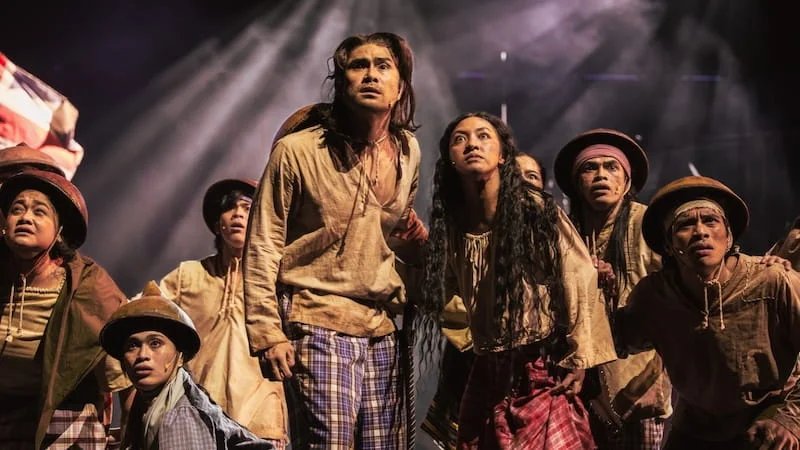
Director Mikko Angeles renders the musical with the grandeur of a myth, with particular focus placed on set pieces and scenes involving the entire ensemble. Even the occasional smaller, lighter sequence—such as the budding romance between Gabriela and Diego, played with charming, enemies-to-lovers angst—is still positioned against Julio Garcia’s formidable set of multi-level platforms. Angeles and Garcia use the height and depth provided by Areté’s Hyundai Hall to create simple but clear visual representations of the distance traveled by the characters or the divisions of power between various Filipino social strata. So no matter what’s happening on stage, the audience is invited to consider which unseen powers are really in control, and which groups of Filipinos are being kept from taking part in conversations about their independence.
With the sheer amount of detail on stage, between JM Cabling’s multicultural choreography and the equally varied costumes by Arvie Santos and Kath Allen Baillo, Gabriela admittedly takes time to find a proper rhythm after a disorienting opening number. The set can feel disorganized with all of the moving elements in this first scene, but once Angeles finds his anchors in Gabriela and Diego, the show’s spectacle is often spellbinding to witness. Meliton Roxas Jr. and Gabo Tolentino’s lights paint across wide expanses of the stage, while Aina Ramolete’s puppets take on the form of delightfully mobile animals, or caricatures of authoritative figures. A mysterious horse that appears to Gabriela throughout the production seems to herald death or destiny, and seeing the horse puppets grow in size and complexity makes for quite the visceral experience.
Achieving harmony
From the outset, Myke Salomon’s score keeps pace with how dynamic things are on stage, busily shifting through a range of sonic influences but in a way that’s always purposeful. Much of the score is inspired by folk music and musical theater, while at key points Salomon introduces brass and electronic instruments. Most importantly, Filipino indigenous music feels like a distinct, essential part of the score rather than being simply a variation of existing motifs. As a body of work meant to express opposing forces eventually achieving harmony, the score maintains a remarkably cohesive, rousing personality.
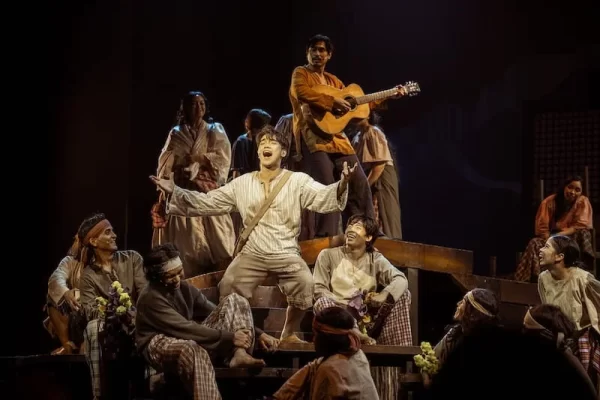
Kerr Allen, CJ Navato, and the cast of Gabriela The Musical; Photo Credit: CJ Ochoa
Similarly deliberate choices can be seen in the performances. As Gabriela herself, Gab Pangilinan embodies the righteous fury of a woman robbed of family, love, and liberty, but she takes care not to let anger flatten the historical figure. Her big, solo musical moments are just raw enough around the edges to introduce doubt into Gabriela’s beliefs. Meanwhile, Salomon plays an appropriately folksy and vulnerable Diego, whose heroism doesn’t appear to come from any innate superiority but from making what he can only believe are the right choices in any given moment.
There are just as many bright spots in Gabriela‘s massive supporting cast, from its 20-person ensemble—constantly switching costumes and cultural expressions, creating the illusion of an endless number of people coming in and out—to several of its featured actors. Delphine Buencamino’s Itneg leader Dawak is an immediately warm, grounding presence. Kerr Allen’s Sebastian elevates what could be a generic role as an occasional narrator with real clarity and enthusiasm. Jon Abella struts about with glee as an entertainingly wicked Alcalde, while CJ Navato’s Miguel Vicos represents the tragedy of Spanish colonialism deceiving Filipinos into becoming Judases to each other—at least until the second act reduces Vicos into a moustache-twirling villain.
The journey within
Vicos becomes a reminder of the battles that Gabriela just couldn’t win, but the character’s abrupt transformation is also indicative of Pat Valera’s book buckling under the weight of all its story. The musical takes shortcuts elsewhere: for one, Diego’s choice to ally with the British against the Spanish during the Seven Years’ War is treated as a deep betrayal, but the script doesn’t let this linger as a prominent source of conflict. And while it’s wise for Valera not to portray Gabriela’s execution—ending her story instead in a call for solidarity—the conclusion rings oddly tidy. After such a long journey, the show cuts to a well-intentioned but sudden display of intercultural, inter-faith unity without really showing the hard work of getting there.
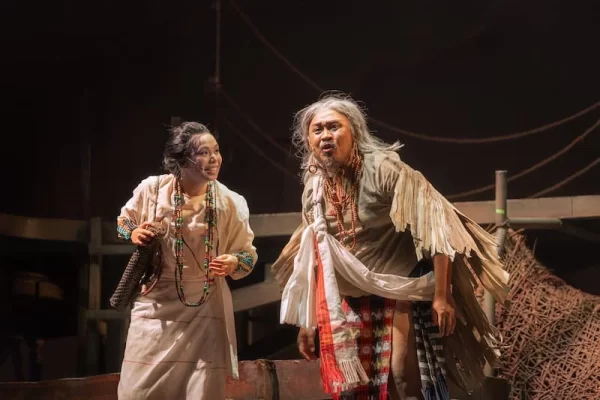
Mikaela Regis as Kunyap/Gimayad, Jasper Jimenez as Tagaben; Photo Credit: CJ Ochoa
And yet, Gabriela‘s active denial of an action-driven narrative is a daring move that pays off greatly. Valera frames the story through Gabriela’s concealed Itneg identity, which he uses to explore hierarchies and infighting among fellow Filipinos, especially along religious lines. Rather than have her find catharsis in avenging Diego’s death, the production has Gabriela take an inner journey for almost the entirety of the second act, offering her peace through reconciliation with her fractured identity. This unexpected change in pace works because it asks us to consider community, particularly with indigenous peoples whose stories are routinely silenced even today. Gabriela’s fury remains righteous but the musical reminds us that anger led with love can’t just destroy, but must construct something new that everyone can share in.
This reviewer watched the 8 PM, November 13 gala performance.
Tickets: P1,299–P3,199
Show Dates: November 13 – December 6, 2026
Venue: Hyundai Hall, Areté, Ateneo de Manila University, Quezon City
Running Time: approximately 3 hours (with a 15-minute intermission)
Company: Barefoot Theatre Collaborative
Creatives: Pat Valera (Book, Lyrics), Myke Salomon (Composition, Lyrics, Musical Direction), Mikko Angeles (Direction), JM Cabling (Choreography), Katte Sabate (Dramaturgy), Missy Maramara (Intimacy Direction), Julio Garcia (Set and Property Design), Meliton Roxas Jr. (Lighting Design), Gabo Tolentino (Lighting Design), Arvy Dimaculangan (Sound Design), Arvie Santos (Costume Design), Kath Allen Baillo (Costume Design), Aina Ramolete (Puppetry Design), Amihan Ramolete-Bonifacio (Puppet Coach), Jaydee Jasa (Wig Design), D Cortezano (Technical Direction), Carlo Gianan (Assistant Direction), Ghie Bernardo (Sound Engineer), Patrick Jusay (Associate Set Design)
Cast: Gab Pangilinan, Myke Salomon, CJ Navato, Kerr Allen, Jasper John Jimenez, Mika Regis, Delphine Buencamino, Carlon Matobato, Jon Abella, Jules dela Paz, Curp Adriano, Joshua Rico Santos, Janji Gamboa, Vincent Sumo, Andre Manguba, Ace Polias, Khalil Tambio, Evan Asuela, Chesko Rodriguez, Ada Tayao, Teetin Villanueva, Ronah dela Peña, Denize Castillo, Mijon Anne Cortez, Lance Reblando, Pappel, Joie Eborde, Karl Salenda, Raphne Catorce, Jherom Villanueva

Comments