
REVIEW: The captivating ‘Karmen 1949’ depicts a woman who is defiant to the last
“The final offering of Areté’s Sa Parang ng Digma season reimagines a classic opera as one woman’s fight to defy conventions in a world that continues to impose limits on her freedom.”
Carmen has always challenged convention. When Georges Bizet’s opera was first performed by the Opéra-Comique in Paris in 1875, audiences were shocked and scandalized by the opera’s risqué themes, realistic characters and tragic ending. The titular character herself had stunned audiences with her brazen attitude and defiance of social norms, her fearlessness and love of freedom representing a new kind of heroine to be depicted on stage.
And yet, after the initial outrage died down, Carmen has since become one of the most celebrated operas of all time, acclaimed for its brilliant music and the authentic and nuanced depiction of characters’ emotions. It has been performed thousands of times all over the world and been adapted in numerous ways on both stage and screen.
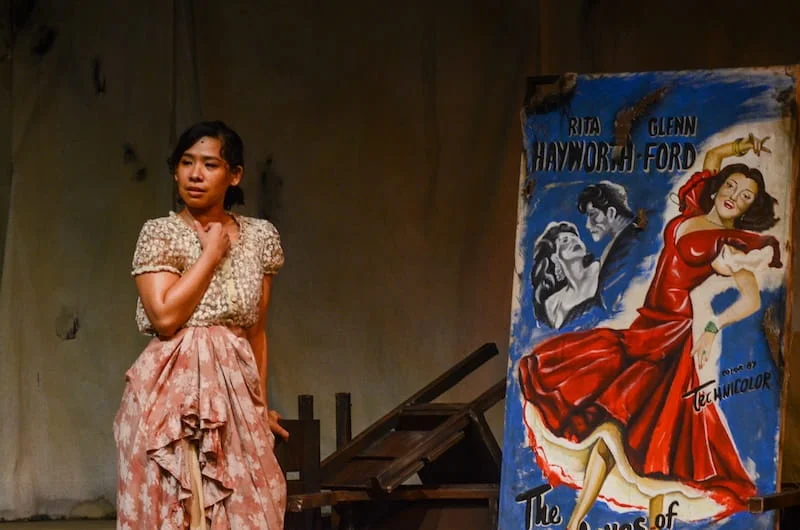
Areté’s Karmen 1949 transfers the action from 19th century Spain to post-war Manila, into a dilapidated movie theater where a young woman (Roxy Aldiosa) admires a poster of the 1948 film The Loves of Carmen starring Rita Hayworth and Glenn Ford. Her companion (Noel Rayos) asks her who she will be this time and she replies that she is determined to follow in Carmen’s footsteps, despite the character’s tragic ending, because she lived and loved without regrets.
Accessible and enthralling
Director Jaime del Mundo and dramaturg Eric V. Dela Cruz have achieved the impressive feat of stripping down a four-act opera to a concise hour-and-a-half musical piece without diluting the source material’s major themes or drastically changing the characters’ motivations. The show takes elements from both Bizet’s opera and Prosper Merimée’s 1845 novella, on which the opera is based. While certain plot points have been merged or removed, such choices have helped streamline the story and emphasize the show’s themes of the destructive forces of jealousy and the liberating power of love.
Farley Asuncion and Angeli Benipayo’s Filipino translation also enhances this production by using words in the vernacular instead of difficult or archaic expressions, which facilitates the audience’s immersion in this new world. Familiar melodies paired with everyday language help ensure that the show’s messages are conveyed more effectively. Hearing Aldiosa enchant the audience with a Filipino version of “Habanera”, for instance, makes the iconic song feel even more impactful.
The show is also filled with genuinely thrilling moments, from a vicious catfight between Karmen and Micaela (Angeli Benipayo) – complete with teleserye-style hairpulling – to tension-inducing duels between Jose and Karmen’s other lovers (fight choreography by Brian Sy). The stakes are never downplayed as the violence the characters inflict on each other becomes reflective of the chaotic world they still reside in and the recency of the devastating war they had all just survived.
A multilayered performance
Aldiosa delivers a tour de force performance as the titular character. Her Karmen sets the stage ablaze with her powerful vocals, undeniable stage presence, and sultry moves. Aldiosa’s portrayal contains multitudes: a survivor, a woman in love, a seductress, a grieving wife, and someone seeking to make her own way in a world that is reinventing itself after decades of conflict.
It is implied in this version of the story that she is a sex worker, but the narrative does not seem to criticize her for such a profession. Here is a woman who loves fiercely and freely. Her very existence is a challenge to the norm, and she remains defiant to the last.
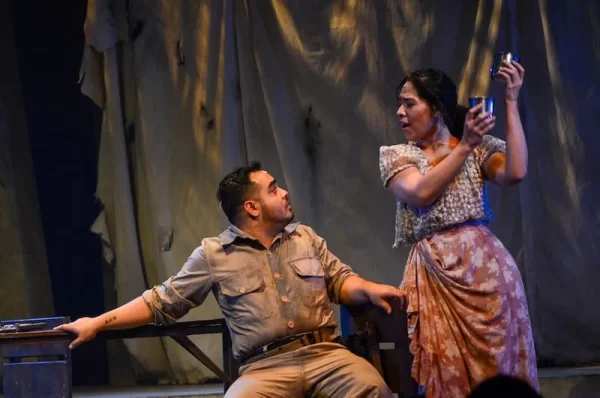
Bryan Homecillo (Jose), Roxy Aldiosa (Karmen); Photo Credit: Irvin Arénas
She shares sizzling chemistry with s Jose, a Philippine Constabulary officer who becomes her lover. Homecillo impressively shifts from naïveté and lovesickness to an obsessive and destructive jealousy. This version of the story makes Jose an Ilocano and Karmen a Waray. Zuniga (Brian Sy) mentions that Jose’s association with her is problematic, but the specific tensions and complications that can arise from this kind of relationship are not very explicitly explored in this piece.
Lives in ruins
Manila was one of the most devastated cities of the Second World War and the remnants of that destruction are evident in this piece. Sarah Facuri’s set confines the characters to a dingy, dimly lit room that transforms from a dilapidated movie theater with a screen riddled with holes to a shabby tavern, with old tables and chairs and where smugglers, sex workers, and soldiers gather. There is a certain lived-in quality to this environment that reflects some of the characters’ struggles.
Similar to the original opera, del Mundo focuses on the lives of ordinary people, all trying to make sense of the new order of things after centuries of oppression and control. The men mostly sport old military or constabulary uniforms while the women dress in plain clothing, no glitz and glamor here (makeup and costume design by Carlo Pagunaling). Jethro Nibaten’s lighting helps make certain musical moments stand out, spotlighting characters as they perform some of the opera’s most iconic songs and subtly changing the light to show shifts in emotional tone.
Benipayo’s Micaela serves as an interesting foil for Karmen, as Jose’s childhood sweetheart and a dutiful, pious young woman in contrast to the free-spirited and daring Karmen. While Jose’s repeated rejection of Micaela is the character’s tragedy, Benipayo’s beautiful singing and unassuming presence gives the character some quiet dignity.
Noel Rayos as Lillas Pastia strikes a great balance between profound philosophical musings on fate and comic relief, particularly when he and Karmen go about entertaining gentlemen-callers. A particularly memorable moment is when Pastia and Jose must cover up for the latter murdering another character by resorting to puppeteering the corpse, Weekend at Bernie’s-style to hide the crime from another person of authority.
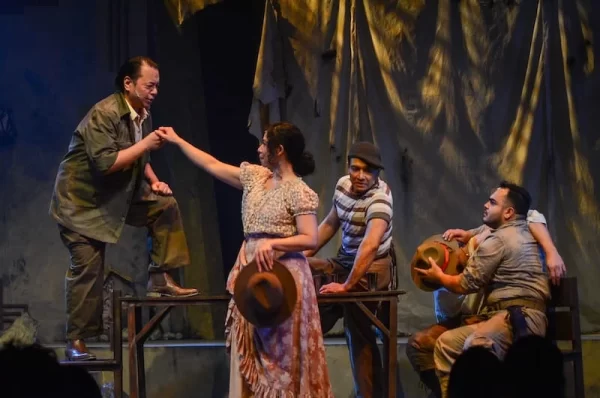
L-R: Ivan Nery, Roxy Aldiosa, Noel Rayos, Bryan Homecillo, Brian Sy; Photo Credit: Irvin Arénas
Ivan Nery is charismatic as Camillo, called the “Toreador” for the specific manner in which he has killed Japanese enemy soldiers. This interpretation of the character is an interesting reimagining of the opera’s character and a great way for Nery to sing his version of the iconic “Toreador song”. Tarek El Tayech makes a brief but impactful appearance as Karmen’s husband, Garcia, who becomes one of the victims of Jose’s jealous rage.
Love and liberty
At the heart of Carmen’s enduring appeal has always been the opera’s complex and fascinating heroine. In every version of this story, Carmen herself is the constant: a woman who is free to do what she pleases and love whom she chooses, consequences be damned.
Karmen 1949’s heroine has survived a war and faced other horrors but refuses to let any of these experiences extinguish her fire. Karmen dares anyone to love her as she is. Whether she will love them back is another matter entirely. Either way, the show reminds us, loving is always worth the risk.
This reviewer watched the 8:00 PM, November 14 show.
Tickets: PHP 2,000
Show Dates: November 13-15, 20-22, 2026
Venue: Doreen Black Box Theater, Areté, Ateneo de Manila University, Quezon City
Running Time: approx. 1 hour and 25 minutes
Producer: Areté
Creatives: Georges Bizet (music), Henri Meilhac, Ludovic Halévy (libretto), Jaime del Mundo (direction), Farley Asuncion (musical direction & translation), Angeli Benipayo (assistant direction & co-translation), Eric V. Dela Cruz (dramaturgy), D Cortezano (technical direction and co-set design), Sarah Facuri (set design), Jethro Nibaten (lighting design), Kabaitan Bautista (sound design and recording engineering), Carlo Pagunaling (costume and makeup design), Brian Sy (fight choreography), Pat Ong (photography), Rio Reyes (graphic design)
Cast: Roxy Aldiosa (Karmen), Bryan Homecillo (Jose), Angeli Benipayo (Micaela), Ivan Nery (Camillo), Brian Sy (Zuniga), Noel Rayos (Lillas Pastia), Tarek El Tayech (Garcia).

Comments