

REVIEW: The intricate ‘Subversive Lives’ preserves a family’s memories of resistance
Areté’s adaptation of the martial law memoir is a uniquely staged production that engages its large, chameleonic cast in telling an essential revolutionary account.
Theater’s capacity for storytelling has never been limited to entertainment or the exploration of characters within defined narratives, as in fiction. Plays often disrupt traditional dramatic structure in favor of more poetic or polemical messaging, or they can take a shape closer to that of non-fiction and journalism, whatever helps deliver their ideas best. Areté’s adaptation of Subversive Lives, the 2012 memoir by Susan F. Quimpo and Nathan Gilbert Quimpo, straddles the line between ensemble-driven drama and historical record—forming a collage of the Quimpo family’s experiences of resistance and survival under martial law, during the dictatorship of President Ferdinand Marcos.
Through the uniqueness of its presentation, the production goes beyond being just a period piece with a large cast. Its layering of different perspectives in both writing and performance, and its invitation to audiences to engage with the show in a more active manner, make this a work that is very much about the process of memorializing. There is a cumulative effect to watching it; as each actor begins to take on an impressive number of new roles and as the script dispenses more and more detail, we are given a formidable account of all these aspects of a revolutionary movement, and a vivid portrait of family bonds holding fast amid the storm.
From all sides
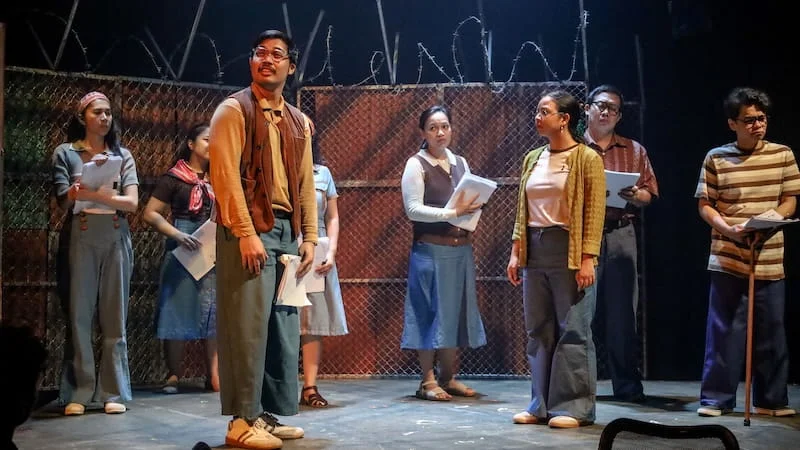
Such density of material naturally seems to call for a unique approach that can better accommodate it. D Cortezano’s set immediately primes the audience for a slightly more participatory experience: the actors traverse four long walkways that enclose most of the audience in a central pit, where they are seated on swivel chairs and are free to turn in their places to choose what to focus on. Given the relatively narrow space offered by the stage, setting and situation are largely established by director Delphine Buencamino’s movement design and by quick, efficient costume changes designed by John Carlo Pagunaling. In what’s proven to be a banner year for plays making especially inventive use of space, Subversive Lives adds to that tapestry by communicating an epic span of time and a breadth of experiences just in the way its characters navigate this 360-degree set.
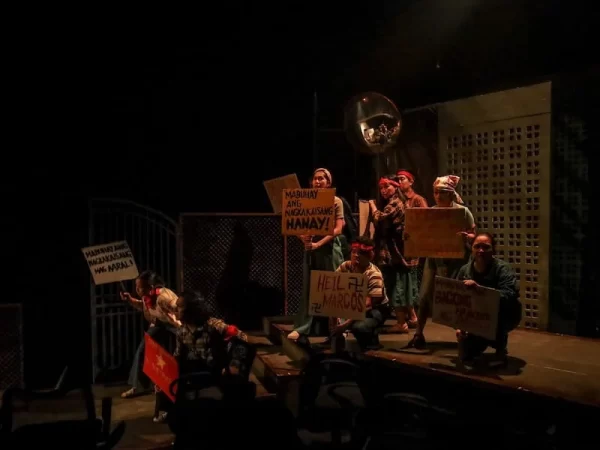
Photo Credit: Myra Ho
With this devised production having still been in partial, continuing development during its opening night performance, it did exhibit inconsistencies that are undoubtedly still being ironed out—in particular, a number of spotlights (designed by Jethro Nibaten) either missed their cues or didn’t match the actors’ blocking. This led to some minor confusion in absorbing all the information being delivered, but didn’t derail the experience by any means. If anything, Nibaten’s lighting makes more striking use of darkness, with the stage mostly kept in low light and shadows, almost as if to help keep the Quimpos’ revolutionary activities clandestine. And mirrors affixed to each corner help notify the audience of any lighting cues behind them, and reflect their act of viewing back to them in the present.
Containing multitudes
The cast takes a particularly active role in juggling the show’s narrative layers—playing a variety of parts across the Quimpos’ individual journeys, regularly alternating between narration and inhabiting a scene, and literally running from one end of the Doreen Black Box Theater to the other. It’s here where Subversive Lives clearly appears as a work constantly in the process of interrogating itself through traumatic memories and providing commentary at a rapid pace. Appropriately, the play is initially framed as the youngest child, Susan (played by Rigel Hechanova), trying to bind her family’s memoirs together, years after martial law.
The performances aren’t always consistent, with some members of this 10-person ensemble slipping into certain roles more comfortably than others. Gino Ramirez, for example, makes for a compellingly gentle Norman (the oldest son) and a number of intimidating military types, but his turn as the Quimpo patriarch doesn’t quite possess the fatherly toughness it calls for. Similarly, Susan is a role that understandably isn’t as prominent, and Hechanova makes her narration more stoic than emotionally involved. And yet, the actors provide such diverse approaches that only emphasize how rich every martial law story is, no matter how small.
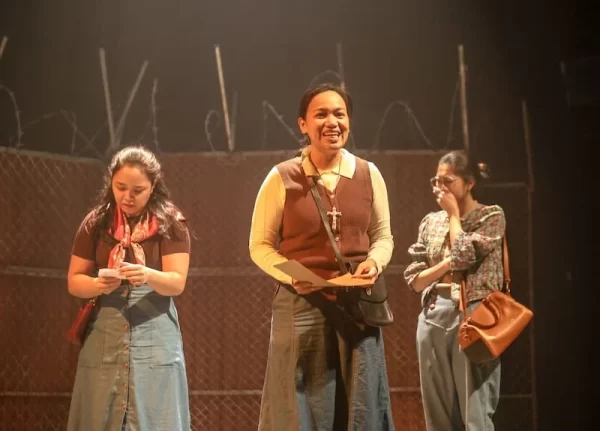
L-R: Teetin Villanueva, Chic San Agustin-de Guzman, Liway Perez; Photo Credit: Myra Ho
Hechanova and Ramirez still provide solid, chameleonic supporting work alongside Neomi Gonzales, Teetin Villanueva, Liway Perez, and Jerome Dawis. As a powerful second-act emotional anchor, Chic San Agustin-de Guzman’s Emilie—an Opus Dei member—carries an especially urgent, extended sequence that culminates in both disillusionment and newfound resolve. Jerom Canlas’ Nathan (or Sonny) and Joshua Tayco’s Jan drive much of the first act, with their eagerness to organize resulting in horrific torture and the shattering of their youthful idealism. And as the polio-stricken Ryan, Timothy Castillo expresses personal tragedy and a complex sense of duty in every word he articulates, with Ryan’s every action capable of being traced back to a moving, beautifully choreographed flashback to his childhood.
Memories of resistance
Buencamino’s handling of all these seemingly disparate elements is a major feat, even just logistically speaking: there’s a great balance of “static” and mobile scenes that never lets the overall feeling of urgency stagnate. Movement around the set is never exhausting to follow, and from the actors’ physical distance from each other on stage, one can feel how each character’s individual battle is so vastly different compared to the rest. And as Subversive Lives continues giving us more information—with remarkably clear sound design by Arvy Dimaculangan—the emotional swell at its center only grows. Rather than overwhelm, the production’s constant reportage (with dramaturgy and libretto by Sabrina Basilio) succeeds at bringing us closer to our present-day encounters against authoritarianism.
If Subversive Lives almost seems stubborn in its use of direct address (instead of maintaining the proverbial fourth wall), its insistence on facing the audience carries great purpose. In a time when disinformation has become more rampant and the spread of fascism relies on faulty collective memory and faultier institutions that fail to uphold truth, the play’s decision to “tell, not show” much of its story is absolutely necessary. It paints a stunning picture of all the intricacies of revolution and the dynamics of a family that keeps falling back into orbit around each other, but it’s just as rousing as an assertion that memories of resistance must be preserved and proudly upheld, now more than ever.
This reviewer watched the 7:30 PM, August 28 performance.
Tickets: P1,500–1,800
Show Dates: August 28 – September 6, 2026
Venue: Doreen Black Box Theater, Areté, Ateneo de Manila University, Quezon City
Running Time: approximately 2 hours and 40 minutes (with a 15-minute intermission)
Company: Areté
Creatives: Delphine Buencamino (Direction, Movement Design), Cholo Ledesma (Assistant Direction), Sabrina Basilio (Dramaturgy, Libretto), Jose Buencamino (Composition), John Carlo Pagunaling (Costume Design), D Cortezano (Set Design), Arvy Dimaculangan (Sound Design), Jethro Nibaten (Lighting Design)
Cast: Neomi Gonzales, Gino Ramirez, Chic San Agustin-de Guzman, Teetin Villanueva, Liway Perez, Jerom Canlas, Joshua Tayco, Timothy Castillo, Jerome Dawis, Rigel Hechanova, Ethan King, Kyrie Samodio

Comments