

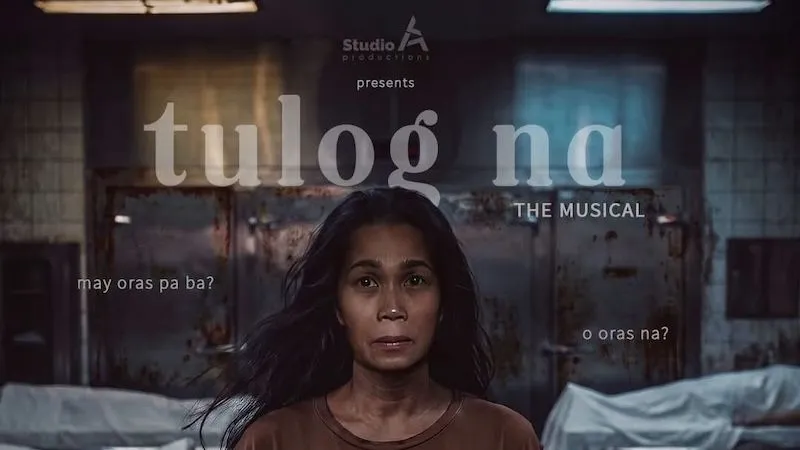
REVIEW: ‘Tulog Na The Musical’ is a rude awakening to what theater might become
Theater is not just a show presented to an audience for the price of a ticket. If we treat it like so, this live exercise of human craft and human witnessing, will become mere commodity.
What makes a musical? For company Studio A Productions, it is to add about an hour’s worth of short songs to a play you’ve already previously staged to add to the running time. That seems to be it. It doesn’t seem to be to add musicality, because rare, if any, are the songs longer than a minute each. They are barely varied in how they are constructed; they do not come together to add to nor define the story’s identity.
Each of these extraordinarily short songs is often a solo, and if they’re not, they’re devoid of much harmony. If I were to describe the musical style of Tulog Na, I would say that outside of the inexplicably baroque-ish overture and the folk-lullaby of the cast singing (in one melody) Sugarfree’s “Tulog Na” as the final number, the rest of the music are nondescript, overwrought forgettable ballads.
A substandard debut
If this is JR Dee’s (Studio A’s purported composer) debut work in Philippine theater’s landscape, it’s a substandard one. But, considering Studio A hasn’t even repeated this name outside of giving it to TheaterFansManila.com when requested for a complete creative team for proper attribution and instead publicly credits itself as the amorphous composer and librettist of this show, one has to wonder the methodology of how they came up with music so mono-styled, simplistic, and unchallenging.
Though I have a theory as to how, let me just say that composers who write musicals understand that each song and production number is to convey human emotions that can sometimes be and feel larger than life, and the only way for them to convey the true gravity of feeling is to get out of reality and present it in the most human of ways: through song. The songs in Tulog Na, however, are wholly unnecessary. All of them can be removed and the show, though not much better off, will at least be mercifully shorter than its current self-indulgent running time.
Mad world
Musicals also involve a level of worldbuilding. It must, in order for audiences to be taken into a world where persons conceivably break out into song and dance. Tulog Na‘s world takes us to a decrepit, dilapidated, unsterile morgue manned largely by a harangued, daster-clad woman, married to a persistent idler who nevertheless owns a possibly successful morgue, considering there would be ten bodies on its slabs for the unnecessary three hours this musical will take to tell its story.
The set by Jef Albea (also director and costume designer), illogical as it may be designed, is the only place where there seems to be texture in this whole thing. Elsewhere, in all its other elements, there’s not much variance or nuance that doesn’t swing big between peddling the audience for laughs, or get a reaction through melodrama.
Dead on arrival
Tulog Na is a musical about ten corpses in a morgue reanimating as they tell each other the story of their lives and deaths. All of these ten corpses get introduced and therefore resolved. To call each of them a caricature or an archetype would be generous. These characters are mere tropes that play into preconceived, problematic, and tired cliches one might vaguely have of them.
The gay man is revealed to be homosexual by ripping open his button-down and showing audiences he’s wearing a bralette underneath. The beggar is not just in ratty clothes, she is also erratic. The student, who liked to party, is also loud and obnoxious. The hijabi OFW is a domestic worker who fell in love with her employer. The old woman can’t remember how she died or indeed how she lived. The young child has died of a tragic childhood illness.
It’s not that people don’t have these stories, but in the most human exercise of theater-making, people with these stories are not flattened to this degree: that every oddity of their individual tropes is made the brunt of the joke until their dramatic, and overwrought solos. They are each of them so underdeveloped that if you felt for these characters, it wasn’t because you connected to these stories or got to know them, but because the show was delivering you sob story after sob story.
The student who liked to party was gang-raped after a night of partying too hard. The hijabi OFW died at the hands of her employer’s jealous wife. A quiet, goody-two-shoes girl died after attempting a back-alley abortion. The pretty influencer died by suicide and was ruthlessly, over-dramatically, victim-blamed for it.
The way these characters were presented in this show, they seem to be put together as though only approximations of what characters with such lived experience might think or behave. As though Danna Bernardino, credited as writer, put these character tropes together to invite audiences to judge their life choices and perhaps find it understandable that they died the way they did. There’s little human empathy going around in this ghoulish morgue.
Broad approach
The first act was mostly all banter, but curiously, if there were ten characters on stage, all of them have the same humor and make similar jabs to one another. The jokes are thrown about willy-nilly, appealing to the lowest common denominator, and probabilistic in eliciting a laugh: if they made three hundred jokes to three hundred people, chances are of course on their side.
The dramatic scenes are just as bad, having the human impact of a touching TikTok. They’re all brief and immediately intensely emotional and, like its humor, grasping at what is visceral and immediately understandable to get a reaction. From how I experienced the audience, the show certainly got engagement, but engagement is different from being engaged, or even engaging with the material in front of them.
And of Pokwang, whose theater debut is lamentably this? She performs competently though her talents were used merely to show what she has shown before: a harangued, naggish everywoman hard-done by a husband, performing emotionality in moments called for it. She flits on and off stage like a star cameo mostly in service of a tired twist that, for all its lack of logic, was also deeply predictable.
The sound (EJ Baliton) was overly, unnecessarily loud; the music, despite being played pre-recorded tracks, still often overpowers the actors. Transitions rely only on the lights cutting completely for the stage to reset for the next scene.
It was, all in all, a meandering, overly long experience. Tulog Na, the title says, as though urging audiences to rest easy as Studio A pumps out and markets its brand of plays and musicals. They’ve produced nine original theater productions in the span of two short years, and are reportedly to stage another original musical just a couple of short months after this one closes. One wonders if the mysterious JR Dee is the music and lyrics person of that one, too.
But maybe to rest easy is precisely what we, theater fans, ought not to do. Instead, we might be better served to wake up to such ways of theater-making where new companies can put together shows and musicals at a rapid pace, yet have no face to show as composer as they churn out these full-length musicals.
Theater is not just a show presented to an audience for the price of a ticket. If we treat it like so, this live exercise of human craft and human witnessing, will become mere commodity.
This reviewer watched the August 21, 3:00 PM show.
Tickets: Php 1,000 – Php 3,800
Show Dates: August 14 to September 13
Venue: Power Mac Center Spotlight, Circuit, Makati and Carlos P. Romulo Auditorium, RCBC Plaza, Makati
Running Time: approx. 3 hours (w/ 15-minute intermission)
Producer: Studio A Productions
Creatives: Danna Bernardino (Written By), Jef Albea (Director, Costume Designer, and Set Designer), Mark Albea (Lighting Designer), EJ Baliton (Sound Designer), JR Dee (Music and Lyrics)
Cast: Pokwang, Cherry Morena, Cary Faith Rodolfo, Jeremy Manite, Primitivo Moscare, Nicollo Gutierrez, Farrah Era, Znaida Sevilla, Jimson Buenagua, Rachel May Lagad, Eunice Somintac, Kaiser Cortina, Jude Gamaliel Tan, Geanne Del Monte, Jena Venderson, Len Venderson

Comments