

REVIEW: ‘A Midsummer Night’s Dream’ champions women’s agency with rollicking comedy
The Playbook Club’s highly entertaining restaging of this all-female-led version of the Shakespeare play features a brilliantly funny cast and big ideas on its mind.
The things that people consider funny may change over centuries, but comedy itself still tends to serve the same purposes: offering relief from everyday concerns, commenting on human experiences, or speaking truth to powerful institutions. Shakespearean comedies are likewise just as capable of holding up a mirror to society after 400 years, even in their original language and with Shakespeare’s habit of having them conclude in marriage. And A Midsummer Night’s Dream is a particularly strange example that’s proven incredibly flexible to interpretation over time—following a love square between four Athenians, the coming wedding of the Duke of Athens to the Queen of the Amazons, a play-within-the-play being mounted by a group of laborers, and the fairies who create mischief for them all.
In this all-female-led production (originally staged in 2023), The Playbook Club knows that it doesn’t need to accommodate every perspective that’s been imposed on the story. Instead, it wisely focuses its energy on bringing out more contemporary feminist ideas from the play, altering small but key parts in the text while retaining its core themes and comic devices. It’s also just a highly entertaining time at the theater, with a real spirit of playfulness running through it and a brilliantly funny cast that gives every role its own distinct color.
Playing make-believe
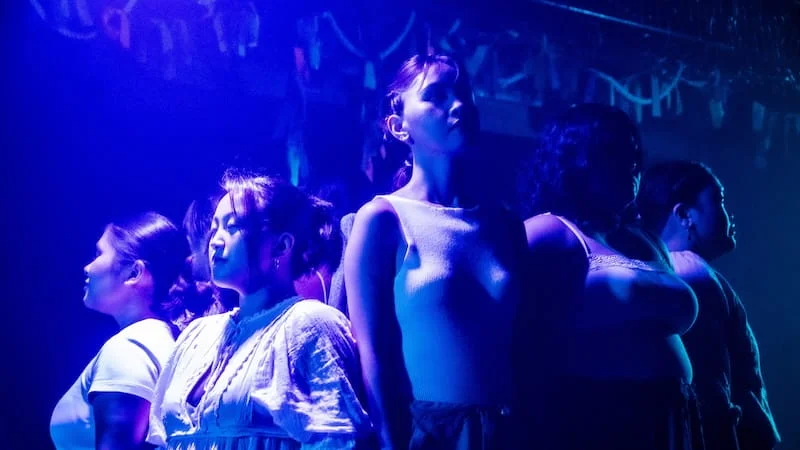
Given the sheer number of characters and subplots in A Midsummer Night’s Dream, it’s no small feat that director Nelsito Gomez makes such a coherent, breezy show out of it, even with a smaller ensemble constantly cycling through multiple roles. There’s a sense that the characters really are just playing make-believe in makeshift costumes, running around the multi-platform, in-the-round stage draped in nets and ropes of cloth. Sarah Facuri’s whimsical production design mixes slinkies, string lights, and colorful spots of makeup with more modern, anachronistic touches—all going a long way to ground the production in more hopeful sentiments. And Rafa Sumilong’s lighting casts a constant, dreamlike glow throughout, at least until certain striking moments towards the end sharpen the drama into a sudden suggestion of tragedy simmering underneath.
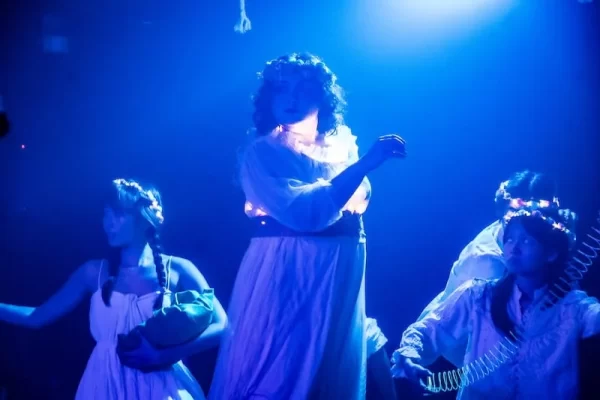
L-R: Chez Cuenca, Mijon Cortez, Teia Contreras; Photo Credit: Elena Christine
The more serious scenes that bookend the show are a stark reminder of a harsher reality that comedy can ease but never fully resolve. Crucial to this production is the relationship between Theseus and Hippolyta, which is made more complicated if not outright hostile. Even for these more powerful figures, marriage is no longer the greatest ideal to strive towards. And yet this never robs the comedy of its effectiveness; the play still succeeds as fast-paced, knowingly silly entertainment in which Gomez puts a wide variety of comedic styles to use. Physical comedy, wordplay, the use of voices, situational comedy, and audience participation all help emphasize that what we’re seeing is just an illusion. There’s comfort in this sentiment, but the clarity we gain from comedy should also spur us to action in this reality.
A woman’s fate
What this Midsummer Night’s Dream ultimately champions, through the help of its all-female casting, is a woman’s right to choose her own fate. Nearly all the characters are tricked, or halfheartedly proceed, into relationships. For some, this is merely treated as an amusing misunderstanding; for others, the loss of agency is dehumanizing. By having every character be played by a woman—and by modifying Puck’s famous final monologue so that it is now explicitly about women, recited by the entire cast—the show emphasizes that the experiences depicted here are overwhelmingly experienced by women even today. There are also definitely queer readings to be made, and the production’s insistence on retaining male pronouns for the male characters played by women can either be an expression of fluidity, or a reminder that patriarchal norms (such as the gendered Athenian marriage laws invoked at the beginning) still cast a shadow over this story.
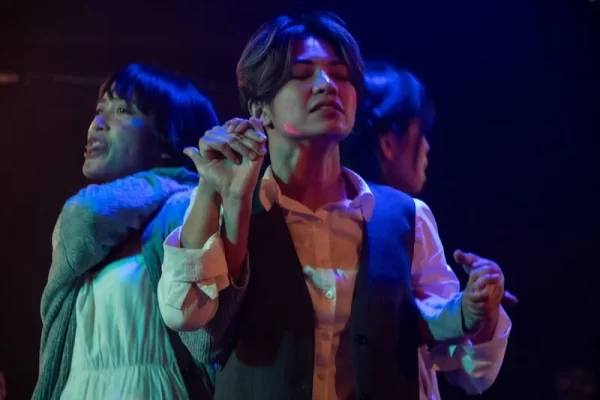
L-R: Chez Cuenca, Leanne; Photo Credit: Elena Christine
Admittedly, the allegory isn’t seamless. But there’s something to be admired in how The Playbook Club doesn’t ever dismiss Shakespeare as outdated, while still pursuing its own vision with good humor and more dignity granted to a number of its characters. Notably, there’s a slight shift in tone to the Mechanicals (the laborers creating the play-within-the-play): rather than simply being incompetent, they do seem to be earnestly trying to do their best. By the end, they prove themselves still capable of moving hearts with theater and storytelling. Hippolyta, in particular, sees through their inexperience and lack of skill and finds a kernel of truth that she nevertheless is able to take with her and potentially use for her own life.
Committing to the bit
As much as the characters in this play have arguably been made more sympathetic than usual, the ensemble also understands how to approach broad comedy with confidence, while setting Shakespeare’s language to a more contemporary cadence whenever needed. There are maybe one too many uses of Justin Bieber’s “Beauty and a Beat” in the show, but otherwise the actors get plenty of varied opportunities to have their own moments: Chez Cuenca’s Helena becoming feral for Demetrius’ love, the exasperation of Leanne’s Demetrius in response, and Barbara Jance with a supply of perfectly timed side comments as Peter Quince—mostly aimed at the single-minded delusions of confidence of Philomena Yap’s Nick Bottom. Even the mystical fairies are shown to be just as capable of silliness as the humans: Nikki Bengzon’s Oberon registers as a mad scientist without all the answers, and Dippy Arceo makes for an appropriately folksy Puck.
Several of the strongest comedic moments in this Midsummer Night’s Dream come from Giselle Giorgia’s Tom Snout and the character’s awkward performance-within-a-performance as a wall, and from Mijon Cortez’s brief but powerful showcase of her voice as Titania. And making the most of every second on stage is Teia Contreras, equally hilarious and affecting as both the increasingly aggressive Hermia and the self-deprecating Francis Flute. Through Hermia’s shock at being betrayed and the way Flute mutters and repeatedly hits himself in the head, Contreras manages to quietly package tragedy into her performance. Some of these performance choices may get lost in the rush of things, but they’re the mark of a production that believes in its vision down to the last gesture.
This reviewer watched the 7 PM, August 21 press preview.
Tickets: P1,000–1,600
Show Dates: August 22–23, 2026
Venue: The Mirror Theatre Studio, SJG Centre, Makati City
Running Time: approximately 1 hour and 30 minutes (without intermission)
Company: The Playbook Club
Creatives: William Shakespeare (Playwright), Nelsito Gomez (Director), Sarah Facuri (Production Design), Rafa Sumilong (Lighting Design), EJ Ramos (Assistant Lighting Design), Uriel Tibayan (Sound Design)
Cast: Nikki Bengzon, Mijon Cortez, Teia Contreras, Chez Cuenca, Giselle Giorgia, Leanne, Barbara Jance, Dippy Arceo, Philomena Yap

Comments