

REVIEW: ‘Andres KKK’ Reclaims a Revolutionary Legacy
In Philippine Ballet Theatre’s (PBT) repertoire, few commissioned works have the historical importance, emotional power and choreographic value of Gener Caringal’s Andres KKK. Debuted in 1996 for the centennial of the Philippine Revolution, it remains relevant because Caringal exposes the fractious nature of Philippine politics and how Filipinos can become their own worst enemies.
With a libretto by Lilia Quindoza Santiago, Andres KKK: Ang Buhay at Pag-ibig ni Andres Bonifacio traces the rise and fall of the plebeian revolutionary amid ego and power struggles.
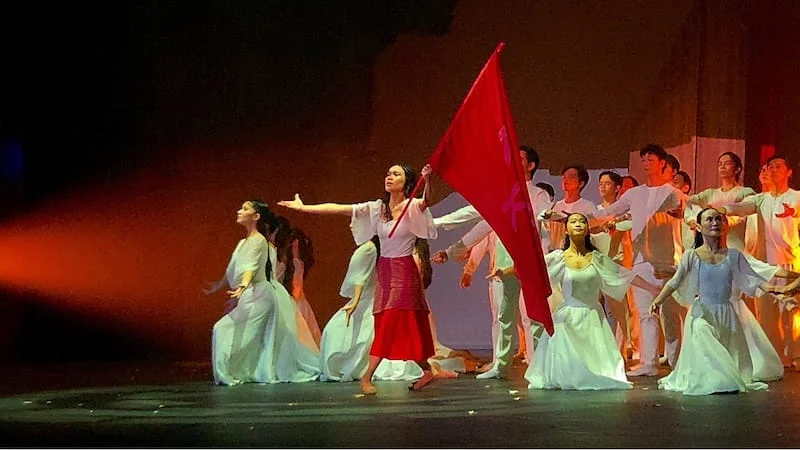
Reform had failed to bring meaningful change, pushing Andrés Bonifacio toward revolution. He helped build the Katipunan, formally known as the Kataas-taasan, Kagalang-galang na Katipunan ng mga Anak ng Bayan (KKK), which drew workers, peasants and other Filipinos into the fight to end Spanish rule. The Spaniards’ discovery of the secret society in 1896 pushed the Katipuneros into open revolt. In August, Bonifacio gathered them in the Caloocan area, where they tore up their cédulas, the tax certificates that served as identity papers. The act became known as the Cry of Balintawak.
Bonifacio’s early attacks on Spanish forces suffered serious setbacks, particularly around Manila and Cavite. His greater achievement was political. He transformed a secret society into a revolutionary movement with support across the country.
But the revolution fractured. When Emilio Aguinaldo and his Magdalo faction assumed leadership after the Tejeros Convention, Bonifacio rejected the change and challenged the new government. Aguinaldo later ordered his execution, eliminating a competing claim to power.
Throughout the turmoil, Gregoria de Jesus, known as Oryang, served as the Katipunan’s Lakambini, an active revolutionary.
CRY OF BALINTAWAK
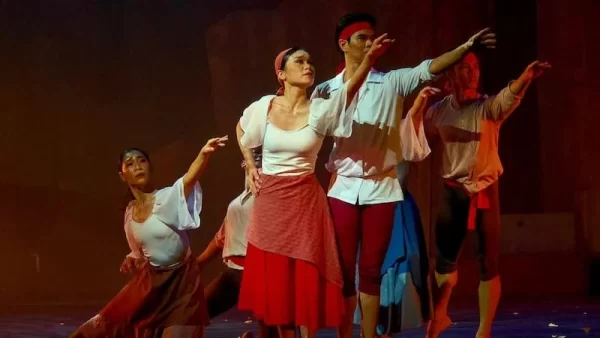
Oryang (Eloisa Jessa Tangalin), Andrés Bonifacio (Matthew Davo), and the cast of Andres KKK Photo Credit: Teddy Pelaez
Caringal’s production is tight. It opens with Guillermo Tolentino’s Bonifacio Monument, its 23 brass figures gathered before an obelisk. The focus closes in on their angry faces before the monument transforms into a stylized tableau. Bonifacio, played by Matthew Davo, holds out his arms and walks toward the audience in despair, as if wondering how the Philippines has reached such a pathetic state.
He circles back into a solo interpreting Bonifacio’s poem Pag-ibig sa Tinubuang Lupa (Love for the Native Land), heard in a now-faint recording by actor Jonee Gamboa.
Composer Jesse Lucas structures the score around Caringal’s narrative, combining indigenous Filipino instruments, guitars, chants and synthesizers.
Caringal shows two sides of Bonifacio: the private Andres, in love with Oryang, and the proletarian revolutionary leader. He does not try to Filipinize the visual language. He uses familiar modern dance movement and stage gestures, giving the dancers room to find emotion through natural breathing, weight and gravity.
The pas de deux between Bonifacio and Oryang feels intimate rather than showy. One yields while the other leads. Unlike classical ballet, where the danseur usually supports the ballerina, Bonifacio often initiates the movement and directs the action.
The guitar maintains an even, unhurried pulse, giving the dancers time to linger, roll across the floor and move through balanced rotational lifts. At one point, Andres holds Oryang nearly horizontal, her body slack against his, and guides her around his body. Weight-sharing and counterbalance make their dependence physical.
The choreography moves from floor work to walking, turning and lifts. Oryang’s red skirt adds another layer of movement, flickering as she turns and travels. For audiences weary of acrobatic pas de deux, Caringal offers something more meaningful. The partnering flows in and out of the dancing instead of becoming a display of virtuosity. The recurring movement of bodies going down to the floor and getting back up gives the duet a dramatic edge.
THRUSTING BOLOS
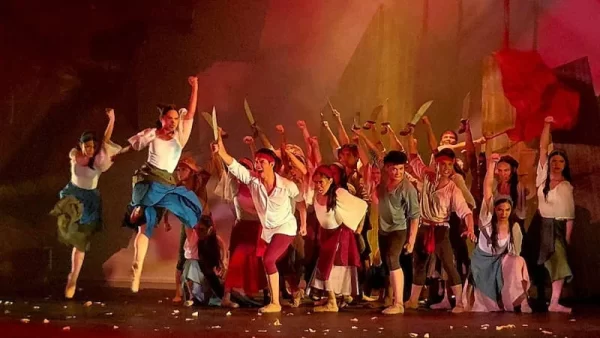
The cast of Andres KKK; Photo Credit: Teddy Pelaez
The Katipuneros’ ensemble dancing is the physical opposite. Deep lunges, wide stances, sudden changes of level, floor work and thrusting gestures give the movement weight and resistance. The dancers propel themselves forward, then pull back and regroup. Caringal repeatedly brings different groups into formations, then breaks them apart. The movement feels combative, as if their bodies are enacting resistance, struggle and confrontation. This is not private emotion but a collective body.
Lucas’ percussion and brass score follows the choreography closely. Musical accents hit the jumps, contractions and releases, suspended turns, the bolo tracing an arc across the floor, the arabesques and kicks. Even the Katipuneros’ chasing feet that form a circle quicken with the rhythm. When the rebels raise their bolos, a musical cue punctuates the gesture, sending the Katipuneras leaping onto the stage.
The contrast with the pas de deux is striking, but the two sections come from the same dramatic vocabulary. The duet is melodic, sustained and fluid. The Katipunero section is rhythmic, percussive and propulsive. In the duet, the melody lets the bodies flow through partnering. The rhythm creates collective force as the dancers attack the beat with their bodies.
Lucas gives each section its emotional and physical character, while Caringal turns the music into different kinds of human relationships. The pas de deux turns love into a physical union, while the Katipunero dance transforms shared purpose into collective force. Both express the individual becoming part of something larger than himself
That makes the contrast between Caringal’s choreography and Lucas’ music interesting. Caringal uses modern dance rather than an immediately recognizable Filipino movement vocabulary to portray revolution. Lucas makes the Filipino identity of the music much more explicit, weaving indigenous sounds into his score.
Caringal keeps returning to the image of bodies gathering into tight formations. The individual disappears into the group. It is a simple but effective picture of mass revolt.
BEYOND NOSTALGIA
The same sense of connection carries into the leads. Andres KKK brings out the strengths of Matthew Davo and Jessa Tangalin. Davo has long been a reliable choice for leading roles. Ballerinas seem comfortable with him because he is polite, attentive and secure as a partner. With Tangalin, he does not simply mark the counts. They ride the musical phrasing, allowing the partnering to breathe with the score.
Still, Davo can be too restrained. When he lets go, however, he can suddenly surprise, whether in a suspended leap or a clean renversé, a turn in which the body tilts backward away from the supporting leg. A deeper reading of Gamboa’s recording, along with more research into Bonifacio himself, could have helped him go further. Bonifacio was a warehouse worker and a theater actor. Davo could have given a more expansive and grounded physicality than being his usual reserved ballet hero.
Tangalin, meanwhile, disappears into Oryang. Her technique is solid, but she never lets it get in the way of the character. This becomes particularly powerful when Oryang confronts the Magdalo soldiers and asks where her husband is.
Caringal does not stage her rape scene literally. Instead, the choreography makes the power imbalance painfully clear. Oryang is assaulted on the ground, reduced to a body under male control. Then she is passed from one soldier to another in an overhead lift, her fragile body suspended above them. The image is disturbing without being graphic. Tangalin’s intensity makes the audience feel the violation, the shock of losing her husband and, later, the strange relief when Andres returns to her in a vision.
The PBT ensemble, joined by dancers from the UE Silanganan Dance Troupe, is at its best in Caringal’s choreography. There is a natural fit between the movement and the dancers. They commit fully to the gestures. The ensemble work has a sense of purpose without looking overly manufactured. They dance as a group, but individual personalities still come through.
That strength makes the revival of Andres KKK significant. PBT has been adding newer works to its repertoire, but returning to Caringal reconnects the company with a defining part of its history. Along with Vinta, Andres KKK has become one of the works that carries PBT’s particular stamp.
The value of such revivals goes beyond nostalgia. Dancers who were part of the original production have passed down their memories and Caringal’s movement language to younger generations. Audiences, too, develop a relationship with works they have seen over the years. A company needs that continuity. Otherwise, each new season risks wiping out what came before.
For PBT, its legacy repertoire is not simply something to preserve. It is a reminder of what makes the company distinctive: dancers performing works created with their particular strengths in mind, and a Filipino choreographic voice that belongs to them.
Tickets: P3,000 (Orchestra) and P2,000 (Dress Circle)
Show Dates:August 22 at 3 PM and 7 PM; August 23 at 3 PM
Venue: Proscenium Theater, Rockwell
Running Time:
Producer: Philippine Ballet Theatre
Creatives: Ronilo Jaynario (artistic director), Anatoli Panasyukov (ballet master), Gener Caringal (choreographer and production designer), Jesse Lucas (composer), Lilia Quindoza Santiago (librettist), Roldan Lozano (lighting designer)
Featured Cast:
Andres: Matthew Davo/ Dominador Delmo
Oryang: Eloisa Jessa Tangalin/ Sophia Martina Tiangco
Procopio: Justine Joseph Orande
Ciriaco: Dexter Igares
Padre Mariano Gil: Ramon Igares Jr.
Teodoro Patinio: Julafer Fegarido
Honoria: Gladys Babayan
Governor General: Jimmy Lumba

Comments