

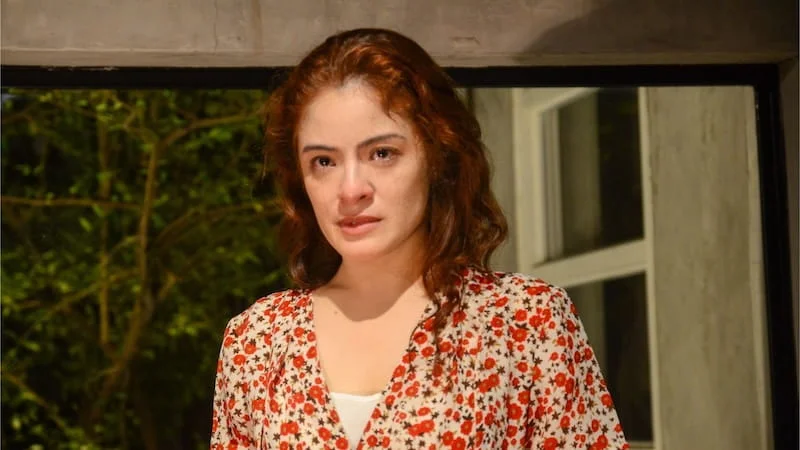
REVIEW: ‘El Fuego del Alma’ is a dark romance told in a uniquely immersive space
Porvenir’s full staging of Tennessee Williams’ ‘Summer and Smoke’ utilizes its makeshift theater to amplify its rich themes and deepen its ensemble’s nuanced performances.
Leave it to small production companies and fringe artists to remind us that theater in Manila need not be restricted to the same dozen venues where most shows today are performed. Porvenir’s El Fuego del Alma—a Filipino translation of Tennessee Williams’ Summer and Smoke—serves as a particularly inspired example of a play that fully integrates its physical space into its storytelling. The production is staged at Sine Pop in Quezon City, a post-war house that has been converted into a microcinema and events space. But rather than build a traditional stage within or use the venue’s own movie theater, Porvenir’s artistic team sets the drama within and around Sine Pop’s lounge area, left generally untouched.
The result is a uniquely immersive show that allows the house itself to amplify the script’s already rich themes. Williams’ story (translated by Eljay Castro Deldoc) follows Alma, a preacher’s daughter, whose principles and perception of herself are challenged as she finds herself drawn increasingly closer to the young doctor living next door. In such an intimate setting, the play’s uniformly strong cast magnifies these characters’ internal changes with an even greater sense of urgency. And through Mark Mirando’s direction and inventive use of this makeshift theater, the production begins to feel like a tale told through memories and wandering ghosts.
Repressed world
The world created by Williams’ original script and Deldoc’s translation is plenty haunting on its own, as Alma’s provincial town becomes characterized mainly by the social rules that keep its characters repressed. Religion and medicine are introduced early on, less as means of salvation and more as vessels through which the family patriarchs impose their ideals onto their children. This gives both Alma and the young doctor, Juanito, reputations to uphold, and so both of them also naturally become the subject of town gossip. But in spite of the things they have in common, the two protagonists can only really meet through small interactions that are nevertheless charged with passion and sexual tension. Having these scenes play out in such close quarters in a kind of domestic setting only heightens how “scandalous” they’re meant to be in the world of the story.
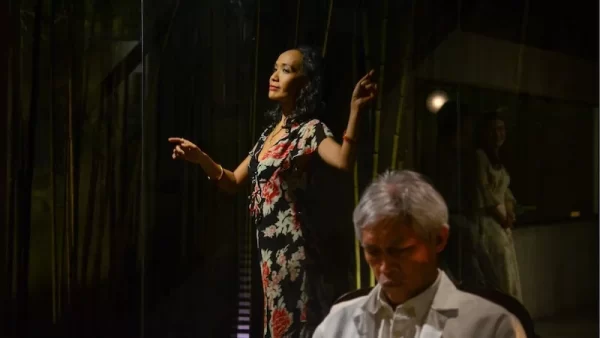
Opaline Santos (Rosa), Rolando Inocencio (Dok Yago); Photo Credit: Irvin Arenas
The larger ideas of El Fuego del Alma are admittedly more compelling than the actual plot that Williams has laid out. It isn’t necessarily an issue that this story would be considered melodramatic especially by today’s standards; the intrigue is still effective even when the various narrative turns are familiar. But there are times when it feels as if the themes aren’t being actively developed through more interesting scenes of conflict, and certain supporting characters can’t help but seem like flat, obligatory additions to the plot rather than clear extensions of the ideas at play. Still, where Alma ends up after all this is entirely earned—even within the show’s narrative limits, the ending she gets is a cathartic, complicated one.
Quiet maturation
Alma’s gradual transformation feels momentous largely because of how she’s performed. Hariette Mozelle (alternating with Nour Hooshmand and Opaline Santos) is remarkably expressive—tracing the entire journey of Alma’s coming of age, from the childlike lilt of her voice when playing the character in her youth to the dam of her emotions breaking at the play’s climax. Mozelle’s every facial feature becomes a new site where Alma can be seen processing everything happening to her, and the character’s poise and commitment to maintaining a traditional, ladylike appearance seems more and more like programming she’s trying to break out of. When Mozelle finally lets the tears flow, it looks like the genuine shattering of one’s self.
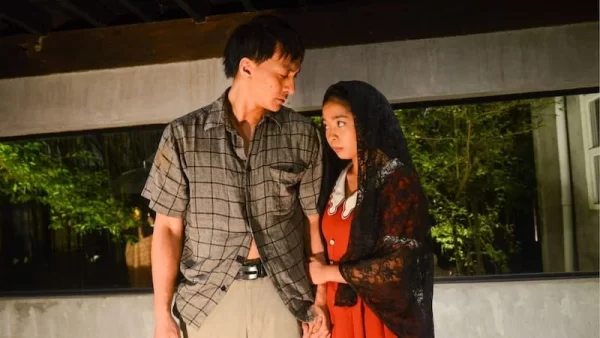
Vincent Pajara (Juanito), Janna Cortes (Nelia); Photo Credit: Irvin Arenas
Juanito, played by Vincent Pajara (alternating with Sandino Martin), goes through a similar journey, as his sullen demeanor eventually hardens into maturity and honesty, albeit through a more self-destructive path. Pajara manages to change the way his silences register, from smug and condescending to sorrowful but at peace with his mistakes. Everyone in El Fuego del Alma‘s cast fills this intimate space well: Rolando Inocencio stands as an ever-present pillar of authority, Janna Cortes’ innocent student Nelia (alternating with Ingrid Villamarin) undergoes her own subtle maturation, Madeleine Nicolas’s earnest Gng. Ortega (alternating with Sheryll Ceasico) acts as a fire alarm for the secrets building up in the town, and Sandino Martin’s salesman Archie (alternating with Pajara and Johnny Maglinao) arrives as an instantly likable breath of fresh air. And in a hypnotic, physical performance, Opaline Santos’ sensual Rosa (alternating with Mozelle) haunts the entire house, even from the peripheries.
Ghosts in the house
Left as it is, Sine Pop already proves to be an evocative location for this story. The performance takes place under the low wooden ceiling of the lounge area, with glass doors to the sides and the audience facing a long picture window looking out into the venue’s miniature bamboo forest. Set designer Ohm David places small angel statues and miniature candles around to evoke a more solemn, somewhat eerie atmosphere—but the actors also achieve this simply by interacting with the space. As they peer in through the window from outside, scamper up the wooden stairs, call out from the second floor, or run around the perimeter of the house to get into position, they almost begin to feel like spirits of a bygone era reliving their memories.
What director Mark Mirando achieves here serves as a real lesson in allowing a narrative to be shaped by a physical location, in a way that isn’t gimmicky. He doesn’t call attention to the uniqueness of his “theater” so much as he immediately gets us to understand what he’s doing with the space. Even with some predictable theater-isms in his direction (e.g. a character pausing at an exit before turning back around), Mirando creates a multilayered, immersive stage that makes intimate moments almost voyeuristic and allows occasional bursts of activity (set to ominous acoustic music designed by Mijon Cortez, played live) to feel like reality folding in on itself. As Mirando has the finale of El Fuego del Alma play out from beyond the audience’s reach, separated by glass, the physical distance still somehow feels like liberation for the ghosts trapped in this house.
This reviewer watched the 7 PM, July 19 performance.
Tickets: P1,800
Show Dates: July 17 – August 23, 2026
Venue: Sine Pop, E. Rodriguez, Quezon City
Running Time: approximately 1 hour and 20 minutes (without intermission)
Company: Porvenir
Creatives: Tennessee Williams (Playwright), Eljay Castro Deldoc (Filipino Adaptation), Mark Mirando (Direction, Dramaturgy), Nour Hooshmand (Associate Direction), Ingrid Villamarin (Assistant Direction), Shenn Apilado (Technical Direction), Ohm David (Set Design), Hershee Tantiado (Costume Design), Gabo Tolentino (Lighting Design), Mijon Cortez (Sound, Music Design), Tristan Bite (Associate Sound and Music Design)
Cast: Nour Hooshmand, Hariette Mozelle, Opaline Santos, Madeleine Nicolas, Sandino Martin, Vincent Pajara, Johnny Maglinao, JP Lopez, Sheryll Ceasico, Ingrid Villamarin, Rolando Inocencio, Janna Cortes, Tristan Bite

Comments