

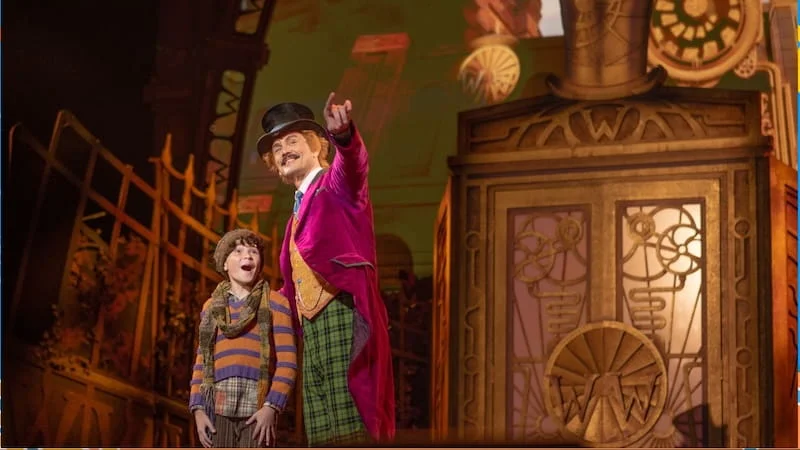
REVIEW: The visually inspired ‘Charlie and the Chocolate Factory’ is a surprisingly dark kids’ adventure
This touring production of the Broadway musical lacks the heart of the Roald Dahl novel, but its special effects and sheer enthusiasm are undeniable.
Both the charm and the challenge to Roald Dahl’s children’s stories are that they often don’t seem to be made only for kids. Arguably his most well-known novel, Charlie and the Chocolate Factory takes the form of a fantasy adventure in which a young, poor boy wins a chance to visit the factory of the enigmatic chocolatier Willy Wonka—only for the story to become a morality tale with especially harsh punishments for its young characters. Depicting this through live performance comes with its own charms and challenges: the spectacle of recreating the magic tricks of Wonka’s world in real time must also balance out the heightened intensity of what these children go through right in front of the audience.
Presented by Broadway International Group and Broadway Asia, this touring production of the 2017 Broadway musical makes strange choices in its adaptation, taking away some of the heart of the original material. And yet the show’s unbridled enthusiasm in telling this story, together with consistently surprising visual effects, allow its sense of wonder to endure even through its more frightening moments.
Bitter and sweet
David Greig’s script for this Charlie and the Chocolate Factory generally sticks close to Dahl’s book, from first-act build-up to the second act’s succession of parable-like set pieces. His dialogue often possesses the same absurd humor as Dahl’s, with frequently funny references and wordplay establishing a world seemingly devoid of any rules—if not for the tenderness and sincerity that the titular character brings. But when the musical arrives at act two, it all but abandons sensitivity for spectacle. Charlie’s family is strangely absent from the ending, and without a full resolution to the narrative, the “naughty” kids are left to suffer even more sadistic fates for their childish misbehavior. With much less character exploration in the second act, even Charlie’s purity of heart becomes secondary to the shock of seeing children getting maimed.
And still, director Matt Lenz (through Jack O’Brien’s original direction) somehow keeps the production highly watchable, moving things along at a brisk pace and tempering its darker qualities with a consistent rhythm to its comedy. Much of the show feels like vaudeville, with a variety of performance styles and physical gags being presented one after the other. Even when you can see where the strings are attached during certain tricks, there’s real excitement in how each idea is presented, whether it’s tap dancing, inflatable outfits, or the combination of puppetry and optical illusion that allows the diminutive Oompa-Loompas to come to life.
Committed cast
The ensemble carrying out the production’s various demands proves to be a committed troupe of comedians, whether they’re playing Wonka’s workers or more specific characters. Particularly effective with their comedy are Kelly Brandeburg—who carves out an entire, unexpected arc for her helplessly neurotic Mrs. Teavee—and Allison Gann, who uses the precision of ballet to complement the shrillness of her bratty Veruca Salt. In a short, more dramatic role as Charlie’s mother, Karylle nevertheless finds an emotional anchor in the sweetly sung “If Your Father Were Here.” And as Charlie Bucket himself, Oliver Wong (alternating with Cohen Toukatly) shows remarkable charisma and clarity in delivery for his age, all without turning into a caricature of saintliness.
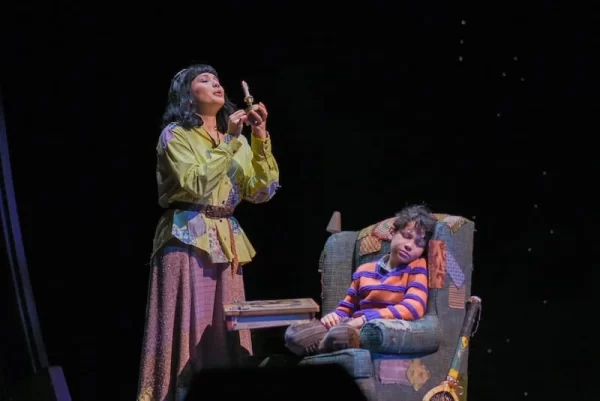
Karylle (Mrs. Bucket), Oliver Wong (Charlie Bucket); Photo Credit: Zeus Martinez Photography
Michael Dalke’s Wonka and Michael Biren’s Grandpa Joe exhibit the same clarity as Wong, but they can’t help but come off more muted against Charlie’s manic tone. Biren is comically expressive enough but registers as too young to sell the character’s breadth of life experience, while Dalke has the sarcasm and mischievous personality but can’t quite communicate Wonka’s world-weariness. Still, when he leads the cast in singing “Pure Imagination” (a song originally from the 1971 film adaptation), he provides a glimpse into the idealism that used to drive Wonka’s chocolate empire. The rest of the score by Marc Shaiman and Scott Wittman is more notable for its variety of sound than for its hooks or motifs, but the music and Mike Thacker’s sound design are still essential to achieving the show’s constant comic rush.
Eye candy
Even without the most emotionally compelling narrative, the strength of the technical qualities here allow the musical to become a showcase in imagination—the very thing that Wonka treasures above everything. Jeff Sugg’s projections, for example, are fully integrated into both the storytelling and the comedy: video backgrounds shuttle people from one setting to the next, aid in the performance of various musical numbers, and travel beyond the stage out to the walls of The Theatre at Solaire. Rory Beaton’s lighting is similarly expressive, with the factory’s bright, strong tones contrasting the more muted, shadowy corners of the Buckets’ home.
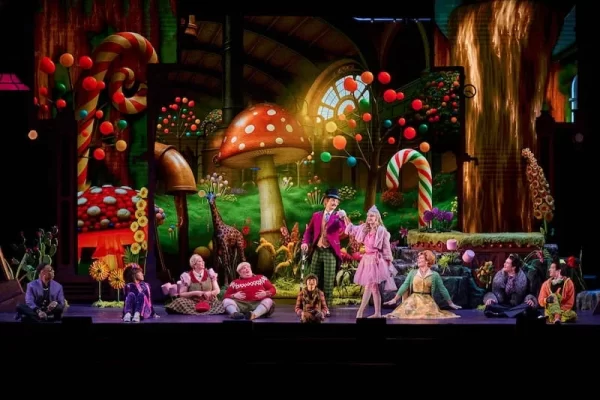
Michael Dalke (Willy Wonka), Oliver Wong (Charlie Bucket), and the Golden Ticket Winners in the Chocolate Room; Photo Credit: GMG Productions
And if nothing else, the musical is a feat of meticulous production design by Mark Thompson. Be it in the townspeople’s winter-ready layered costumes or in every chamber in Wonka’s wonderland-esque factory, Thompson builds a sense of heightened reality that allows the show to play loose with logic and the laws of physics. But just because anything goes here doesn’t mean the production stops being surprising; each new image we see is its own little phenomenon. From a chocolate giraffe in a completely edible room, to the glowing red eyes of human-sized squirrels, to a mother and father dancing among the constellations, this Charlie understands how much can be said just through a little bit of theater wizardry.
This reviewer watched the 8 PM, July 9 gala performance.
Tickets: P1,580–7,400
Show Dates: June 8–26, 2026
Venue: The Theatre at Solaire, Parañaque City
Running Time: approximately 2 hours and 30 minutes (with a 20-minute intermission)
Company: Broadway International Group, Broadway Asia
Creatives: David Greig (Book), Marc Shaiman (Music, Lyrics, Arrangements), Scott Wittman (Lyrics), Jack O’Brien (Original Direction), Matt Lenz (Direction), Joshua Bergasse (Original Choreography), Alison Solomon (Choreography), Nate Patten (Music Supervision), Greg Jarrett (Music Supervision), Mark Thompson (Set and Costume Design), Christine Peters (Tour Scenic Design), Jeff Sugg (Projection Design), Rory Beaton (Lighting Design), Mike Thacker (Sound Design), Basil Twist (Puppet Design), Tim Clothier (Illusions), Doug Besterman (Orchestrations)
Cast: Michael Dalke, Oliver Wong, Cohen Toukatly, Karylle, Jill-Christine Wiley, Michael Biren, Sam Nackman, Allison Gann, Giselle Amarisa Watts, DJ Plunkett, Jorie Janeway, Brandon Grimes, Darren Lorenzo, Kelly Brandeburg, Gino Bloomberg, Emma Casertano, Jaden Holtschlag, Ava Karas, Jeleesa Monet, Mychal Phillips, James Roberts IV, Grayson Stranko, Ian Saunders, Christopher Salvaggio, Stella Schwartz, Harrison Asher Smith, Kendal Williams, Armando Yearwood Jr., John Zamborsky

Comments