

REVIEW: A confidently classical ‘Waiting for Godot’ speaks directly to our suffering today
“With compelling performances, focused direction, and the timelessness of Samuel Beckett’s words, Teatro Meron’s take on the absurdist classic is a play for all seasons.”
As Teatro Meron has shown with its productions of Sopranong Kalbo and Ang Medea in 2025, its mission of bringing classical plays to a wider audience isn’t about making them contemporary but to prove that these plays, just as they are, are still concerned with contemporary matters. This is perhaps best seen in the company’s production of Samuel Beckett’s Waiting for Godot—a show that’s managed to remain recognizable in the cultural consciousness, but at times merely as shorthand for something opaque or uneventful. Here, without “updating” the text or its appearance in any obvious ways, Teatro Meron attempts to make the case that Godot is always of its time.
And with performances that deal with Beckett’s script in various, compelling ways, direction that hints strongly toward the notion of humanity within the context of war, and the playwright’s immortal words wrestling with the meaning of suffering, this attempt is a confident success. Director Ronan Capinding, his ensemble, and his artistic team don’t try to force one message onto this story of two men passing the time and contemplating their existence. Sometimes, the best one can do with a classical text is choose where to place emphasis and which themes should emerge more clearly, and that’s what opens up this production to all kinds of interpretations.
Burden of Knowledge
So much of Waiting for Godot depends on its actors interpreting generally difficult material into experiences that feel ordinary and familiar. And through their own distinct approaches, each performer here ends up articulating a different response to the burden of having knowledge and desire—which every human being deals with, whether they know it or not.
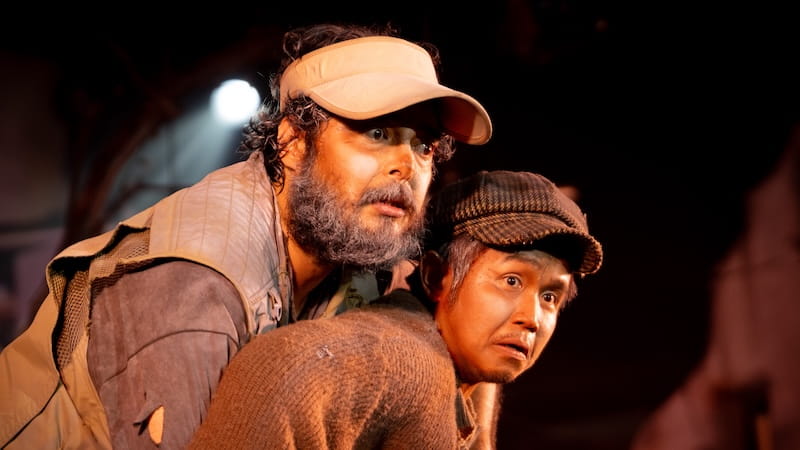
Tarek El Tayech is an immediately commanding presence as Vladimir (or Didi), always seeking understanding and taking on an instinctively protective role over his partner Estragon (or Gogo). But El Tayech’s performance is also one of physical weariness, which gradually metastasizes into the full horror of recognizing the existential trap they’re in. Meanwhile, JJ Ignacio’s Gogo faces their predicament with more oblivious resignation, though he’s still haunted by nightmares and his own eroding memory. Ignacio’s softer, more jovial approach—expressed most purely in the fondness he shows for Didi—becomes a reminder of a time of innocence now long gone.
As Didi and Gogo wait and converse, they also meet the violent and domineering Pozzo (played by John Bernard Sanchez), all swagger and self-satisfaction signifying nothing but a hollow need to feel whatever he can. Leashed to Pozzo’s side is his near-catatonic slave Lucky, in a remarkably physical performance by Lenard Tiongson, his posture caught in perpetually tense and strained angles and a thousand-yard stare. Lucky is now a shell of a human being, but when he’s made to perform “thinking,” the incoherent philosophical ramblings that pour like a faucet from Tiongson’s mouth become incredibly disconcerting—like the Tower of Babel contained in a single body.
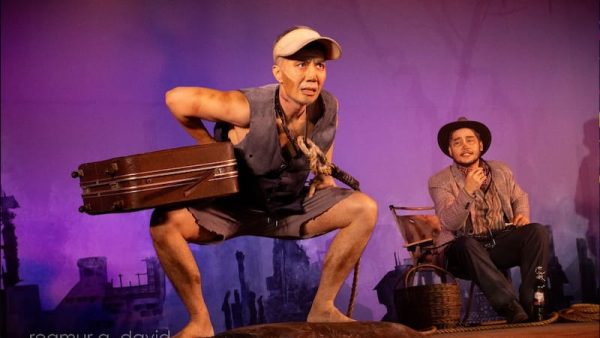
L-R: Lenard Tiongson as (Lucky), John Bernard Sanchez (Pozzo); Photo Credit: Reamur A. David
Absurdity of War
If these individual performances may at times feel like they belong to entirely different shows, or that Didi and Gogo don’t have the “chemistry” expected from a pair of longtime companions, their incongruity eventually feels more deliberate in the context of the play’s absurd humor. These characters don’t seem to be meant to exist in the same time and place, with Capinding finding unexpected comedy in absurd line readings, how the characters stumble over each other, and how they’re reminded of the never-ending nothingness that makes up their days.
Still, Waiting for Godot ultimately uses its absurdity to introduce a whole range of serious, challenging ideas that the human race has wrestled with since the beginning. This production in particular orients itself toward the reality of war and what happens to order, morality, and relationships when so much inhumanity has already occurred. The characters are dressed in tatters and in light, clown-like makeup that naturally fades from their faces throughout the performance. Tata Tuviera’s production design situates the action against a backdrop of decimated buildings in the distance. When day plunges suddenly into night, the full moon appears like a stationary searchlight (designed by Ian Bautista).
There’s value in how the show holds back from outright naming its setting—allowing the story to encompass all locations in need of protection against occupying forces and foreign invaders. At the same time, this lack of specific detail also risks having the show flatten the unique tragedies faced by each war-torn nation into vague visual motifs. It’s not that the production needs to drape itself in flags, but for a script as dense as Beckett’s, its visual design doesn’t lend itself to nearly as many ideas. However, it still does count for something that the play offers glimmers of hope beyond the ruins—be it in Didi’s lullaby echoed in sparse piano notes, or in the lights that sprout from the central tree, extending to the stars.
Everything Happens
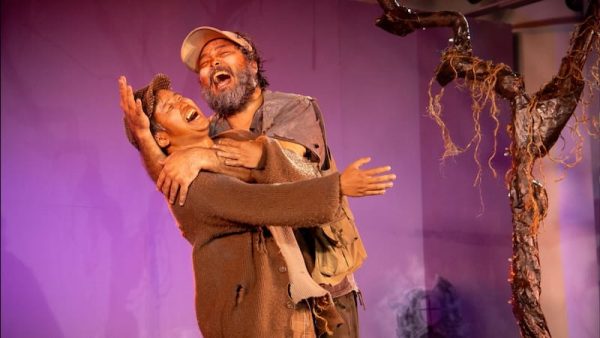
L-R: Jesus Joseph Ignacio (Estragon), Tarek El Tayech (Vladimir); Photo Credit: Reamur A. David
More than anything else, it’s just good to be reminded that this text—often known as a play in which “nothing happens”—is actually impossibly rich, in which arguably everything happens. Beckett’s words are bursting with interesting detail, even when logic seems to lose its way. Themes of power, authority, and suffering run deep through the material, but the characters are never so abstract that they become difficult to care about. As aging men losing their faculties (no doubt due to the desolation of their surroundings seeping into them), Didi and Gogo still hold on to their belief in some sort of structure; letting that go would only mean madness, or worse, loneliness.
And when it comes to Godot himself, the man whom Didi and Gogo are waiting for in order to fulfill some sort of sense of purpose, Beckett leaves the door wide open for interpretation, with many imagining him as God or an authority figure. But for this Godot, the answer could also be much closer to the human experience. In the shadow of war, as Didi desperately calls after Godot’s messenger boy (Yael Ledesma) and begs to be seen and recognized, one might just hear the calls of the survivors of war and genocide asking not to be left alone in their desolation.
This reviewer watched the 7:30 PM, February 9 press preview.
Tickets: P2000
Show Dates: Feb 13–Mar 1 2026
Venue: The Mind Museum, Bonifacio Global City, Taguig
Running Time: approximately 2 hours and 15 minutes (with a 15-minute intermission)
Company: Teatro Meron
Creatives: Samuel Beckett (Playwright), Ronan Capinding (Direction), Ian Bautista (Lighting Design), Tata Tuviera (Production Design), Arjay Rosales (Technical Direction)
Cast: Tarek El Tayech, JJ Ignacio, John Bernard Sanchez, Lenard Tiongson, Yael Ledesma

Comments