

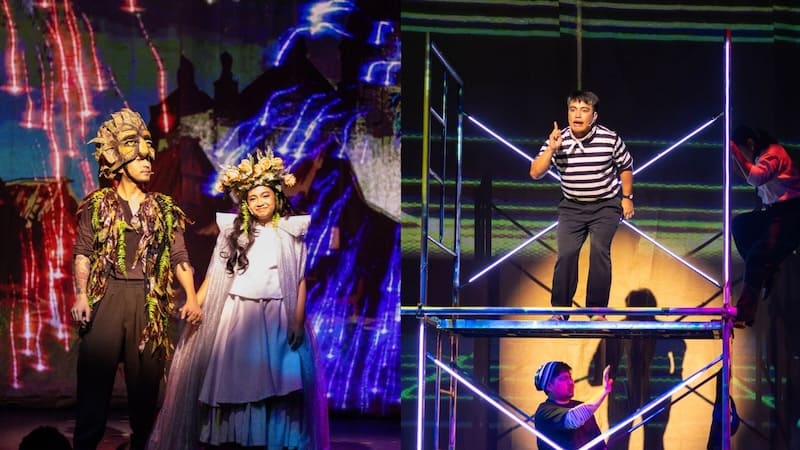
REVIEW: ‘Kislap at Algo’ is a smartly curated wake-up call for the Filipino youth
“PETA’s twin bill production of ‘Kislap at Fuego’ and ‘Children of the Algo’ sees common themes of resistance emerge from the plays’ wildly different approaches.”
Originally performed as part of Philippine Educational Theater Association’s (PETA) Control + Shift: Changing Narratives festival in 2024 and 2025, Dominique La Victoria’s Kislap at Fuego and Mixkaela Villalon’s Children of the Algo recently concluded its new run, now as a twin bill. Whereas each play previously stood as one part of a much larger program, this production of Kislap at Algo provided a greater opportunity for the works to directly respond to and enhance one another.
At first glance, the plays couldn’t have been more different from each other—with Kislap being a romantic folktale set during the Philippine Revolution, and Algo structured as a series of vignettes following four Filipino content creators in the present day. But what PETA succeeded in doing, even with the narrative limits of each work, was provide a modest sort of guide towards political awakening for younger audiences. Presented through two contrasting styles of theater, the twin bill used stagecraft and strong ensemble performances as a way to gradually encourage an awareness of injustice and the need for organization and collaboration for a broader united front.
Kislap at Fuego
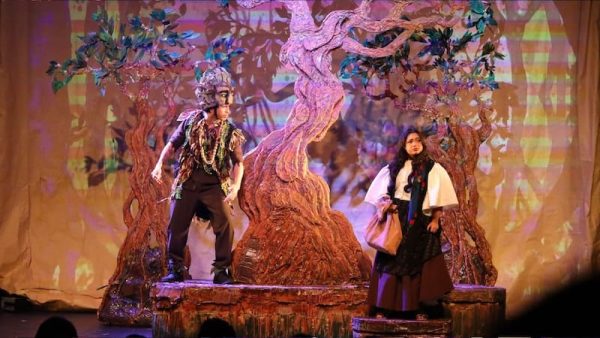
CJ Navato and Kyle Napuli; Photo Credit: PETA
The first play dealt with the overlapping of two realms typically kept separate, with a young human woman, Gabriela (Felicity Kyle Napuli), volunteering herself into the servitude of a kapre (CJ Navato). And as was only appropriate for a story meant to inspire a sense of wonder about the world, there was an impressively high number of moving parts to this, despite its lean, roughly hour-long runtime—from costume changes and whimsical props and puppets, to Rafa Sumilong’s warm, atmospheric lighting and Boni Juan’s production design for this peaceful corner of the engkantos’ forest. But with the crack of gunshots from Spanish soldiers (sound designed by Kabaitan Bautista), this humble paradise and the entities inhabiting it always seemed one misstep away from invasion.
La Victoria’s script (translated by Gentle Mapagu) managed to weave together romance, comedy, and rousing revolutionary sentiment, though it also couldn’t help but feel like a prologue to a bigger story rather than its own, self-contained tale—at times, pausing its momentum to describe a bigger picture that never quite found a resolution. Still, its characters proved immediately easy to root for, thanks to playful direction by Maribel Legarda and J-mee Katanyag and equally enthusiastic performances from the cast. Navato and Napuli created two complete portrayals within their very first scenes together, quickly establishing a dynamic loaded with both romantic tension and an inexplicable familiarity with each other, already bonded despite their differences.
Children of the Algo
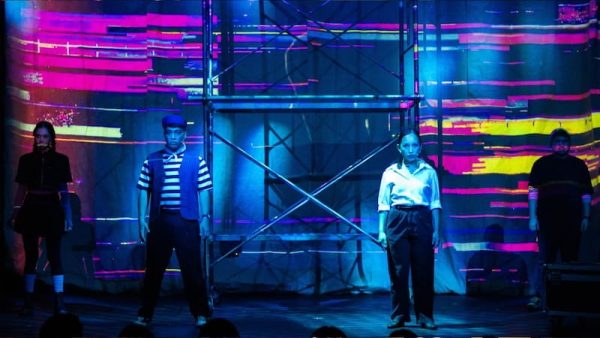
L-R: Otep Madriaga, James Pe Lim, Nyla Festejo, Frances Akol; Photo Credit: PETA
The second play departed from a traditional narrative structure and instead took on the rhythms of a restless night doomscrolling through short-form social media content. Mounted on a bare stage with only some rickety scaffolding as scenery (production design by director Johnnie Moran) and the occasional strobe of “glitching” lights (by Rafa Sumilong), this was meant to evoke a dizzying sense of perpetual motion. All four cast members, led by an increasingly anxious Otep Madriaga, spoke with a deliberately exaggerated affect that only added to the play’s direct, aggressive style—before the characters eventually shed their public personas, revealing a common concern for the future of the country.
The storytelling techniques here only stayed compelling up to a certain point, however. There was only so much that these characters could do with their surroundings before the images they formed through their blocking began to repeat themselves without any clearer intention. And as the cycle of mini-monologues went on, the lack of more color and personality to the set and projections began to feel like a missed opportunity to really capture the hypnotic sensory overload of social media. But Villalon’s script still oriented these vignettes towards a greater overall truth: that our frustrations with other people of different backgrounds and social classes may all stem from larger political and economic forces designed to keep us fighting each other rather than overhauling the systems that are really to blame.
Kislap at Algo
Taken together, neither of these plays necessarily discussed specific solutions to oppressive regimes or economic disparity—and they didn’t have to. More than anything, the twin bill functioned as a call to action by establishing that there is much more that unites the different sectors of Filipino society than one may realize; recognizing this becomes the first step to attaining freedom and justice. In Kislap, the engkanto realm had its resilience and magic, while the human realm had its literature and the courage of its people. In Algo, each of its characters had their own unique perspective into how Filipinos are boxed into structures preventing them from achieving more. It was only when all of these people came to an understanding of their common desires that their strengths could finally be put to full use
And perhaps more importantly, Kislap at Algo placed the Filipino youth at its center, characterizing them as possessing agency, creativity, and the will to fight back and change things themselves. Both Gabriela and Otep Madriaga’s character, Mark, ended up breaking through their respective realities even when faced with violence or censorship. This is a theme that may not have jumped out quite as clearly from either play before they were curated in succession like this, but this twin bill certainly helps draw it out, while demonstrating how universal this call to action can be across all kinds of theater.
This reviewer watched the 3PM, February 6 show.
Tickets: P1000–1800
Show Dates: Jan 27–Feb 7 2026
Venue: PETA Theater Center, New Manila, Quezon City
Running Time: approximately 2 hours and 15 minutes (with a 15-minute intermission)
Company: Philippine Educational Theater Association
Creatives: Kislap at Fuego: Dominique La Victoria (playwright), Gentle Mapagu (adaptation, dramaturgy), Maribel Legarda (direction, choreography), J-mee Katanyag (director), Kabaitan Bautista (music direction, sound design), Boni Juan (production design), Bene Manaois (projection design), Rafa Sumilong (lighting design) | Children of the Algo: Mixkaela Villalon (playwright), Johnnie Moran (direction, production design), Mikaundre Santos (dramaturgy), JJ Valerio (sound design), Rafa Sumilong (lighting design)
Cast: Kislap at Fuego: CJ Navato, Felicity Kyle Napuli, Ekis Gimenez, Carlon Matobato | Children of the Algo: Otep Madriaga, Nyla Festejo, James Pe Lim, Frances Marie Akol

Comments