

UNI-BASED REVIEW: Tanghalang Ateneo’s ‘Emilia’
“Tanghalang Ateneo’s ‘Emilia’ is a rousing reminder that women’s voices must be heard and that women’s stories matter.”
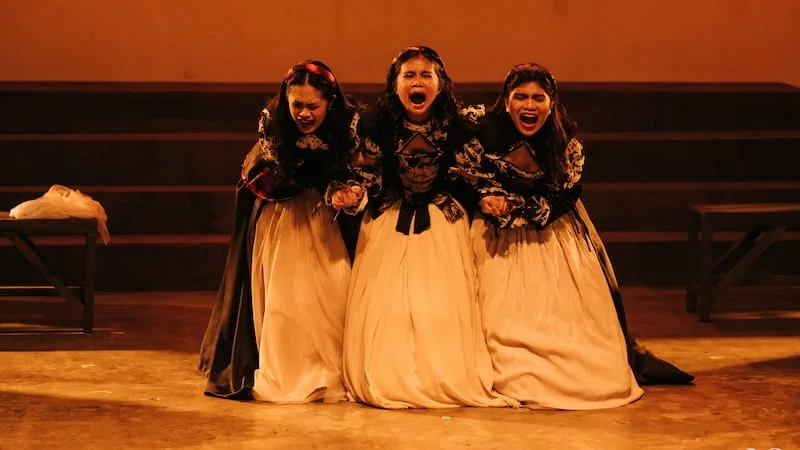
The identity of the “Dark Lady” who inspired many of William Shakespeare’s most memorable sonnets has been the subject of countless debates among academics for centuries. One of the theories put forward is that this mysterious figure is the poet Emilia Lanier (née Bassano), who lived at the same time as the Bard himself. Tanghalang Ateneo’s Filipino translation of Morgan Lloyd Malcolm’s play explores this possibility while also presenting a powerful story about how women’s voices have been silenced for centuries. More than simply depicting the life of a fascinating figure who has been kept in the margins of history, Emilia is a rousing, riveting reminder that the unjust systems that had kept her in the shadows remain rampant even today.
With engaging and naturalistic delivery of Lloyd Malcolm’s dynamic dialogue, which varies from period-appropriate formality to the occasional, anachronistic expression, Emilia’s all-female cast immerses the audience in a world that feels both foreign and familiar. Eventful as the piece is, one never feels lost in the action, as Sarah Facuri’s clear direction ensures that every scene is given its due. And even as Emilia’s struggles to navigate court life and pursue her passion for the arts begin to feel arduous, the show is never bogged down by the weight of its message of female empowerment in a patriarchal world but instead, is propelled, with the cast’s energetic and compelling performances, to remind audiences why such a message is so vital.
Portrait of a woman on fire
The titular character is played by three women, all representing the character in different stages of her life. Chloe Abella’s Emilia 1 has the most to do as her character transitions from the youthful innocence of an orphaned daughter, the scared but sad resignation of a reluctant bride, and the unspeakable grief of a bereaved mother. She undergoes every transformation seamlessly and her performance is filled with an impressive confidence from the get-go. So charismatic is she that she is almost missed when she sinks into the shadows.
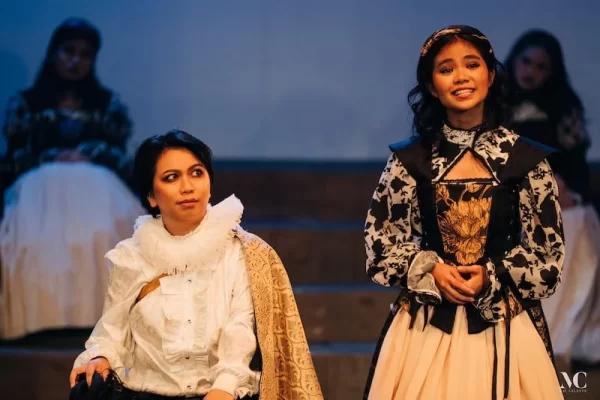
L-R: Joy Delos Santos (Panginoong Henry Carey), Chloe Abella (Emilia); Photo Credit: May Celeste
Francesca Dela Cruz is a force of nature as Emilia 2. She enters the story strengthened by her experiences and determined to make her mark in the world. Her rage at the injustices she is subjected to is palpable and at certain moments, when she stands in the center of the stage, against a background of warm light (lighting design by Jethro Nibaten and Perine Nyssa Bianzon), she looks like a woman ablaze. Her most memorable moment is her fury at watching an excerpt of Shakespeare’s Othello, with a character ostensibly based on her and with certain lines of dialogue allegedly stolen from her own lips. The scene cannot help but be reminiscent of a similar confrontation of another woman in Shakespeare’s life in the film Hamnet.
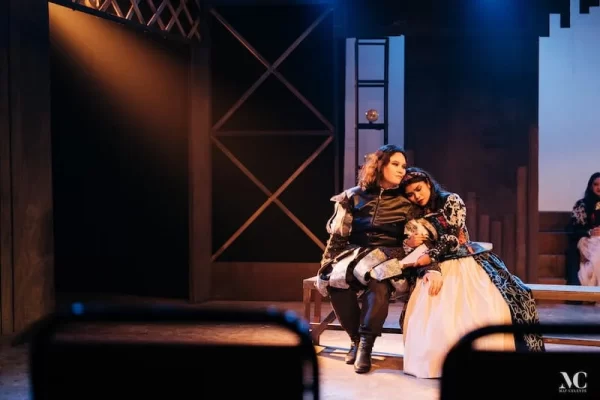
L-R: Bea Racoma (Alphonso Lanier), Francesca Dela Cruz (Emilia); Photo Credit: May Celeste
Maliana Beran is the first and last Emilia we see. She opens the play as the narrator, reminding the audience that women have not always been able to tell their stories. She portrays Emilia in her last years, as a teacher and advocate for women’s rights, unflinching in her conviction and unwavering in her efforts. Her final address to the audience is a blazing call to arms that no one is likely to forget.
A comedy of terrors
This production puts its characters in the spotlight, with sumptuous costumes (by Hershee Tantiado) that would not go amiss in any Shakespearean production, complete with gowns, corsets and the iconic Elizabethan collars. A simple but evocative set (designed by Facuri) with bleachers against a blank screen and moveable benches and chairs and members of the cast sometimes standing for bookshelves in a library, transports the audience to various locations in Elizabethan England, from noble houses to the royal court, to the stage at the Globe Theatre, to the banks of the Thames. Among the anachronistic touches are some musical interludes with modern choreography (movement design by Facuri) which cannot help but delight the audience and provide moments of levity during long stretches of dire scenes.
The male characters provide much of the comic relief in this piece and the female cast deftly portray them as flawed creatures and not outright caricatures. Joy Delos Santos as Panginoong Henry Carey is Emilia’s aged, lecherous but influential lover, who forces her to become his mistress in exchange for access to education. Bea Racoma as Alphonso Lanier is Emilia’s bumbling husband, a pompous buffoon of a man who is a constant disappointment to her and a constant source of laughs for the audience. Chantei Cortez as Will Shakespeare is the least laughable of the lot, a charming, seductive poet who finally seems to be Emilia’s equal, but who betrays her trust for his own gain. The play never lets the audience forget that these men, for all their merry manners and mustache-twirling, are also capable of being monstrous. They are the villains who hold Emilia and so many women like her back from achieving their true potential.
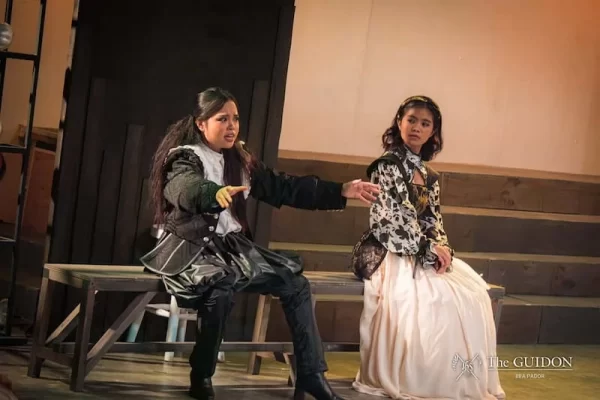
L-R: Chantei Cortez (William Shakespeare), Chloe Abella (Emilia); Photo Credit: Bea Pador/ The Guidon
Solidarity in sisterhood
But Emilia is not without her supporters. In the end, as the play shows us, it is the women, however limited their means may be, who do not fail her and who provide her with opportunities to learn and grow. And this is what fuels her own determination to share her knowledge with others. Some of the most heartwarming scenes of the play come when Emilia, as a teacher, engages in earnest dialogue with her students—laundresses, tavern maids, and other lowborn women. When one of her students, Eba (Petes Castillo), shares a poem she wrote herself, having found freedom in the written word, it is a powerful moment.
Ultimately, the genius of Emilia is in the way this phenomenal production expertly balances the elements of comedy and tragedy, presenting an unmistakably human story of a person who constantly faced discrimination and abuse. But it is also a distinctly female story, of the unique ways in which women have been silenced by patriarchal systems throughout history. And the justified rage burning within Emilia from the beginning of the play until its final moments, where she infects the audience with her fury is a testament to the ongoing violence and injustice women continue to face to this day. While the message of female empowerment in a patriarchal society is familiar territory, when conveyed in a manner this compelling, it is still very much a story worth telling.
This reviewer watched the 7PM, April 9 show.
Tickets: P550-800
Show Dates: April 11 to 26 2026
Venue: Rizal Mini-Theater, Ateneo de Manila University, Quezon City
Running Time: approx. 2 hours 30 minutes (with a 15-minute intermission)
Company: Tanghalang Ateneo
Creatives: Morgan Lloyd Malcolm (playwright), Sarah Facuri (direction, set design, and movement design); Teresa Barrozo (composition and sound design); Erika Estacio (sound design); Jethro Nibaten, Perine Nyssa Bianzon (lighting design); Hershee Tantiado (costume design); Julia Vaila (photography)
FACULTY BOARD: Jenny Jamora (artistic director), Sabrina Basilio (moderator and resident dramaturg), Jethro Nibaten (director for technicals and design)
Student Creatives: Teia Contreras (assistant direction); Ayeesha Pandapatan (graphic design) ; Julia Macuja (associate set design) ; Amina Javellana (associate costume design); Julienne Edar Ballaran (assistant photography)
TA DRAMATIST COLLECTIVE: Gab Mactal, Keith Bernas, Meeka Sayaboc (translation); Regina Manalo, Petes Castillo, Joyce Ann San Buenaventura, Thandie Aliño, PM Oliveros (dramaturgy)
Cast: Francesca Dela Cruz, Bea Racoma, Nicole Sintor Chua, Joy Delos Santos, Iman Rahima, Bienne Dator
Student Cast: Chloe Abella, Maliana Beran, Chantei Cortez, Patricia Ann Panganiban, Andie Manlusoc, Petes Castillo, Cadence Velas, PM Oliveros, Camille Samson, Ara Mariano, Gabrielle Stephanie Taño

Comments