

REVIEW: ‘Ang Paglalakbay’ offers visually arresting ballet built on bold stagecraft
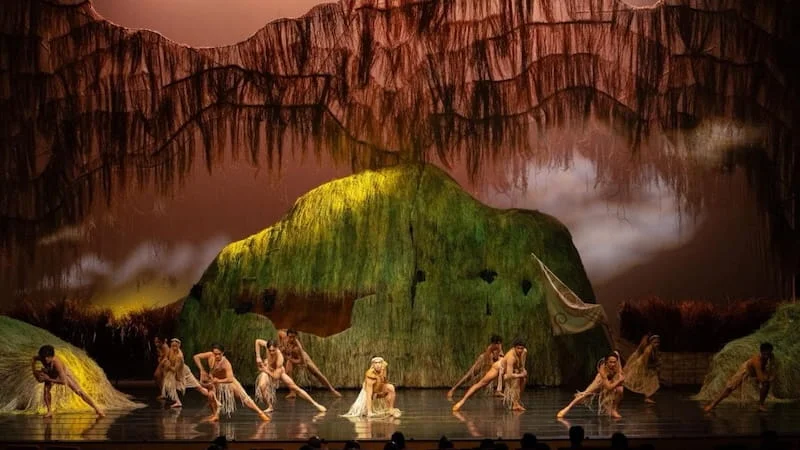
In Ballet Philippines’ Ang Paglalakbay: The Journey of the Sea People, the stage becomes a series of living installations where the work of multimedia artist Leeroy New meets the lighting design of Andrei Fabricante. The scale and tactile details of the set, and the painterly lighting effects, make a clear case for the company’s decision to invest in this season ender. They give weight to a story drawn from Batanes and to a larger idea of the Philippines as a seafaring culture. The visual design carries as much of the narrative as the choreography, shaping the world in which the dancers move.
The design holds the audience’s attention so firmly that lapses in execution and uneven passages in the choreography recede from view. The focus remains on the stage picture. Artistic director Mikhail Martynyuk places clarity at the center. The story can be followed from start to finish without the aid of program notes.
Ang Paglalakbay is about a voyager named Ama (Rudolph Capongcol), who survives a dangerous journey and reaches Batanes as a stranger. In the village he meets Kaman (Regina Magbitang), an Ivatan, and they fall in love. The land resists him. The Spirit of the Land (Danielle Kleiner) mistrusts the outsider and turns Ama into stone. Kaman grieves and pleads for mercy until Ama is restored to his human form.
The couple returns to the elders and makes a promise to live in harmony with the island. It becomes a condition for staying and a recognition of the place they have entered. Their son, Biyag (Eduarson Evangelio), grows up drawn to the sea. He leaves Batanes and follows the path his father once took, beginning a journey of his own.
Sights and Sounds
New’s installations take shape as sculptural dwellings made from thick layers of dried grass, echoing the steep pitch of Ivatan thatched roofs while rising from the stage like extensions of the earth. Suspended fringes of fiber stretch across the upper space and suggest a ridgeline or dense vegetation. At the center, a grassy mound shifts in use, at times a solid island and at others a flexible ground for the ensemble.
Fabricante’s lighting moves from the intense gold of midday to the deeper and ethereal tones of twilight. In intimate scenes, the light narrows and isolates the dancers, bringing out the organic textures of the costumes and set. As the action opens out, the lighting spreads across the cyclorama in saturated fields that suggest distance and scale, framing the idea of migration.
The maritime sequence draws on the Austronesian journey. The structures that earlier suggested shelter now frame the stage as islands. A field of blue opens up, filled with suspended boat frames that suggest movement across water and time. At the center, a tataya or fishing boat carries the dancers through undulating fabric floor work that follows the rise and fall of the sea. The lighting deepens into indigo and softens the edges of the stage, while the boats catch the light and take on a luminous presence.
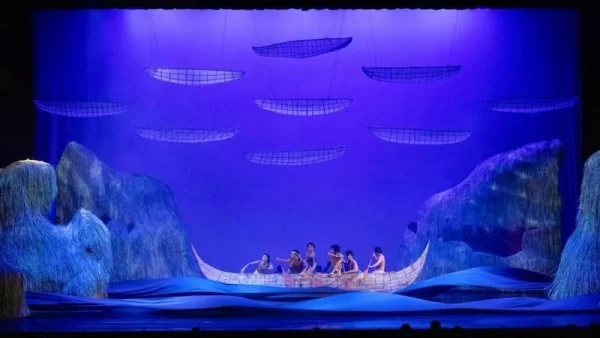
Photo Credit: Liza Marcos/ Facebook Page
Instead of conventional scoring, the sound design shapes how the audience experiences the stage through music, effects, and silence, and how these are arranged over time. Composer Ronald Khaw de Leon builds the score from texture rather than melody. Metallic tones cut through the space, while a low bass sustains a steady vibration underneath. Brief passages on the kulintang add a local inflection. The layers continue to build, guiding the pace of the action.
Artistic Liberty
Martynyuk takes artistic liberty in shaping the work through classical ballet and an old school Russian narrative structure rather than pursuing a literal rendering of Batanes culture and arts. The storytelling follows the Russian arc that establishes the world, introduces the characters, builds the conflict, and arrives at resolution after struggle. Like the iconic Spartacus ballet where the story focuses on the gladiator and a captive, the emotional center of Ang Paglalakbay is the relationship between Ama and Kaman, expressed through partnering that culminates in a dramatic overhead lift.
Still, elements of local movement appear through a chanter between acts and motifs drawn from Ivatan warrior dances, where men strike short bamboo sticks in tight, rhythmic patterns.
After several seasons, the Ballet Philippines dancers show greater strength and control, executing pirouettes in attitude—turns made on one foot while the other leg is lifted, bent, and opened to the side or back—with steadiness on pointe. Across the company, their feet curve into clean, lifted arches, the instep drawn upward like a bow under tension.
Capongcol and Magbitang have remained consistently assured in performance. However, amid the impressive athleticism and fluid partnering of Capongcol and Magbitang, the performance could benefit from a more defined emotional arc.
More to Be
More could have been drawn from the boyish energy of Eduardson Evangelio as Biyag, whose performance suggested potential that has yet to fully cohere into expressive depth.
A similar restraint applies to Danielle Kleiner as the Spirit of the Land—an ethereal presence whose long-limbed, lyrical quality gives her a graceful stage presence. The choreography could have been more actively shaped to expand dynamic contrast and emotional range.
Emerging talent Krystyn Janicek, as the Spirit of the Sea, displays a sinewy quality in movement that suggests ease and openness. The movements for the role would benefit from further refinement to bring greater articulation and clarity to that fluidity.
Overall, Ang Paglalakbay is most persuasive in its visual world and in the strength of its performers, who show steady growth in control and presence across the company.
This reviewer watched the 2 PM, April 11 show.
Tickets: P4,017 (lower orchestra center), P3,347.50 (lower orchestra side), P2,410.20 (upper orchestra center and upper orchestra side), P2,008.50 (Premium Gold center and Premium Gold sides), P1,071.20 (upper balcony center and upper balcony sides), and P803.40 (upper balcony center and upper balcony sides)
Show Dates: April 10 – 12
Venue: The Theatre at Solaire
Running Time: approx. 1 hour and 40 mins with a 10-minute intermission
Producer: Ballet Philippines
Creatives: Mikhail Martynyuk (artistic director, choreographer, stage designer), Sheree Chua (librettist), Leeroy New (set designer and costume designer), Ronald Vinceszo Khaw De Leon (music composer), Arvie Santos (associate production designer), Pete Andrei Fabricante (lighting designer)
Featured Cast: Guilbert Castillo Bonggay (Ivatan Chanter); Regina Magbitang, Jemima Reyes Ocampo, Danielle Kleiner, Nicole Barroso (Kaman); Rudolph Capongcol, Mark Anthony Balucay (Ama); Mark Anthony Balucay, Carlo Padoga, Eduardson Evangelio (Biyag); Eduardson Evangelio, Carlo Padoga, Alexis Piel, Emmerson Evangelio, Rudolph Capongcol (Friends of Ama); Jemima Reyes and Nicole Barroso, Regina Magbitang and Danielle Kleiner (Friends of Kaman); Nicole Barroso, Regina Magbitang, Danielle Kleiner, Jemima Reyes Ocampo (Spirit of the Land); Krystn Janicek, Regina Magbitang (Spirit of the Sea)
Comments