

UNI-BASED REVIEW: Dulaang UP’s ‘Fiestas y Muertos’
“DUP’s adaptation of ‘Noli Me Tángere’ is appropriately epic in scale with interesting character nuances—but it eventually becomes a long-winded show with an unclear vision.”
There is something about José Rizal’s Noli Me Tángere that, for this writer, seems to resist straightforward dramatic adaptation. The novel certainly works as drama, but as a treatise on the Philippines’ social ills during the Spanish occupation, it almost seems to demand the kind of patient dissection that literature provides. Dulaang UP’s Fiestas y Muertos takes on this difficult task of faithfully retelling the story of the young, idealistic Crisostomo Ibarra returning to a deeply corrupt Philippines.
DUP’s production mounts Noli on an appropriately large scale—mostly successful in weaving a narrative that concerns an entire nation rather than just a select ensemble of characters. And even with its fidelity to the original text, its performances suggest several new aspects to how one may think of these established figures in Philippine literature. However, the same challenges persist in this version, as it gradually becomes a long-winded show whose vision becomes clouded.
National tragedies
With all the difficulties that come with adapting Rizal, Fiestas y Muertos succeeds in preserving the richness of his themes. Andrew Estacio’s script (adapted from Virgilio S. Almario’s Filipino adaptation of Noli) reorganizes the book’s chapters while keeping the hypocrisy of the Spanish and debates of reform versus revolution firmly in place. The dialogue between characters may not be subtle but Estacio knows it doesn’t have to be. Rizal’s bluntness and frustration are kept intact, and even greater emphasis is placed on how everyone’s fates are closely tied together. The tragedies of a nation affect all—a sentiment unfortunately still worth repeating today.
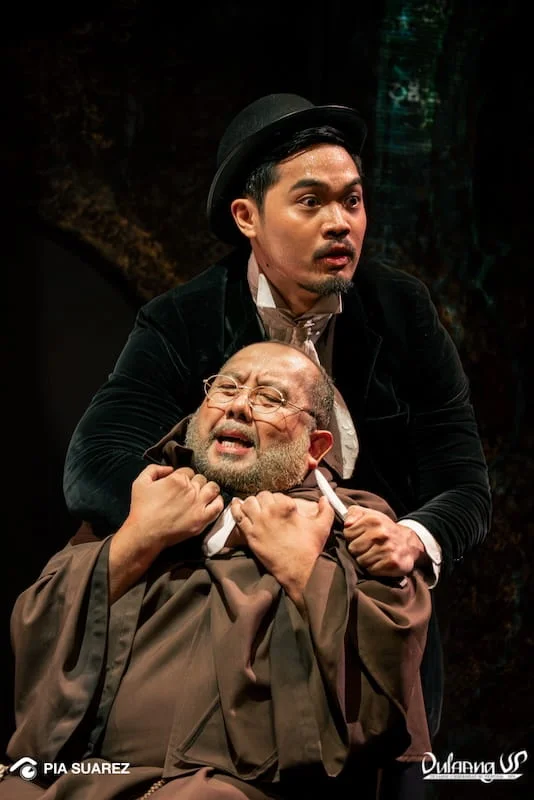
Jerom Canlas (Crisostomo Ibarra), Jojo Cayabyab (Padre Damaso); Photo Credit: Pia Suarez for Dulaang UP
Charles Yee’s production design creates an easy visual shorthand for the hierarchy of power: a large open space lies in front of a raised platform, that is in turn under the shadow of a church. Characters are frequently physically oriented toward (or within) the church but Barbara Tan-Tiongco’s lighting can come from anywhere, piercing through the darkness like a divine warning. In the absence of more props on stage, Carlos Siongco’s costumes become responsible for illustrating the vast divides between social classes, while key set pieces—the encounter with a crocodile, and the construction accident—are still rendered with impressive spectacle.
New interpretations
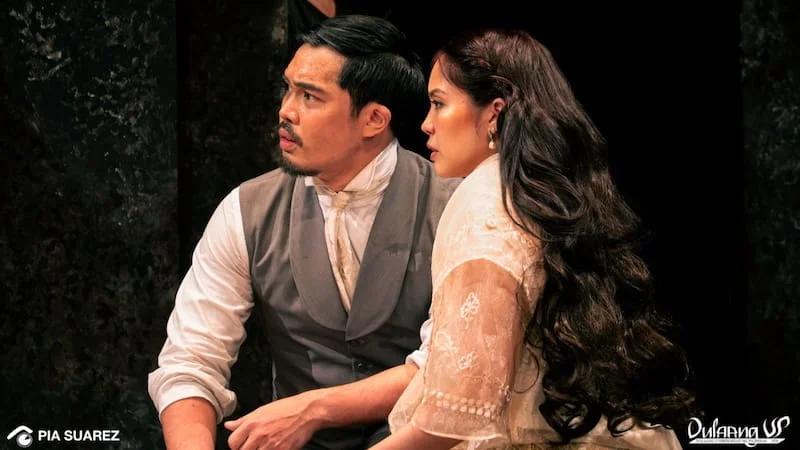
The play mostly does what one may expect from a Noli adaptation, but there are nuances to several of its performances that keep things interesting. Jerom Canlas’ Ibarra makes the young man’s disillusionment especially urgent, his anger almost primal. Justine Peña reworks Maria Clara’s stereotypically demure characterization into a self-assured performance that exudes a gentler kind of authority. And Elora Españo’s expanded role as Salome gives the production another hopeful set of eyes to look through, with Españo’s earnestness registering as an authentic extension to Rizal’s work. She isn’t just a haphazard addition to the show’s list of primary characters.
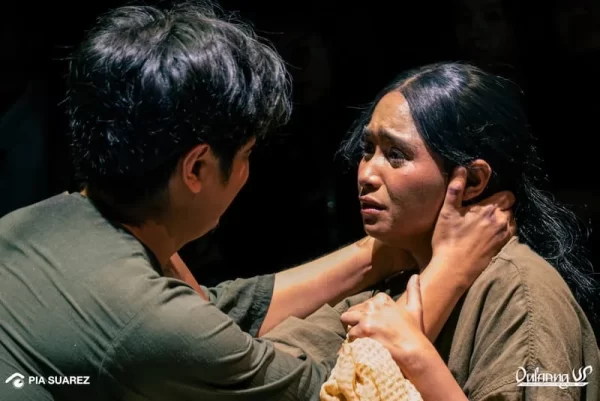
Ross Pesigan (Elias), Elora Españo (Salome); Photo Credit: Pia Suarez for Dulaang UP
With that said, Fiestas y Muertos doesn’t always manage its satirical balance of comic and dramatic elements well, with more overtly comedic characters and scheming villains at times coming off like people belonging to a different version of Noli altogether. Meanwhile, Peña’s approach to Maria Clara, while unique, isn’t as convincing by act two. When she hits rock-bottom after learning that Padre Damaso is her real father and that “Ibarra” has died, Peña continues to exude inner strength—but this makes it feel as if all this tragedy isn’t affecting her as much as it should to drive Maria Clara to choose exile to the convent, or death. And Peewee O’Hara’s Inay Dorang (a gender-bent take on Pilosopo Tasyo) struggles with her many monologues, as inconsistent delivery weakens the power in her words. More broadly, the character never really comes off as essential to the play.
Buckling under the weight
Overall, Fiestas y Muertos proves more capable at setting up its pieces than at knocking them down. Its two-hour-long first act gradually hits its stride and becomes surprisingly nimble for its duration, with director José Estrella keeping her ensemble busy—pushing events along with a palpable sense of indignation at the violence and corruption that has infected the characters from every social class. But as the second act inevitably places greater focus on its smaller group of primary characters, the production begins to feel weighed down by its length, and the empty spaces of the IBG-KAL Theater begin to feel the absence of activity.
With its paternity plot twists and mistaken identities, melodrama is a part of Noli‘s DNA. However, as the play reaches its climax and extends into a drawn-out denouement, these revelations are deployed in somewhat clunky fashion. The last sequence consists of characters repeatedly coming in and out of scene in a way that grows tedious before long, robbing the final image of the haunting quality it should possess. By the end, the show’s ambition buckles under the material’s density. But despite everything, this is still an admirable attempt at wrangling a difficult text, proving how powerfully the original still stands.
This reviewer watched the 2 PM, October 24 performance.
Tickets: P1,200
Show Dates: October 23 – November 15, 2026
Venue: IBG-KAL Theater, University of the Philippines – Diliman, Quezon City
Running Time: approximately 3 hours and 15 minutes (with a 10-minute intermission)
Company: Dulaang Unibersidad ng Pilipinas
Creatives: Andrew Estacio (Playwright), José Estrella (Direction), Sir Anril Tiatco (Dramaturgy, Additional Lines), Jem Javier (Dramaturgy, Additional Lines), Charles Yee (Production Design), Carlos Siongco (Costume Design), Barbara Tan-Tiongco (Lighting Design), Angel Dayao (Sound Design, Music), Joyce Garcia (Video Design), Al Garcia (Movement Design), Mykee Ababon (Technical Direction), Jefferson Villacruz (Graphics), Aji Manalo (Sound Engineer), Mercedes Planta (Historical Adviser), Popo Amascual (Assistant Direction), Joey Vargas (Assistant Direction), Gaby Asanza (Assistant Dramaturgy), Jonas Garcia (Assistant Dramaturgy)
Student Creatives: Czar Arnejo Bedoya (Assistant Dramaturgy), Ligel Garbo (Assistant Dramaturgy), Reign Righteous (Assistant Dramaturgy), Third Salamat (Assistant Lighting Design), Jisu Jang (Assistant Sound Design), Raine Cruzate (Assistant Sound Design), Lan Tee Sy (Lighting Design Apprentice), Lhoure Ghel Manguiat (Production Design Apprentice), Jada Bartolome (Video Design Apprentice)
Cast: Jerom Canlas, Ross Pesigan, Justine Peña, Peewee O’Hara, Elora Españo, Iris Montesclaros, Jojo Cayabyab, Joseph Pe, Kiki Baento, Rigel Hechanova, Jonas Garcia, Gaby Asanza, Joey Vargas
Student Cast: Quiel Campo, Daphne Louise, Dan Duplon, Avi Sulibet, Gena Suelto, Kurt Reyes, Maki Sabio, Gian Barcheta
Comments