
REVIEW: ‘The Play that Goes Wrong’ affirms the artistry of slapstick comedy
“GMG’ Productions’ play within a play showcases the sheer craftsmanship and coordination required to elicit laughter out of both failure and victory.”
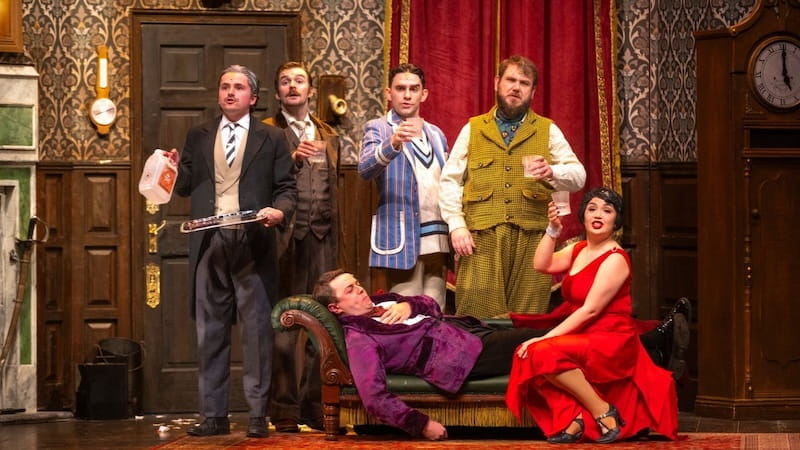
If GMG Productions’ The Play that Goes Wrong tells us anything about slapstick comedy, it’s that there is very little room for ego if one wants to perform it well. Presented as a show within a show—a mystery entitled The Murder at Haversham Manor, being staged by the Cornley Drama Society—the play requires all of its actors to play the fool, while at the mercy of a set that’s meant to overpower them. And over the course of the production, we learn next to nothing about these Cornley performers’ hopes and dreams, except that they are trying to survive until the end of act two.
The result of all this silliness is, thankfully, a wholly enjoyable experience. Originally staged in London in 2012 by Mischief Theatre, the show is a reminder of both the craftsmanship and the sheer commitment (if not borderline danger) that physical comedy can entail. It’s more of a thrill ride than it is a story being told in the traditional sense, but it’s one that still requires the utmost trust and coordination between the members of this production’s international cast. Even if the entertainment it offers is ultimately simple, it manages to pull off the balancing act of getting audience members to root for the characters’ successes and failures in equal measure.
Murphy’s law
It’s admirable that the play is able to run for two hours on what is basically one joke: anything that can go wrong will go wrong. Props go missing, lines are forgotten, lighting and sound cues are missed, and actors are knocked unconscious mid-performance. This is all directed by Hannah Sharkey (from Mark Bell’s original direction) with an incredibly dry sense of humor. Even when things descend into chaos, the characters always return to a state of quiet self-consciousness as they realize there’s still an audience looking at them. The show’s many awkward silences are deliberate, as characters watch somebody crawl off stage or stare at a piece of furnishing that’s accidentally fallen off the wall. But at times this choice becomes repetitive and this deadpan approach begins to wear off in the second act.
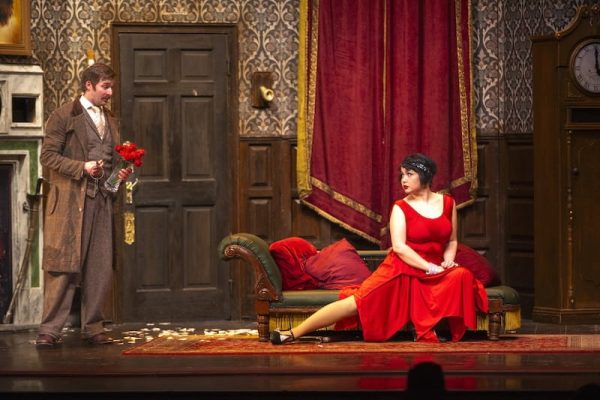
Tom Babbage as Chris (Inspector Carter), Mikkie Bradshaw- Volante as Sandra (Florence Colleymoore); Photo Credit: Zeus Martinez Photography
However, even when the comedy isn’t perfectly sustained, the quality of the stuntwork only escalates. The Play that Goes Wrong is really all about its spectacle. Nigel Hook’s original set consists of a 1920s-style living room with a tiny second-floor study and a contemporary tech booth off to the side. This environment becomes the play’s true main character with a temperament of its own. The amount of movable and detachable parts on this stage remains surprising until the end, with every new environmental hazard—a defective door, a collapsing platform—feeling like some divine test of the characters’ commitment to the art form. The stunts are so unexpected and always just realistic enough that a legitimate show stoppage during the gala performance didn’t feel like an interruption but like an extended meta joke.
Playing the fool
What’s striking about this ensemble is how evenly matched all of the actors end up being. There is no one character who is positioned as morally or intellectually superior to the others, and nobody tries to oversell a joke or a reaction to try and steal the spotlight. There’s a narrative function to this—all of these characters, even the in-show director of The Murder at Haversham Manor, are equally incompetent and equally unwilling to walk away from what they’ve already started. But beyond this, there also seems to be a practical aspect to the cast being this cohesive. Given all the stunts they have to perform together, the performers are clearly just as focused on each other’s timing, acting as one unit as they get into precise position with every beat.
And yet, every performance in The Play that Goes Wrong is still distinct in their mannerisms and personalities. As the director, Chris (also playing Inspector Carter), Tom Babbage plays his exasperation with increasing anguish, especially in how he plays off of members of the audience. In particularly physical performances, Owen Jenkins (as Robert/Thomas Colleymoore) proves remarkably flexible, while Liam Horrigan (Jonathan/Charles Haversham) is still compelling in a nearly silent performance.
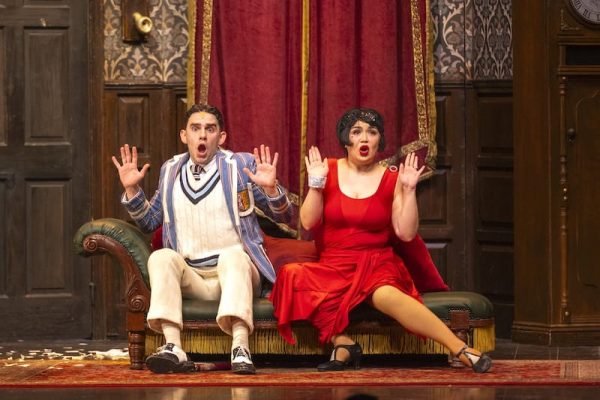
Sebastiano Pitruzzello as Max (Cecil Haversham), Mikkie Bradshaw- Volante as Sandra (Florence Colleymoore); Photo Credit: Zeus Martinez Photography
Mikkie Bradshaw-Volante (Sandra/Florence Colleymoore), Tom Hayward (Dennis/Perkins), Tom Bulpett (tech operator Trevor), and Olivia Charalambous (stage manager Annie) all relish their characters’ moments of humiliation without self-consciousness. But Sebastiano Pitruzzello (Max/Cecil Haversham) is arguably this production’s most impressive assortment of quirks, as he mimes every syllable of his monologues and blatantly laps up the applause from the audience.
Human errors
But as the dust settles and as the show comes to end, there isn’t as much catharsis as one might expect. To be fair to co-writers Henry Lewis, Jonathan Sayer, and Henry Shields, they actually have written a decently engaging murder mystery comedy in The Murder at Haversham Manor, despite all of its absurd twists. But even with the whodunit solved, the only thing that the “real” actors can celebrate is their own survival. We never understand what’s at stake for the Cornley Drama Society. Is it foolish to even look for greater drama in The Play that Goes Wrong? Perhaps, but it can’t help but feel like a missed opportunity when the play introduces but doesn’t follow through on issues such as a lack of funding and unfair competition between blockbuster theater and smaller productions.
Thankfully, this isn’t a major issue when the show gets as creative as it does. The comedy isn’t just physical—oftentimes the play finds clever humor in the very process of trying to memorize a script. In one scene, Sandra skips ahead and begins saying her dialogue one line too early. In another instance, Dennis repeats an earlier line, putting the rest of the actors into an accelerating time loop until he remembers the proper words.
And what becomes fascinating to observe is how the production’s “mistakes” and “successful” attempts at doing the scenes both inspire laughter and applause. This isn’t incidental; it’s evidence of set-ups and payoffs being structured effectively. We aren’t rooting against the characters nor waiting around them for them to succeed. No matter how they fare, their earnest effort at live theater is what’s being applauded.
This reviewer watched the 8 PM, November 7 gala performance.
Tickets: P999–P6,000
Show Dates: November 6–22, 2026
Venue: The Theatre at Solaire, Parañaque City
Running Time: approximately 2 hours and 20 minutes (with a 20-minute intermission)
Company: GMG Productions, Mischief Worldwide Ltd.
Creatives: Henry Lewis (Playwright), Jonathan Sayer (Playwright), Henry Shields (Playwright), Hannah Sharkey (Direction), Mark Bell (Original Direction), Jake Curran (Resident Direction), Nigel Hook (Original Set Design), Ric Mountjoy (Original Lighting Design), Jason Bovaird (Manila Lighting Design), Roberto Surace (Original Costume Design), Rob Falconer (Original Music), Andy Johnson (Original Sound Design), D Cortezano (Manila Sound Design)
Cast: Jake Curran, Olivia Charlambous, Tom Babbage, Liam Horrigan, Owen Jenkins, Tom Hayward, Mikkie Bradshaw-Volante, Sebastiano Pitruzzello, Stuart Vincent, Tom Bulpett, Stephanie Astrid John

Comments