

REVIEW: The intimate, multilayered ‘anthropology’ unpacks the limits of AI-assisted grieving
“Purposeful design and complex performances power the human heart of Barefoot Theatre Collaborative’s new thriller, even as its questions on AI ethics are left hanging.”
For better or worse, Barefoot Theatre Collaborative’s production of the 2023 Lauren Gunderson play anthropology arrives at a time when concerns about the ethics of artificial intelligence aren’t exactly considered science fiction anymore. This story of a woman investigating her sister’s death by developing a chatbot that resembles her has proven eerily prescient in our current age of unregulated generative AI and chatbot psychosis. And while the concept of AI has existed in fiction for over a century as a means to explore a whole range of themes, these stories can’t help but carry a different kind of weight and expectation today, given the speed at which this technology has become integrated into our lives.
To this end, anthropology doesn’t provide the most conclusive dissection of the questions it sets up about AI ethics. But it still stands by its characters with a fierce belief in humanity’s messiness, through its intimate, purposefully designed set and deceptively layered performances. This is a production that succeeds in letting tech point us toward human problems—all without actually using harmful GenAI in its storytelling.
Trapped in the machine
For a show whose conflicts develop primarily through digital spaces, its modest physical stage is already able to facilitate so much of the characters’ emotional journeys. Sarah Facuri’s set—a circular platform and matching ceiling fixture, with two curved benches that can be pushed around the circle—immediately calls to mind the clean aesthetic of commercial computer technology today. But there’s also something intentionally claustrophobic about this design, especially when the ceiling fixture begins to lower and shift, and when D Cortezano’s lights begin to strobe as if the technology is growing unstable. These characters almost seem trapped inside the machine of their own isolation and the tunnel vision that tends to come with grief.
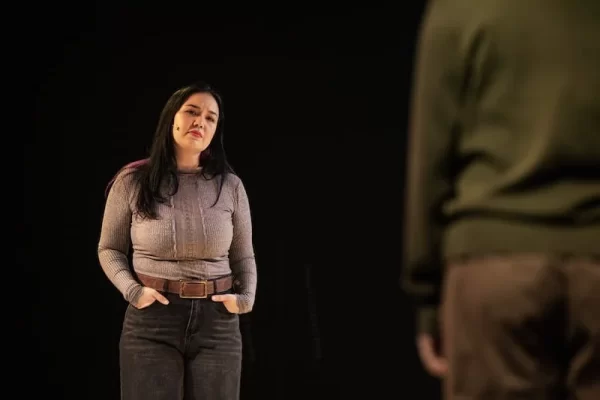
Mikkie Bradshaw-Volante as Raquel; Photo Credit: CJ Ochoa
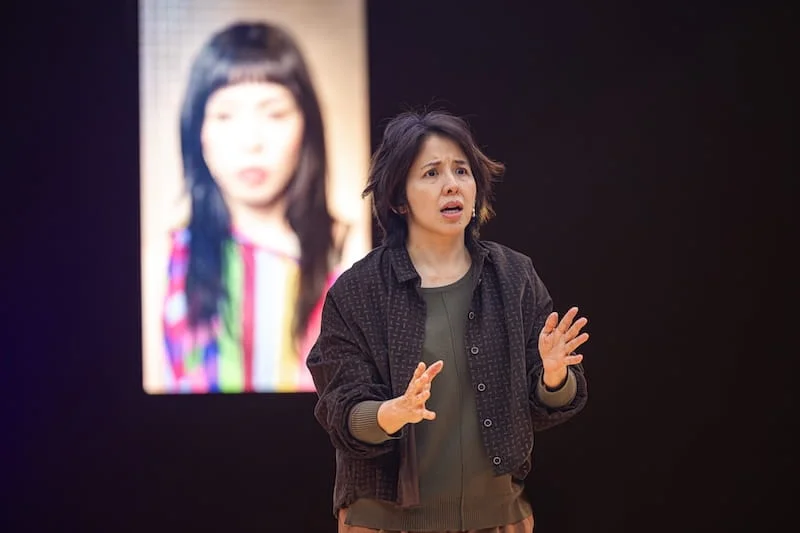
But what really animates anthropology and proves essential to its storytelling is its video design (by Cuecraft Studio and Steven Tansiongco). Four screens positioned around the theater are where Merril’s (played by Jenny Jamora) AI imitation of her late sister Angie (Maronne Cruz) makes her presence known, through a combination of pre-recorded video and a remarkably stable live feed. Every slightly delayed response from Angie only emphasizes the artificiality of the otherwise warm and vibrant figure we see on screen, with tension being heightened through every notification ding and distorted noise that we hear (designed by Arvy Dimaculangan). But as Angie appears and reappears between screens of text and visual information, she also begins to appear hauntingly omnipresent.
Social programming
This tension also trickles into the script itself. The more we’re reminded that Angie is only operating according to her programming, the more that her words can’t be trusted, and the crueler her displays of comfort become. Getting AI to fabricate half-truths to ease people’s grief is an ethical dilemma that Gunderson lays rich groundwork for here. And the question of what an “authentic” caring relationship should look like is made more poignant by having a cast entirely made up of women—already so often scrutinized by the ways they conform to societal expectations of care. Every interaction Merril has with these women is a conversation with an aspect of her past that has messily come to an end, and that she thinks can be fixed by uncovering the truth of her sister’s death.
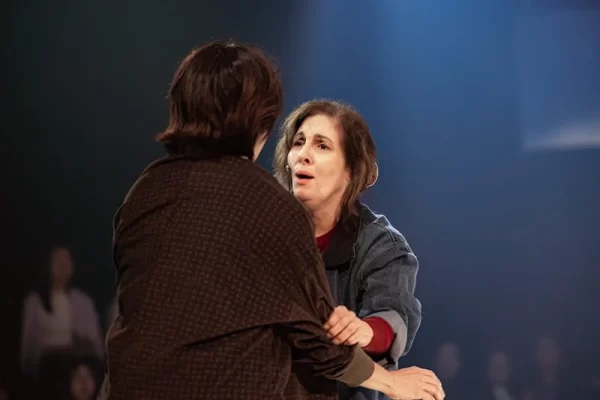
L-R: Jenny Jamora (Merril), Jackie Lou Blanco (Brin); Photo Credit: CJ Ochoa
However, as interesting as the play’s discussions on AI are, its technological questions are essentially set aside as it heads into its climax. Where the story ends up isn’t unwelcome by any means—it only highlights the kind of fractured social environment that makes this technology so attractive to the desperate and isolated. But as new, sensitive themes are introduced in its final act, anthropology’s thoughts on AI ethics become more muted, and the show stops before it can really unpack all this new information. And while it isn’t Gunderson’s fault that real-life chatbot psychosis has only gotten more philosophically thorny than anything she’s written here, this script can’t help but feel like it’s missing more sociopolitical context for how AI technology can harm the vulnerable.
Facing reality
With that said, it’s admirable how playful Caisa Borromeo’s direction is, giving the production the pulse of a thriller despite its “two-dimensional” conversations of a woman talking to a screen. Some lighter moments (in particular, profanity-laden bickering between Merril and Angie) aren’t as funny as they are loud and busy, but Borromeo still maintains an uneasy tension over everything—and she still depends on her actors to carry the technology, not vice versa. Jenny Jamora demonstrates endless emotional stamina, verbally sparring with the AI under the assumption that she’s in control. As Merril’s ex-girlfriend, Raquel, Mikkie Bradshaw-Volante doesn’t get to impose as prominent a presence but acts a strong anchor to rationality nonetheless.
As Merril’s mother, Jackie Lou Blanco arrives with a striking fragility and sense of lived-in history that contradicts everything we hear about the character up to that point. But if anyone serves as the highlight of anthropology, it’s Maronne Cruz. Without ever turning AI-Angie into a sinister caricature, she plays up aspects of the real Angie just to please Merril as a show of artificial mercy. And later on, Cruz becomes just as affecting as a portrait of abject fear and abandonment, an embodiment of the reality so many of us may want to retreat from but must learn to face with courage.
This reviewer watched the 8 PM, March 12 press preview.
Tickets: P2200–2500
Show Dates: Mar 13–29 2026
Venue: Doreen Black Box, Areté, Ateneo de Manila University, Quezon City
Running Time: approximately 1 hour and 40 minutes (without intermission)
Company: Barefoot Theatre Collaborative
Creatives: Lauren Gunderson (Playwright), Caisa Borromeo (Direction), Sarah Facuri (Production Design), D Cortezano (Lighting Design, Technical Direction), Arvy Dimaculangan (Sound Design), Cuecraft Studio (Projection Design), Steven Tansiongco (Projection Design)
Cast: Jenny Jamora, Maronne Cruz, Mikkie Bradshaw-Volante, Jackie Lou Blanco

Comments