

REVIEW: In ‘The Dawn of Ballet’, Ballet Manila Dances to the Beat of The Dawn
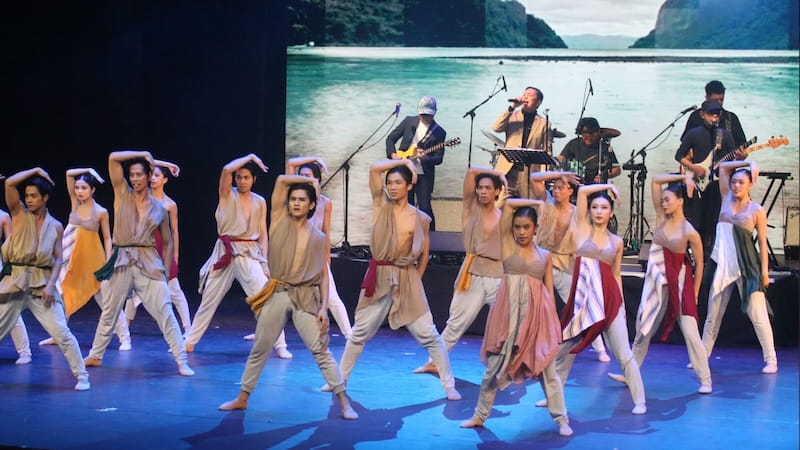
If Ballet Manila’s (BM) pre-season offering The Dawn of Ballet were a dish, it would be Pancit Malabon from a fast-food joint—a jumble of ingredients and flavors, yet surprisingly satisfying. The 31-year-old company teams up with The Dawn, an OG Filipino rock band whose music blends new wave, post-punk, and classic rock influences, providing a vibrant backdrop for ballet.
Choreographers Gerardo Francisco, BM’s associate artistic director, and choreographer-in-residence Martin Lawrance bring new energy to the stage, interpreting eight of the band’s greatest hits. The result is refreshing: a ballet infused with the pulse of drums, electric guitar, and the raw spirit of rock.
ABSTRACTION
The program opens with a mystical tableau: 40 dancers kneel on a dimly lit stage, LED candles flickering softly as they bow before the Virgin Mary. The mood is reverent. British choreographer Martin Lawrance says it’s a celebratory ritual marking the 40th anniversary of The Dawn, founded in 1986, and BM’s artistic director Lisa Macuja-Elizalde’s return from Russia to start her career in the Philippines.
As the lights gradually open, The Dawn appears upstage, immediately shifting the atmosphere into concert-driven energy. The band’s raw, live sound provides propulsion that the dancers feed on, making the movement feel like a physical manifestation of the music’s electric guitar, bass, and drum rhythms.
The opener, Lawrance’s Enveloped Ideas, is an abstraction of the seen and the unseen. The recurring movement originates in the torso, limbs unfurling and retracting like a book opening and closing its pages. Dancers embody the title, moving through sharp percussion with torso accents landing like heartbeats. Soloist Noah Esplana spins like a tornado then sweeps diagonally across the stage with athletic contemporary precision. As more dancers fill the space, the solo melts into a synchronized ensemble.
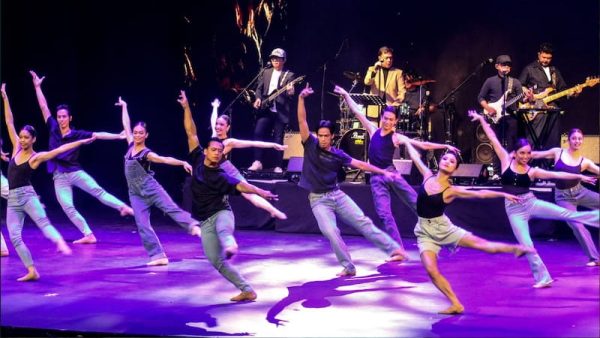
The company of Ballet Manila with The Dawn in Enveloped Ideas; Photo Credit: Erickson Dela Cruz
The music swells, layered with brass and repeating guitar patterns, driving jumps, side tilts, and flowing unison. Vertical movements and partnered lifts give way to floor-bound slides and paired swings. The transformation from individual energy to collective unity becomes a living “envelope,” wrapping the performance in shared intensity and celebration.
In Love Will Set Us Free, Lawrance emphasizes velocity and release. The ensemble bursts into airborne jumps and sweeping phrases, punctuated by an over-the-shoulder lift where the woman extends horizontally like a board as her partner turns, an image of freedom and trust. Rafael Perez commands the stage in a solo, powered by the electric guitar’s wah-wah pulse, showcasing his signature turns. Couples gather and disperse in fluid groupings, propelled by the live band visible against a saturated red LED backdrop.
Midway, a duet introduces nuanced partnering: assisted turns, shared weight, and held catches prolong the emotional peak before the choreography expands into full ensemble patterns of jumps, directional shifts, and bursts of floor work, sustaining the music’s driving tempo.
JUST LIKE BEFORE
Francisco’s Tulad ng Dati centers on couples and the push-pull of relationships, closely tracking The Dawn’s rock anthem with Jett Pangan’s yearning vocals. The steady, galloping drumbeat drives the runs, jumps, and sharp directional changes, while melodic guitar lines open into sweeping stage patterns. Drum crashes and guitar shifts prompt sharp turns or sudden floor drops, while sustained vocal notes are mirrored in controlled extensions, creating a visual “stretch.”
Ballet technique is evident in pointe work and refined lines, delivered with a grounded, athletic attack that matches the rawness of the live music. Partnering underscores the theme of longing: dancers reach for each other on sustained phrases, separate on accented beats, or mirror one another across space. Different couples hint at past loves and love triangles, punctuated by Francisco’s flashes of bravura lifts, physically embodying the pulse, phrasing, and emotional arc of the music.
Lawrance’s I Saw You Coming In spotlights Joshua Enciso, whose intensity and physical command have made him a recurring lead, partnered with BM It Girl Shamira Drapete. The premise is spare: Enciso and two companions occupy a barren landscape when Drapete appears as a charged vision, desire under restraint. Drapete moves with precision: sharp head snaps, weighted steps, poised arms, and transitions driven by breath rather than melody. The men cross swiftly in the background, contrasting the tension of the couple.
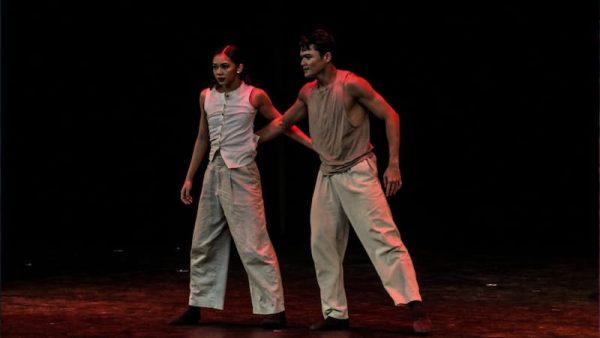
Shamira Drapete, Joshua Enciso in I Saw You Coming In; Photo Credit: Erickson Dela Cruz
A striking image emerges when Drapete hurls herself into Enciso’s arms, body straight and horizontal like a plank, fusing trust and risk. Their partnering sustains unresolved tension, with his friends as physical and emotional counterweight. The minimalist, pulse-driven score reinforces simmering anticipation, allowing choreography to speak louder than overt drama.
The mood shifts into a more lyrical tone with Saan Ka Pupunta. Francisco, known for his skill with group dances, emphasizes directional movement: the ensemble flows as one, with body waves and shifts guided by lyrics, embodying the question, “Where are you heading?” A soloist parts from the group, then returns to help form a sculptural human pyramid, its overhead lift illuminated for dramatic effect.
The ensemble breaks into clusters, suggesting relationships and shared journeys. Brief partnering—hands meeting, bodies exchanging weight, then separating—visualizes connection and departure. Sustained guitar lines support longer suspensions and turns. The group often faces outward, bodies angled in multiple directions, reinforcing the theme of searching or choosing a path before transitioning to the next musical segment.
SHADOWS AND BOATS
I Stand With You is driven by a powerful rock track, concert-style energy amplified by drums and gritty electric guitar riffs. Lyrics such as “In a house of sorrow, in a house of pain” set a somber, almost desperate tone. Abigail Oliveiro and Mark Sumaylo form the emotional core, with his inner shadows portrayed by four dancers in black unitards. These moving shadows contrast the couple’s intense poses, amplifying tension.
Oliveiro in red and Sumaylo in gray combine long, fluid extensions and intimate partnering with sudden, sharp interruptions. Lifts convey both strength and vulnerability, while the ensemble moves with grounded, explosive energy—high-flying jumps and floor rolls echoing the guitar’s intensity. The interplay between the couple’s intimacy and the ensemble’s force create a dynamic balance of human drama and collective power. In all, Lawrance’s works are well thought of.
Francisco’s Isang Bangka translates The Dawn’s rock anthem into a visual celebration of unity and resilience. The drumbeat and bassline evoke the rowing, creating constant forward momentum, while soaring electric guitar lines and emotive vocals amplify collective purpose. Choruses such as “sama-sama (togetherness)” and “isang bangka (one boat)” act as communal calls, mirrored by the ensemble’s synchronized rowing gestures.
Floor work and undulating body rolls evoke water, while acrobatic lifts symbolize lifting one another in times of struggle. Long white veils, manipulated as waves or sails, add ethereal beauty and emphasize coordination. The choreography mirrors the music’s dynamics: contained, rhythmic motion during verses expands into high jumps and wide arm spans at choruses. Against island and beach backdrops, the piece balances grounded rock energy with balletic lightness, celebrating Filipino resilience, rhythm, and unity.
BAND AND BALLERINA
I would have enjoyed the program more if the musical direction had been clearer and if Ballet Manila had more time to rehearse. Although The Dawn curated songs that are powerful on their own, the arrangements lacked a compelling arc. There was little breathing room for the audience to absorb one high-energy dance before being launched into the next.
While the choreographers created a story—from the abstract contractions in Enveloped Ideas to expansive group work with sail-like props in Isang Bangka—the music didn’t quite rise to match these shifts. Some pieces felt rushed, perhaps a consequence of Francisco juggling multiple projects: restaging Ibong Adarna in Dumaguete to be shown at the end of February and Sleeping Beauty in mid-March. The effect was most apparent in the encore, Salamat, which felt like a patchwork of excerpts rather than a fully realized finale. At least, he deserves a trophy for multi-tasking.
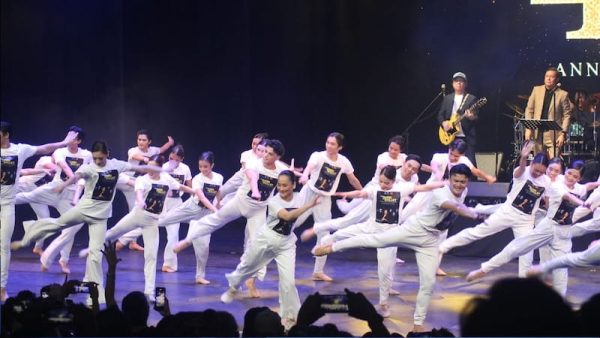
Lisa Macuja-Elizalde dances with the company in Salamat; Photo Credit: Erickson Dela Cruz
The dancers occasionally appear under-rehearsed, with side tilts that didn’t quite lean toward the floor or contractions originating in the shoulders rather than the core. Sometimes the dancing seem rushed or lacking in dynamics. For audience members not attuned to the dance language, the evening can read as a nonstop sequence of running, jumping, floor rolls, and overhead lifts with swinging partnering. It is undeniably busy, but despite these imperfections, the show remains an enjoyable, energetic celebration of music and movement.
The Dawn of Ballet intertwines a conversation between the band and Ballet Manila’s artistic director and CEO, Lisa Macuja Elizalde, highlighting parallels in their careers. Band leader Jett Pangan paid homage to Teddy Diaz, the group’s original guitarist who died in 1988, without dwelling on the grisly details.
Just as the band was rising in popularity, Diaz was stabbed to death in front of his girlfriend’s home in Quezon City by two men reportedly under the influence of alcohol and drugs. Despite his attempt to hand over his wallet, one assailant fatally stabbed him in the throat. His murder, which occurred only weeks after the release of The Dawn’s second album, I Stand with You, shocked the Filipino music community and became a turning point in the band’s career.
That same year, Elizalde’s “personal tragedy” unfolded onstage when she performed as the guest artist in the Royal New Zealand Ballet’s Romeo and Juliet, portraying the fated heroine. In both cases, loss and resilience shaped not only their art but also the way they connect with audiences.
Tickets: Free Admission
Show Dates: February 20 and 21, 7:30 PM
Venue: Aliw Theater
Running Time: 1 hour
Producer: Ballet Manila
Creatives: Gerardo Francisco and Martin Lawrance (co-choreographers), Lisa Macuja-Elizalde (artistic director)
Cast: The company of Ballet Manila
Comments