

REVIEW: An intriguing ‘Master Class’ orbits around its tragic, towering opera star
“While it may not be as powerful as Maria Callas herself, Philippine Opera Company’s biographical play finds its strength in Menchu Lauchengco-Yulo’s stunning performance.”
In the comfort of a theater, watching a piece of art is often a gratifying experience, as we get to appreciate the result of so much hard work having been molded into one cohesive thing. When this same theater is still being used as a rehearsal space, however, it can become a fierce battleground between egos, techniques, and—in Philippine Opera Company’s production of the Terrence McNally play Master Class—against the very history and tradition of one’s art form.
Presented as a public mentoring session between the legendary opera diva Maria Callas (played by Menchu Lauchengco-Yulo) and several opera singers in training, the show functions as a biographical drama of a different kind, as we learn about Callas’ particularly tortured past purely from on stage and in her head. Unfortunately, the resulting production isn’t nearly as powerful as the iconic artist at its center, as it struggles to keep a consistent hold on the very concept of its being a master class. Still, McNally’s script creates an intriguing, comprehensive portrait, with all roads leading to a toweringly accomplished performance by Lauchengco-Yulo.
Reality on stage
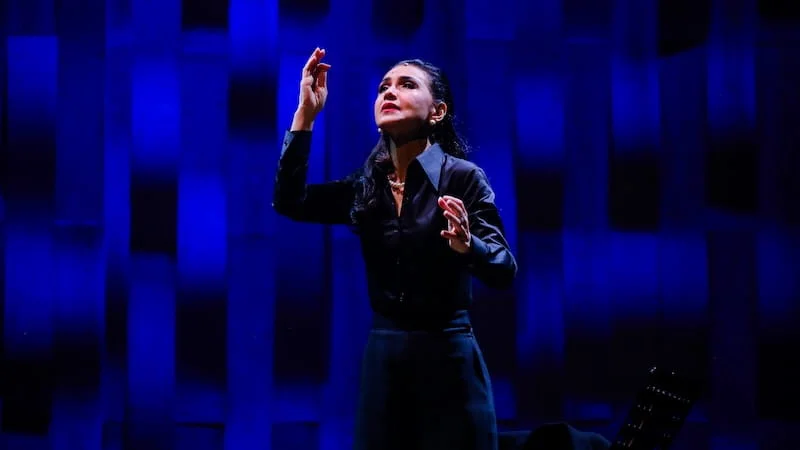
The play begins with the house lights still on, as Lauchencgo-Yulo, already in character, strides down the theater aisle. Joey Mendoza’s set is kept realistic, furnished as a soundproofed rehearsal room with little else aside from a piano on stage. One of the first things Callas tells her audience is the importance of having a “look,” and as the other characters enter, we understand (through Zenaida Gutierrez’s costumes) how these students may only see opera as a light hobby, a romanticized ideal, or a shot at fame. In contrast, Callas’ black suit (specially designed by JC Buendia) is a sleek, bold, professional statement—armor that she dons to protect this art form that has become her life.
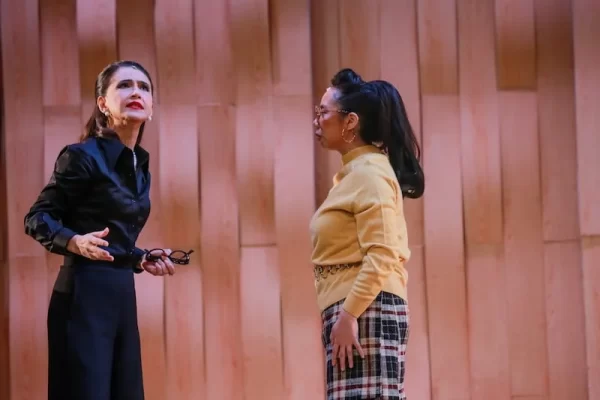
L-R: Menchu Lauchengco-Yulo as Maria Callas, Alexandra Bernas as Sophie de Palma; Photo Credit: Myra Ho
However, even as Callas directly addresses the audience, Master Class loses focus when handling its supposed lack of a fourth wall. The stiff, mannered way in which the supporting actors have been directed clashes sharply with Lauchengco-Yulo’s naturalistic approach, and the script’s dry humor occasionally misses its mark because the show can’t decide on the tone of its own reality. Only when director Jaime del Mundo gets to scenes in which Callas actively coaches the students, letting the music speak for itself, does the play really hit its stride. Both acts culminate with Callas retreating into extended inner monologues, which del Mundo wisely allows Lauchengco-Yulo to carry all on her own, supported only by D Cortezano’s strong, hypnotic lights.
Death of the artist
Just as the production takes a moment before it starts to become more comfortable, McNally’s script also takes some time to find its footing within its rigid structure. Act one spends far too long on Callas’ first student, whose interactions with the opera diva just aren’t all that interesting or revelatory. Here, any snarky jokes made at the expense of the younger singer may only seem funny thanks to Lauchengco-Yulo’s delivery, not due to the writing itself. But Master Class fares far better in its second act, which varies its structure enough to stay surprising, and introduces new characters who successfully poke holes in Callas’ ego to get her to reveal more about herself than intended.
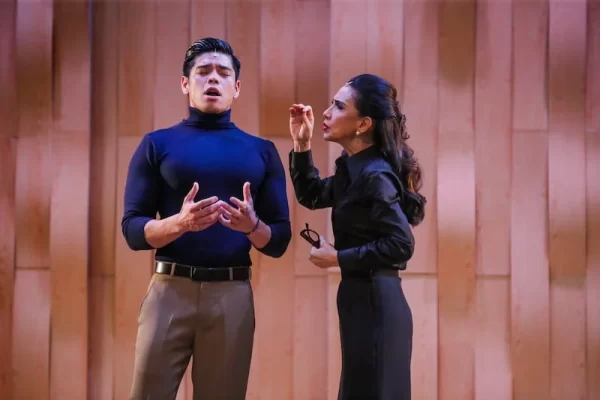
Arman Ferrer as Anthony Candolino, Menchu Lauchengco-Yulo as Maria Callas; Photo Credit: Myra Ho
And while the show seems to depend so much on its ending monologues, McNally is still able to create tension through them. What becomes striking through these outpourings of information about the ways Callas was mistreated throughout her whole life is the realization of who she’s actually become at the other end. This is not a story about a woman’s triumph against all odds; rather, Maria Callas the human being is now just Maria Callas the ideal—forced to represent a standard that other opera singers pursue, which she was only able to achieve herself through so much suffering. When she hears her students sing, she seems to react in both wonder and fear of all that she’s been through.
All in the voice
Every element of Master Class really does orbit around Callas. However, this doesn’t mean that the other performances surrounding Lauchengco-Yulo shouldn’t be trying to challenge her as well. The supporting performers are clearly talented opera singers first and actors second—but when some of their acting choices ring artificial, they end up breaking the illusion that this play is meant to be presented as realistic. To their credit, though, Louie Angelo Oca (as the pianist Manny) stays present and receptive to everything he sees from his corner of the room, while Angeli Benipayo (as bubbly soprano Sharon) still lands comedic beats with real charisma.
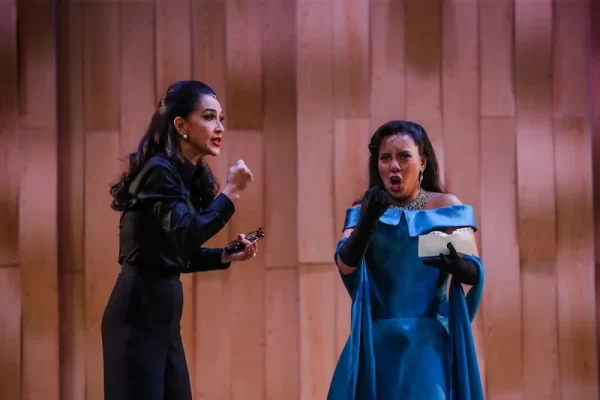
L-R: Menchu Lauchengco-Yulo as Maria Callas, Angeli Benipayo as Sharon Graham; Photo Credit: Myra Ho
With that said, everyone else is understandably under the shadow of Lauchengco-Yulo, who puts on a stunning showcase of her own with every tool she has at her disposal. Even if Callas doesn’t sing in this show, so much of the role depends on voice. Lauchengco-Yulo understands how to conduct an audience’s sympathies through the slightest shifts in vocal tone, at turns authoritative, sharply funny, and unexpectedly thoughtful in her wisdom. And during the stream of consciousness of Callas’ monologues, the actress morphs through various ages and figures in the artist’s life, her identity fragmenting before us. There are layers upon layers to this performance, coursed through the operatic characters Callas has played, and Lauchengco-Yulo echoes all of these voices without letting us forget the real person hidden underneath.
This reviewer watched the 8 PM, May 15 gala performance.
Tickets: P2,300–4,000
Show Dates: May 15–30, 2026
Venue: Carlos P. Romulo Auditorium, RCBC Plaza, Makati City
Running Time: approximately 2 hours (with a 15-minute intermission)
Company: Philippine Opera Company
Creatives: Terrence McNally (Playwright), Jaime del Mundo (Direction), Joey Mendoza (Set Design, Projection Design), D Cortezano (Lighting Design), Rards Corpus (Sound Deign), Zenaida Gutierrez (Costume Design), JC Buendia (Costume Design), Mamarhaye dela Cruz (Hair and Makeup)
Cast: Menchu Lauchengco-Yulo, Alexandra Bernas, Arman Ferrer, Angeli Benipayo, Louie Angelo Oca, Jaime del Mundo, Nelsito Gomez

Comments