

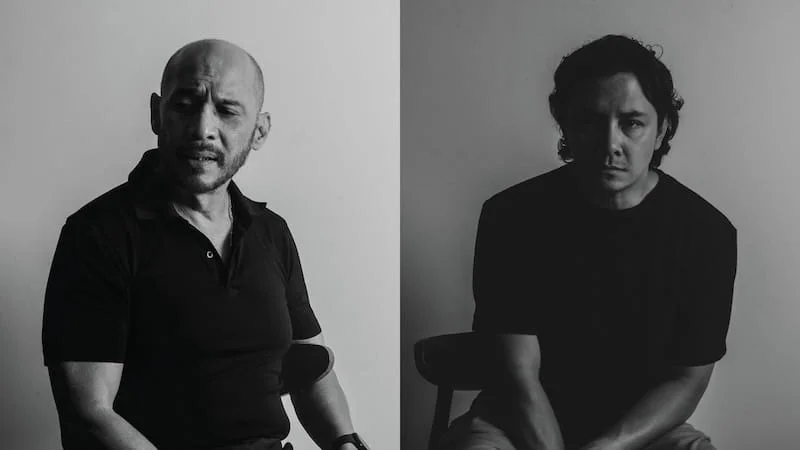
‘A Number’ tackles identity and father-son relationship in the age of AI
Caryl Churchill wrote A Number during the height of the controversy of the cloning of Dolly the sheep in the early 2000s. While that incident is probably unknown to many young theater goers today, the play is still relevant because it discusses the same issues: the essence of identity, parental relationships, and the incessant debate of nature vs. nurture.
Maintaining that position are the producers, The Necessary Theater and WHYNoT, of the new Manila play that will run for two weeks this October. JC Santos makes his directorial debut while playing the son who was cloned or is the source of the clone opposite Bart Guingona’s desperate father. The two actors last performed together in the critically-acclaimed Red in 2023.
While cloning may not be at the forefront of people’s minds today, preservation and protection of their identity is. “There are people who are being replicated online, digitally, who are not who they are,” said Guingona during the press conference on September 24. This play “is like a precursor to that, the whole idea that now you can replicate people, do fake versions of the same person.”
Which version?
Ultimately, the play asks, “How ethical is the whole idea of using a technology for your own selfish means? So, it’s a cautionary tale of someone who went to the wrong hands with technologies when people tried to play God,” he added.
The two excerpts during the press con showed the original son and at least one clone interacting with the father on two separate occasions. One version hated the father for abandoning him as a child. The second version loved the father for raising him with care and devotion only to discover he is not the original. The father’s reason for cloning his boy will be revealed during the play.
However, the revelation triggers an unwelcome awakening for the non-original version or clone. As Santos put it, “Can I still love this father while he’s actually checking my identity if I’m not real or if I’m real?”
Santos first read the script when he was in drama school in New York in 2013. He thought of it while musing about the kind of play he would do again with Guingona. A Number was easy to mount, it only had two characters, it ran for only an hour, and it was intellectually engaging.
“There is a mystery and a thriller,” said Santos, “and I want to go deeper.”
Fatherly influence
Yet underneath all the dark sci-fi elements was a “healing process” between the onstage father and son. Santos could identify with the younger man’s resentment towards the older one. He was a child of OFWs who kept “blaming them [his parents]” for the distance. Now as an adult, he is communicating with them again. One lesson learned through that trial was “to be more present for my daughter” who is 6 years old.
Because as psychologists point out, childhood and parenting shape adulthood. “We are not self-made,” Santos continued. Identity “starts at the home that you grew up in, the home that you’re building.”
He has come to appreciate his parents and their generation: “They weren’t taught to feel.
They’ve been enduring and resilient. They weren’t taught to process at that time. They were taught to survive.”
Guingona echoed that the plot revolves around the father’s quest for redemption and a second chance. At the same time, the son does a lot of growing up.
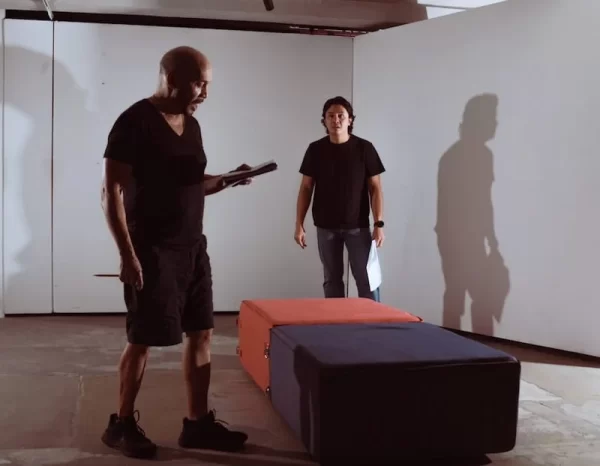
L-R: Bart Guingona, JC Santos in rehearsals; Photo Credit: WHYNoT
As the play starts, the son appears to be the weaker character. “But you will see he’ll come into his own,” said Guingona. “Then you will find that the weakest person in this entire thing is the father.”
What also drew the actor to the material was the sheer intellectual and mental challenges it presented. The “stream of consciousness” script, which had no punctuations, was hard to memorize and analyze. “You have to engage your brain to let the language take you where it’s supposed to take you.”
Reflecting this journey is the set design which will have infinity mirrors that will show back the characters’ layered identities. It will actually invite the audience to sit behind the mirrors, giving them literally different perspectives, and changing them from mere spectators to jurors of the drama.
Collaboration
While the tension between father and son will be palpable, the behind-the-scenes dynamics between the veteran stage actor-director and his younger counterpart is more free and mutually supportive. Guingona jokingly said that one condition for him to appear in the play was that Santos directs this time. Guingona was the director during Red. He laughingly added that during the latter’s rehearsals, during dinner breaks, Santos would suggest how to approach certain scenes. “He would be directing me,” he said.
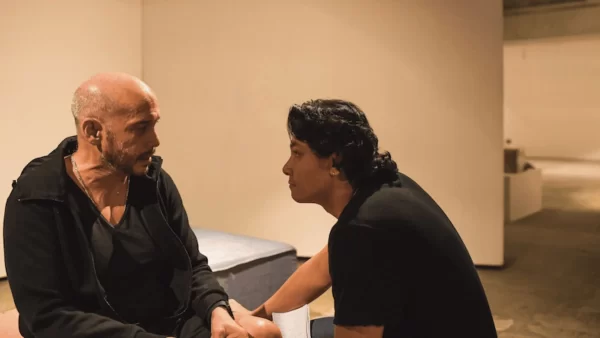
L-R: Bart Guingona, JC Santos in rehearsals; Photo Credit: WHYNoT
When it was time for A Number, they left “our egos outside the door,” he continued. “I totally respect his vision,” he said of Santos. “He has fresh ideas and perspectives.
“He does his homework and he comes in prepared. He has intelligence that is both instinctive and artistic.”
Meanwhile, Santos said that the one thing he appreciates most about Guingona “the legend” is his “always leaning toward learning. I am learning a lot of things from him. It is like I am in college when I am with him.”
Guingona, who has been busy with film projects recently, admitted that he has not joined theater productions with big casts “not because I am suplado” but because he prefers plays that will “engage me, body, heart, and soul. If I’m going to do theater, it has to change me in some way” as an artist and “even as a human being.
“It has to alter my perceptions about realities and make me a little wiser. I need to walk away a little wiser. I find that the two-handers, the monologues, or the intimate spaces have the ability to make your soul. You’re able to shovel all the dirt out, and dig deeper until you get to the heart.”
Can the audience of A Number expect to have that experience?
“They are going to think about what is happening,” said Guingona. “But as it all falls into place, brick by brick, they are going to be stunned by the work.”
‘A Number’ runs for nine performances only from October 9 to 18 at WHYNoT, 4/F Karrivin Studios, Makati. Each performance is limited to 80 seats, with free seating.

Comments