

Areté’s ‘Karmen 1949’ Asks the True Meaning of Freedom After Devastation
Bizet’s classic opera becomes a fast-paced musical piece anchored on Filipino sensibilities.
Is liberation, or wresting control from oppressors to attain socio-political and/or individual self-governance, really freedom? And what does freedom truly mean? That’s what the creative team behind Arete’s Karmen 1949 wants to unravel while introducing Georges Bizet’s famous 19th-century opera, on which it is based, to a younger audience.
The French composer’s Carmen is one of the world’s most popular and highly acclaimed operas, its lead role sung by no less than legends like Maria Callas. At the same time, it made history by causing a stir in Europe during its first performances, presenting its title character as a liberated woman who bucked the conventions of her time. A free-spirited gypsy in Spain, she defied traditional norms and did whatever she wanted, lived wherever she pleased, and loved whomever she chose.
An embattled environment
Karmen 1949 brings that story and its characters to Manila in 1949, a city that is still coming to grips with its identity after being given its political independence by its American colonizers only a few years earlier. On top of that, the former “Paris of the East” is still recovering from the trauma and damage of the Second World War. “During that particular period, everybody was talking about freedom but nobody really knew what it meant,” said dramaturg Eric V. Dela Cruz in an interview with TheaterFansManila.com. As his research revealed, the Filipinos of that era noticed the contradictions that belied their true state; America still had great economic influence on its former colony, exploiting its resources while managing a trade imbalance that restricted the flow of Filipino products into its shores.
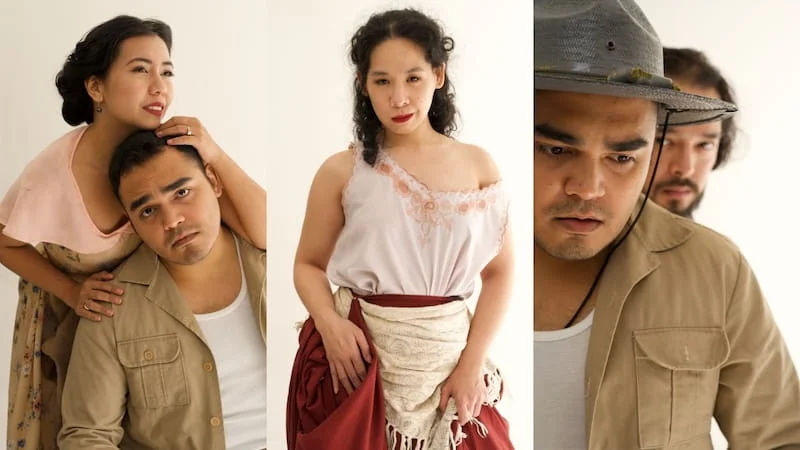
In this embattled environment, Karmen (Roxy Aldiosa) makes a home out of a former movie house, “dragging a poster of Rita Hayworth,” a 1940s Hollywood movie star, “and almost worshipping it,” said director Jaime del Mundo. “In a theater that is filled with Filipino movie posters, there is an American [image]. So she’s doing things her way.”
View this post on Instagram
This image of fighting for one’s passion amidst a devastated landscape was partly inspired by the ruins of a bombed-out movie house that del Mundo had seen in a trip to Corregidor. Coincidentally, according to his research, the building did show in the 1940s a film titled “The Loves of Carmen” starring Hayworth. Another inspiration is the landmark The Metropolitan Theater which was not rehabilitated properly after the war, said Dela Cruz. As a result, it was divided into separate areas that became “a boxing ring, a hotel, and a cheap motel where there were sex workers.”
While this Karmen is also a prostitute by trade, del Mundo said, “She’s not interested in sex. She’s interested in freedom. She sleeps with people for money. But that’s a means. It’s not who she is.”
The spelling of the character’s name also drives home the search for identity and authentic freedom. After the so-called liberation, said Dela Cruz, Filipinos who were “against colonial mentality or the former colonizers were translating their names into the Filipino alphabet.”
Filipino milieu
The letter K represents “Filipino sensibilities and the socio-cultural context,” continued Dela Cruz whereas the very familiar C conjures up Bizet’s Italian roots. Adding to the local color is that Karmen is Waray while her obsessed suitor Jose is an Ilocano.
Jose (Bryan Homecillo), who brings the tragedy into the narrative, is a Philippine Constabulary soldier with a history of violence. He represents the polar opposite of Karmen, said Dela Cruz: “He’s looking for order or security in an environment that’s chaotic. He thought he would find it with Karmen but she was not giving him the assurance of a commitment. That’s why he lost his mind.” In casting for the role during auditions, del Mundo was looking for an actor who was “a cross between a puppy dog and a serial killer.”
View this post on Instagram
Del Mundo, who had already directed two versions of Carmen—one in Italian, another in French—wanted the pieces to be sung in Tagalog. The finished translation will not sound like Balagtas or characters from Rizal’s novels but “will still be true to the era, and will be understandable,” said musical director Farley Asuncion who co-translated the original material with assistant director Angeli Benipayo.
Having directed at least a dozen operas, del Mundo advocates performing these art forms “in the vernacular,” or in a language, such as English or Tagalog, familiar to the community the production is performing for. “It’s the only way for the traditional opera to get new audiences.” He pointed out that the original pieces, which were written in Italian, German, and French were “written for Italian, German, and French audiences. The composers themselves would have their librettos translated if they went to another country.”
Listening during rehearsals, Dela Cruz found that “the lyricism of the Tagalog matches perfectly with the grandiosity of the music of the opera.” He also maintained that the vernacular provides the Filipino audience access not just in terms of intellectual understanding but also emotional resonance.
Perhaps for the same reasons of accessibility, Karmen 1949 has streamlined the original four-act version with its chorus and 40-strong cast members into a 70-minute production with just seven characters including Karmen and Jose.
A musical piece
“This [production] is stripped down,” acknowledged Dela Cruz, “It focused more on the relationship of the characters.” While Bizet’s Carmen normally uses a huge cast and spectacle to paint its period’s particular “socio-economic environment,” he said that their team will be “tapping into the collective memory of post-war Manila. That memory is in our genes. When we see the characters, we know where they came from and their situation. We don’t need all those choruses to tell us how poor it was [then].”
Due to budget and space constraints, the music, which is still Bizet’s traditional orchestration, will be played on a track and not performed live by musicians.
Perhaps because of all these changes, del Mundo prefers to define the 70-minute Tagalog-sung Karmen 1949 as “a musical piece. In the traditional sense, it’s really not an opera.”
This blurring of the line between opera, musical theater, and other artistic production pieces might actually be advantageous to the kind of audience Areté wants to attract. “The younger generation of audiences now do not necessarily separate an operatic show from a musical,” said Heleynah Galan, the production’s marketing director who herself belongs to that younger demographic. “They’re becoming more and more curious about different styles of theater. They see operas online and abroad, and what they offer. They are now more open-minded in the things that they consume, and they want to experience it.”
Karmen 1949 runs at the Areté, Ateneo de Manila University for two weekends, from November 13 to 15 and November 20 to 22, 2026. Performances are on Fridays at 8 PM and Saturdays and Sundays at 3 PM and 8 PM.

Comments