

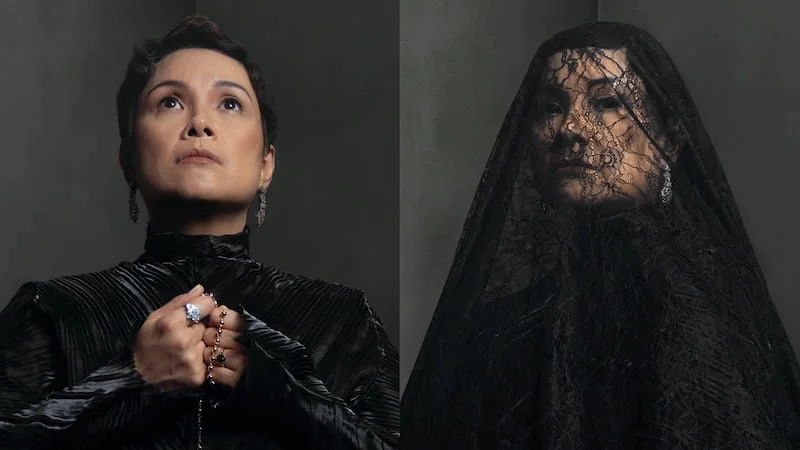
Lea Salonga on Finding the Humanity in Complex Characters and Why ‘Ang Tahanan ni Bernarda Alba’ Still Resonates
“The actress reflects on what draws her to dark and complex characters, why Bernarda Alba is more than a tyrant, and how the play can remind modern audiences to keep fighting for women’s rights.”
Lea Salonga is becoming Bernarda Alba.
As the stage and screen actress prepares to play the titular role in Theater Group Asia’s upcoming production of Ang Tahanan ni Bernarda Alba, TheaterFansManila.com sat down with her for a quick chat about portraying complicated characters, learning the tongue-twistery lines in the script, and reckoning with the colonial influences and feminist implications of the play.
As previously announced, this will be the Philippine premiere of Chay Yew’s adaptation of Federico García Lorca’s The House of Bernarda Alba, translated into Filipino by Guelan Varela-Luarca.
Colonial influences and familiar beats
This will be the first production where Lea will perform her role completely in Filipino although she shares that the language used in this translation is a mixture of Filipino and Spanish. Terms like “materiales fuertes” are used when describing the women in the community, for instance.
When Lea described her character to another journalist, the latter recognized the Philippines in Bernarda’s character and Lea links this to the fact that the play was originally written in Spanish and has left traces of colonial oppression and collective trauma. “Spanish colonial rule left a mark. It didn’t always leave a mark in tangible things, but in traditions that get passed down for better or worse. In this case, for worse.”
She also mentions that the dysfunctional family dynamics in this play that was first staged in 1945 Buenos Aires will resonate with 2027 Filipino audiences. Many of the characters’ experiences will be painfully familiar with Filipinos. “Who doesn’t remember being on the receiving end of a slipper? Or a slap in the face? Or anything. These things leave a mark.”
On playing dark and complex characters
Lea has recently played dark, complex characters such as Mrs. Lovett in Sweeney Todd (2019), The Witch in Into the Woods (2025) and sometimes even outright villains like Madame Thénardier in Les Misérables: World Tour Spectacular (2026). In the Dreamworks animated film, Forgotten Island, she even plays a mythological monster, Manang the manananggal; quite a departure from being the singing voice of two Disney princesses.
When asked what makes her sink her teeth into such roles, Lea admits that she finds them more fun. She also enjoys finding the humanity in these characters and understanding their motivations.
“With Mrs. Lovett, it’s very simple. It’s the Industrial Revolution, and this woman is running out of supplies for her meat pies. Here comes an opportunity, and she took it. All of a sudden, she’s begun to enrich herself. I mean, we know how this musical ends: she gets chucked into an oven because of her deeds.”
Finding the humanity in morally complex characters is the same approach she is taking to tackling Bernarda Alba so that she can avoid portraying the latter as a one-dimensional villain. Lea is deeply interested in understanding what has made Bernarda the way that she is.
Building Bernarda
The play follows the titular matriarch, who imposes an eight-year period of mourning on her five daughters following the death of her second husband. Confined in silence, restrained by tradition, and obsessed with reputation, the Alba household becomes a prison for all its inhabitants, with Bernarda as its warden. But tensions escalate, particularly with the arrival of a potential suitor for one of the daughters, and the carefully maintained balance is thrown into disarray as the women begin to understand their desires and the lengths to which they are willing to go to acquire them.
Bernarda Alba is not an easy character to crack and Lea herself admits that Bernarda is hard to like. But Lea loves how determined Bernarda is to uphold her family’s pristine reputation. She also admires the fortitude with which the character faces life, a trait that Lea suspects was trained into her.
“Because I don’t think a woman like this comes out of nowhere. I don’t know that she’s a dyed-in-the-wool tyrant, but it’s probably the way her own households as a child were run. And so, she is going merely by the examples of parenthood that she saw and modeled her own style after.”
But while she admires certain traits in the character, Lea also hates that Bernarda is “not above physically hurting another human being to get what she wants.” Such actions are rooted in the character’s internalized misogyny where, in her desire to protect her daughters, she also causes them great pain.
Much of the play’s conflict explodes when Bernarda’s daughters begin to rail against the constraints their mother has imposed upon them. And as they struggle to regain some of their agency, Bernarda’s response is to tighten her grip and inflict more cruelty on them.
Lea shares an example of this and how Guelan Varela-Luarca’s choice of language, using alliteration and repeated syllables, intensifies the scene. When Bernarda sees one of her daughters wearing makeup, she calls her out:
“You look like a cheap whore. The word that Guelan uses is ‘pipitsuging puta.’ I say cheap whore, you barely react. I say ‘pipitsuging puta’, and immediately it’s a visceral reaction.”
It’s a scene familiar to generations of women who have probably heard something similar from strict, overbearing mothers. While Bernarda may have the best of intentions, she still upholds outdated and destructive norms such as the Madonna-whore complex, where women’s value is defined by their sexual purity, and the notion that marrying one’s daughter off was the only way to ensure her survival.
A cautionary tale of women’s freedom curtailed
On its face, Ang Tahanan ni Bernarda Alba, despite having an all-female cast, does not seem like a feminist play. After all, it focuses on the repression of women and features a great deal of violence against them. But Lea still sees a value in staging such material in 2027, as a vital reminder that we must not revert to such brutal times.
“Current events kind of necessitate a play like this being staged and produced. If only to say, this was written in the 1930s. Doesn’t look like humanity has moved forward very much from that point.”
Despite the bleakness of status quo, Lea hopes that women will continue to have the strength to keep fighting, to never return to the dark confines of Bernarda Alba’s house.
“Let us not go back to days like this, where women had very little options available to them. Let us not give up what so many women, over the decades, have fought for all of us to have.”
Ang Tahanan ni Bernarda Alba will be staged at the Power Mac Center Spotlight Blackbox Theater in Circuit Makati beginning February 2027.
PHOTO CREDIT:
Property of Theatre Group Asia
Artistic Director: Clint Ramos
Executive Director: Christopher Mohnani
Art Direction & Concept by Ernest III
Photos by Jyllan Bitalac; Assisted by Sherie Bolo & Kyle Espiritu
Hair and Make Up by Kusie Ho
Styling by Team Ryuji Shiomitsu
Production Design by Justine Arcega-Bumanlag
Lighting Design by D Cortezano; Assisted by Rafa Sumilong
Movement Direction by JM Cabiling
Produced by Art Directed, Jaz Orbe

Comments