

REVIEW: ‘The Notebook’ is a remarkably gentle take on an epic love story
Theatre Group Asia’s production of the musical based on Nicholas Sparks’ novel is exceedingly warm, elegantly composed, and handles its subject matter with grace.
Say what you will about melodrama, but there is a clear appeal to it that has allowed many soap operas and unabashed tearjerkers to endure as audience favorites: the catharsis it offers is direct and the feelings it puts on display are raw and often unpretentious. A particularly recognizable example of a film made in this same, unapologetically melodramatic style is 2004’s The Notebook, which is in turn based on Nicholas Sparks’ 1996 novel. The stage musical adaptation, produced here by Theatre Group Asia, draws more from the book than the movie, but the plot largely remains the same across all three versions: an elderly man visits his wife—who suffers from Alzheimer’s—in her nursing home, and recounts their love story to her.
It comes as a pleasant surprise, then, that this production resists the easy temptation of indulging in all the heightened emotions and manipulative drama one might expect from a premise such as this. What we get instead is an exceedingly warm retelling of a romance in both past and present, bolstered with an affecting musical score performed by a handful of powerful singers. And despite subject matter that could very well end up becoming exploitative in the wrong hands, the show remembers to let notions of care shine through its tragedy.
Tastefully modest
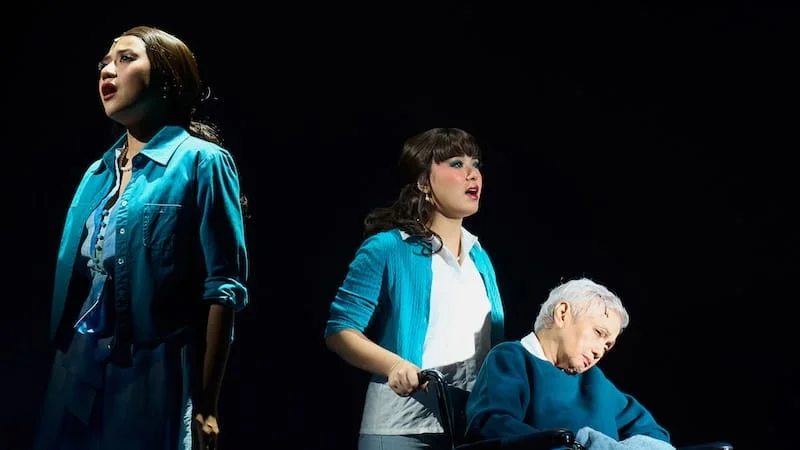
There’s a gentleness to the way that director Nicholas Polonio handles this musical, smartly preventing it from taking on the feel of a sweeping epic and instead keeping things tastefully modest. There are no unnecessarily flashy, large-scale numbers, with the greatest spectacle here arguably being that of rain showering down on the central couple. Polonio is more quietly focused on having the different stages of Noah and Allie’s lives intersect through simple but evocative tableau work. As scenes from their youth, adulthood, or elderly lives play out, characters from other points in time occasionally come into view—at times mirroring the main subjects of a scene, providing context like a living flashback, or directly interacting with the protagonists. For Noah and Allie, the people they used to be and the love they shared are still alive in their memory, fighting to overcome their deteriorating mental faculties.

Benedix Ramos (Younger Noah), Sheena Belarmino (Younger Allie), Jiallian Ita-as (Georgie), Shaun Ocrisma (Fin), Felicity Kyle Napuli (Sarah); Photo Credit: Jyllan Bitalac and Sherie Bolo
This is helped along by Miguel Urbino’s clean, equally restrained production design that strips things down to their most essential elements: the skeleton of the house built by Noah, a small pier where the two lovers first meet, and the lightly furnished walls of a nursing home always present at the peripheries of their minds. The rest of The Notebook‘s world is expressed through a backdrop of moving panels and transparent screens that often form a sky of blue, with Cha See’s soft lighting making tender scenes that much more delicate. Even instances of conflict are approached with a sensitive touch; Polonio doesn’t cheapen these moments, but he treats them matter-of-factly without ever reveling in the characters’ suffering.
Generational yearning
The same sincerity comes through in Ingrid Michaelson’s score (musical-directed by Farley Asuncion), which stays within an earnest mode of folk-inspired singer-songwriter pop. Michaelson knows that she doesn’t need to lean on spectacle either, and her songs here tend to remain understated, expressing yearning or deeply suppressed emotion without necessarily letting the characters’ inner selves scream outwards. But she still creates plenty of space for delicate melodies and striking harmonies—most notably when all three Allies share the stage for “I Wanna Go Back” and when all three Noahs reflect on time slipping away in “Iron in the Fridge.” Even the climactic 11 o’clock number “My Days” feels totally purposeful in its deployment of powerful moments, ultimately articulating Allie’s biggest decision through the simplest, most innocent terms.
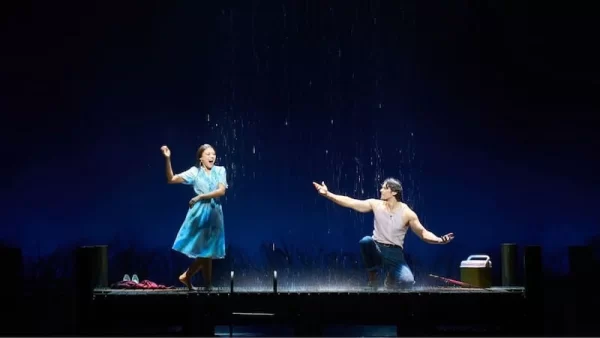
Morissette (Middle Allie), Laurence Mossman (Middle Noah); Photo Credit: Jyllan Bitalac and Sherie Bolo
The Notebook‘s vocal parts are given almost entirely to its six main actors, who always stay sophisticated without slipping into the saccharine. It’s a joy to see a musical’s lead role written specifically for a senior actor, and Rody Vera’s devastating turn as Older Noah keeps the character dignified and hopeful despite all tragedy. Laurence Mossman’s charming Middle Noah finds a bridge between Vera’s humor and the self-effacing nature of Benedix Ramos’ Younger Noah. Ramos is an immediately likable, disarming presence, but his accent work is shaky and his vocal approach to the show’s score comes off much less rounded compared to his scene partners.
As Older Allie, Celeste Legaspi conquers the difficult tightrope of appearing vulnerable and confused without making a caricature of Alzheimer’s. Morissette grounds her Middle Allie in real rationality and not simply raw passion, and the sheer control she displays in “My Days” clearly stems from a full understanding of the character. But it’s Sheena Belarmino’s Younger Allie who is perhaps most impressive—confidently matching the gravity of Morissette’s tone, and balancing innocence with a soulfulness that’s well beyond her years.
Notions of care
That the cast can locate all these nuances is no easy feat given how The Notebook’s story is admittedly quite thin. Scenes between the Young Noah and Allie don’t feel particularly rooted in a strong sense of setting, and the social class conflict that keeps them apart is always politely tiptoed around, as if speaking in specific terms would make the romance less appealing. The dynamic between Middle Noah and Allie is refreshingly mature, but the conflicts that come up between them (especially one involving Allie’s mother, played by Carla Guevara Laforteza) are so cleanly resolved that they lose urgency. The Older Noah and Allie are responsible for easily the most narratively substantial parts of the whole production.
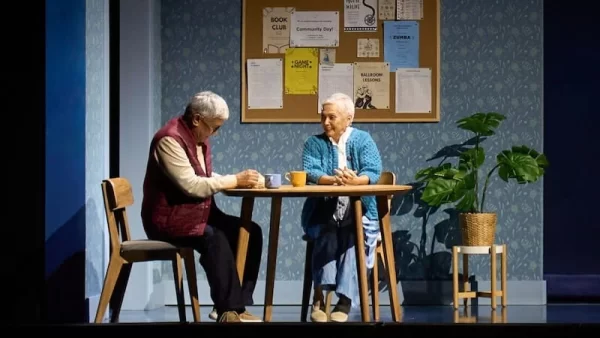
Celeste Legaspi (Older Allie), Rody Vera (Older Noah); Photo Credit: Jyllan Bitalac and Sherie Bolo
And yet, Bekah Brunstetter’s libretto smooths over these rougher edges with clever, engaging dialogue and each version of each character possessing different perceptions of the world around them. Remembrance of a person’s true self serves as a unifying theme, but it’s the show’s centering of care that really distinguishes it. Rather than dwell on Allie’s affliction, which would stop at the level of evoking pity, The Notebook dedicates much time to the patient, consistent process of helping an Alzheimer’s sufferer feel understood. As daunting as it is to deal with, this disease isn’t some impossible, unknowable thing—and neither is our capacity to form a community around those in need. Neither is our ability to love them even when the days get difficult.
This reviewer watched the 7:30 PM, September 2 gala performance.
Tickets: P900–5,500
Show Dates: September 3–20, 2026
Venue: Samsung Performing Arts Theater, Circuit Makati, Makati City
Running Time: approximately 2 hours and 15 minutes (with a 15-minute intermission)
Company: Theatre Group Asia
Creatives: Ingrid Michaelson (Music, Lyrics), Bekah Brunstetter (Book), Nicholas Polonio (Direction), Jamie Wilson (Associate Direction), JM Cabling (Choreography), Miguel Urbino (Production Design), Farley Asuncion (Musical Direction), Cha See (Lighting Design), Jordana Abrenica (Sound Design), Jaydee Jasa (Hair and Makeup)
Cast: Rody Vera, Celeste Legaspi, Morissette, Laurence Mossman, Sheena Belarmino, Benedix Ramos, Carla Guevara Laforteza, Floyd Tena, Shaun Ocrisma, Jillian Ita-as, Felicity Kyle Napuli, Markki Stroem, Kathleen Francisco, Omar Uddin, Justine Narciso, Albert Silos, Katrine Sunga, Edward Benosa, Gimbey dela Cruz, Jamie Wilson

Comments