

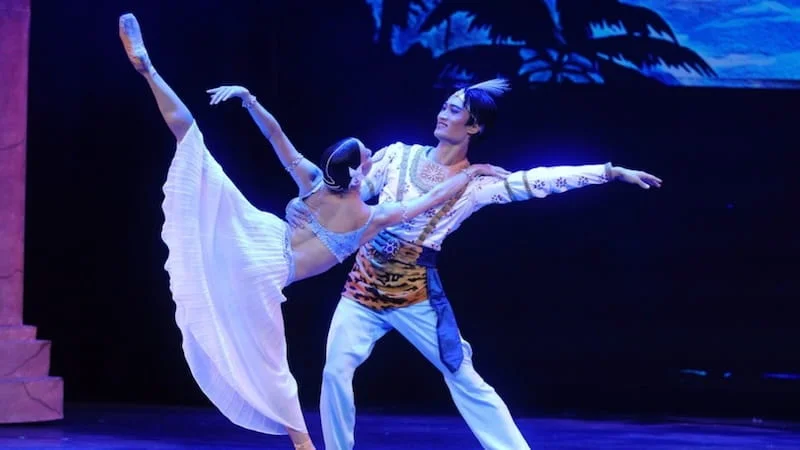
REVIEW: Ballet Manila Raises the Bar with ‘La Bayadère’
In 1986, fresh from the venerable Mariinsky Ballet, Lisa Macuja Elizalde arrived in Manila like a force of nature. Filipino audiences had rarely seen such technical strength, polish and relentless drive for perfection. Four decades later, she continues to raise the bar through Ballet Manila, a company synonymous with the Russian classical tradition and an uncompromising pursuit of excellence.
That commitment is evident in La Bayadère, the season finale, which boasts strength in numbers, with a large ensemble for its many corps dances and a roster of strong soloists. Elizalde has invested in two Russian coaches to raise the company’s technical and artistic standards. To bring true Russian classicism to the production, Mariinsky principals Kimin Kim and Renata Shakirova return to dazzle the audience.
Set in a 19th-century Eurocentric vision of India, La Bayadère centers on the tragic love story of Nikiya, a temple dancer, and Solor, a warrior who swears eternal fidelity to her over a holy fire. Jealous of Solor, the High Brahmin reveals the warrior’s secret oath to the Rajah, setting off a fatal chain of events. Their romance is upended when the Rajah forces Solor to marry his daughter, Princess Gamzatti, who confronts Nikiya. During the betrothal festivities, Gamzatti secretly sends her a basket of flowers concealing a venomous snake. Bitten during her forced performance, Nikiya refuses an antidote from the High Brahmin and dies. A guilt-ridden Solor seeks escape through opium, guided by the Fakir, where he is haunted by visions of his lost love before reuniting with Nikiya in the ethereal Kingdom of the Shades.
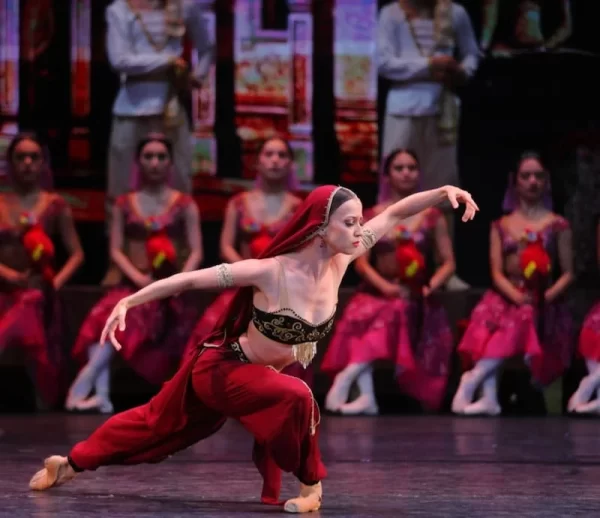
Renata Shakirova as Nikiya; Photo Credit: Konrad Ong
From a cultural standpoint, the ballet’s premise fundamentally misinterprets traditional Hindu customs. Brahmins, particularly high priests, are expected to adhere to strict codes of purity and spiritual discipline. Historically, ascetic traditions often framed worldly temptations and sexual desire as obstacles to enlightenment. The depiction of the High Brahmin obsessed with Nikiya and orchestrating a deadly vendetta out of romantic rejection reflects a 19th-century Western orientalist trope rather than authentic Hindu practice.
STAGE PARTNERSHIP
As Solor, Kimin Kim makes bravura look like play. Where other danseurs can seem to labor through demanding jumps and turns, he attacks them with precision and ease. His circuit of soaring leaps with full turns in midair combines extraordinary height with tremendous reach. The most exciting part is the sudden transformation before takeoff. He gathers himself into a compact coil, then explodes upward and outward into a huge, expansive leap. His pirouettes are equally thrilling, driven by speed but held on a remarkably tight axis, so the rotations appear to snap into place and finish with complete control. Even the most difficult combinations seem to cost him nothing, and his landings are feather light. That effortless command sets him apart.
An exceptional partner, he is attentive to his ballerina, giving her confidence without overpowering her, and makes difficult lifts and supported turns look natural. His strength is always at her service, allowing her to appear weightless rather than showing off his effort.
Kim brings that same restraint to the acting. He conveys the warrior’s love for Nikiya, his unease at being forced to marry Gamzatti, and the guilt and grief that follow Nikiya’s death without overplaying any of it. His emotions register in his reactions and the quality of his dancing. He gives Solor an inner life without turning him into a melodramatic hero.
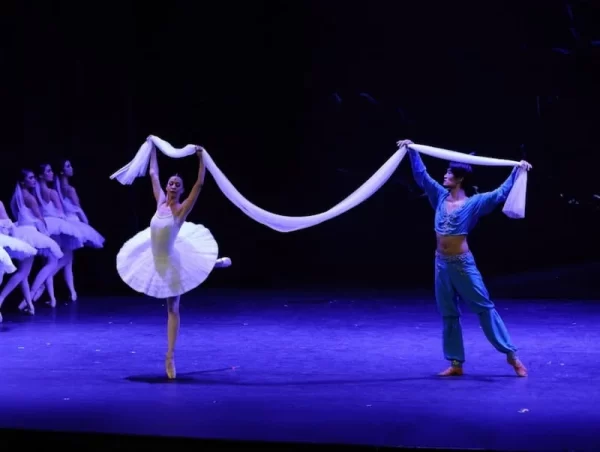
Nikiya and Solor in the Scarf Duet, Act 3; Photo Credit: Konrad Ong
Renata Shakirova, as Nikiya, is the embodiment of pure classicism, displaying the union of strength and softness, clarity and breadth, correctness and musicality. The Vaganova training is known for the coordinated use of the whole body, expressive arms and upper body, strong placement, and effortless control.
Shakirova’s dancing has that balance and control, allowing the choreography to speak for itself. Within that classical purity, her movement is lush and expansive, giving Nikiya a natural sense of longing and vulnerability. Her willowy arms bend and unfurl like branches blown by the wind, while her sharply articulated bourrées, or tiptoe glides, flicker across the stage like a quicksilver current. Her pirouettes in arabesque are solid and assured, anchoring the Scarf Duet with strength. Her big leaps open across the stage like a bird suddenly taking flight, bringing freedom to the dancing. She brings exceptional musical phrasing to Nikiya, and with abandon and dramatic intensity. Her anguish becomes even more compelling.
This prima ballerina does not overplay Nikiya. Her feelings emerge through her face, gaze and movement. With Solor, she conveys tenderness and desire without becoming sentimental. In the next act, she refuses to be diminished by Gamzatti and is ready to assassinate the Rajah’s daughter as they fight for Solor. Ultimately, she is coerced into dancing and dies without overacting. In Act 3, she transforms into an ethereal presence. Her reunion with Solor is tender and forgiving. The scene shifts from earthly passion and conflict to love beyond death.
BM’S STAR MAGIC
Most striking this time is the company acting, which is crucial to La Bayadère. Ballet Manila has long been technically strong, but its mime and acting could feel perfunctory, as if the dancers were going through the motions. Here, the gestures are broader but more purposeful. What once looked like arms sending semaphore signals now has greater nuance, with dancers using their eyes, shoulders and entire bodies to convey character and emotion.
As Gamzatti, Abigail Oliveiro conveys the class consciousness of the condescending Rajah’s daughter, who looks down on Nikiya, a mere water bearer. She is the powerful woman who expects to get what she wants. The engagement celebration is her moment of victory in the Grand Pas d’Action. She maintains the façade of the confident bride even as Solor keeps his emotional distance. The pas d’action is built around this contrast between public celebration and private conflict.
Gamzatti’s solo is not simply a display of virtuosity. Oliveiro uses it to assert Gamzatti’s possessiveness toward Solor and delivers the variation without a glitch. The fast footwork, multiple turns, balances and quick changes of direction are demanding enough. The real test comes in the diagonal passages and series of Italian fouettés, with the body and leg whipping around in quick, sharp pivots, like a fan blade snapping from side to side. Her energy remains consistent until the end, with the multiple whipped turns in the coda lashing out with the speed and force of a spinning top.
When young danseurs tackle a bravura variation, they can burn through their energy too early. The risk is having nowhere to go but down. As the Golden Idol, Jos David Andes, who has shown power and flair in his jumps in the past, looks nervous at the gala. He starts powerfully, but as the variation progresses, some landings become wobbly and the foot does not tuck as tightly in the signature bent-leg turning jumps. Even small details, from the mudras or hand gestures, begin to slacken. Balletomanes will notice these details. For a general audience, however, Andes still has the energy to make the Golden Idol a crowd-pleaser.
Nearly unrecognizable, Mark Sumaylo anchors the ballet with an authoritative presence that marks his growth into Ballet Manila’s go-to character actor. His High Brahmin moves with heavy, measured gravity, tracing a compelling descent from pious priest to vengeful villain after Nikiya rejects his advances. Through sharp glares, taut gestures and a rigid posture that barely masks his hypocrisy, Sumaylo delivers a performance of intensity, proving his strength in complex character roles.
DARK SHADOWS
The Lead Shades, Pia Dames, Pearl Dames and Shaira Comeros, bring out their strengths in their respective solos. Pia deftly navigates the First Shade’s fast footwork, traveling turns with sweeping extensions. Pearl executes the Second Shade Variation with intricate beaten jumps and sustained balances with clarity. Shaira commands the Third Shade with steady hops on pointe anchored by whipped pivots that sweep the working leg from front to arabesque. While their technical execution is clear, the solos lack a bit of spring and effervescence to feel fully buoyant and musical.
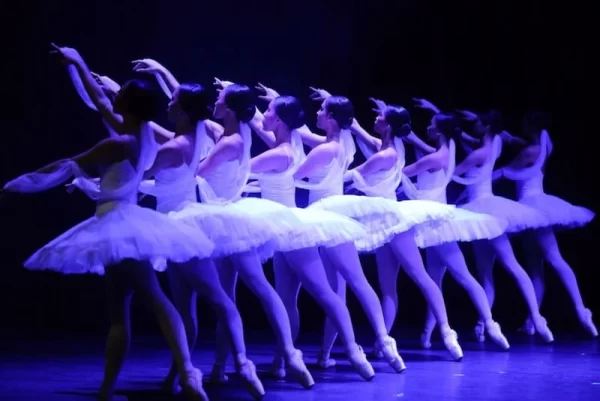
Synchronized corps de ballet in The Kingdom of the Shades; Photo Credit: Konrad Ong
One of the most exciting numbers in the betrothal celebration, the Danse Indienne, with its earthbound jumps, crisp foot stomping and tribal vibe, offers a sharp contrast to the refined classical variations. Dancers Stephanie Santiago, Romeo Peralta and guest artist Vince Pelegrin bring this piece to life, combining exaggerated character flair with intense, wild fervor.
As the Fakir, Juan Angelo de Leon delivers a committed performance, anchoring the role with earthiness and executing impressive leg-over jumps with panache.
The corps shows unity and equal spacing between the dancers in all the group dances. In the last act, the dance has a calm, controlled quality that suits the ghostly atmosphere of the Shades. The signature series of repeated arabesques creates a beautiful ripple effect, and the overall picture is clean and orderly. However, synchronization is not always even. There are small differences in the timing and height of the arabesques. Some dancers look less secure. The corps is attractive and well disciplined, but it will take time to achieve greater precision, uniformity and artistry to create the almost supernatural effect that Kingdom of the Shades demands.
Nevertheless, audience response and online ratings have been high despite the flat lighting. In Act 3, it is literally a kingdom of shades, with the lighting so dark that shadows fall across the dancers’ faces. Even so, Ballet Manila’s La Bayadère makes a strong case for a company still pushing itself toward the ideal of Russian classical ballet.
Tickets: P3,090 (Center) and P1,545 (Sides)
Show Dates: August 14, 8 PM; August 15 and 16, 5 PM
Venue: Aliw Theater
Running Time: approx. 2 hours and 15 minutes (with a 15-minute intermission)
Producer: Ballet Manila
Creatives: Lisa Macuja Elizalde (artistic director); Natalia Radulgina (guest ballet mistress); Alexander Kurkov (guest ballet master); Gerardo Francisco Jr. (rehearsal master and music master); Julia Macuja (set designer); Carlo Reyes (lighting designer); Deidrich Tanteco (projections designer)
Featured Cast:
Nikita: Renata Shakirova; Solor: Kimin Kim; Brahmin Lead: Mark Sumaylo; Gamzatti: Abigail Oliveiro; Golden Idol: Jos David Andes/ Rafael Perez; Rajah: John Ralp Balagot; Lead Shades: Jasmine Pia Dames, Jessica Pearl Dames, Shaira Comeros; Fakir: Juan Angelo De Leon/ Germaine Dawal; Servant Woman: Shamira Drapete; Toloragva: Noah Esplana

Comments