

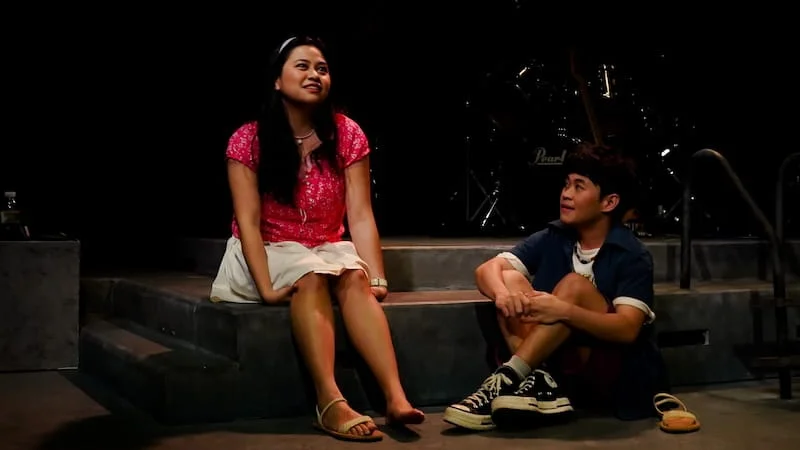
REVIEW: The excellent ‘Mga Binago ng Araw’ finds healing in our memories of youth
Sensitive direction, authentic performances, and a rich script by Guelan Varela-Luarca make Mad Child Productions’ new offering one of the best plays of the year.
As has been proven by countless Hollywood remakes, the popularity of jukebox musicals, and all manner of throwback trends, nostalgia is now often treated as its own currency—but a story that succeeds in making an audience feel nostalgic is not automatically the same as a good story told well. In lesser hands, a play like Mad Child Productions’ Mga Binago ng Araw could have been an empty exercise in reference-farming, as it follows a barkada of upper middle-class teenagers experiencing love and heartbreak in the summer of 2005. Told in nonlinear fashion, the show is also framed through the eyes of Nia (played by Jam Binay) sifting through her teenage memories in search of something important that haunts her but that she can’t fully grasp.
Thankfully, the sensitivity of Monty Uy’s direction and the wealth of detail in Guelan Varela-Luarca’s script make this a production well aware of the traps that nostalgia can set. This story may still speak in mid-2000s cultural references, but similar to Varela-Luarca’s 3 Upuan, what it’s ultimately concerned with is our perception of the phenomenon of time itself and what vulnerabilities of ours are being masked by our rose-tinted memories of youth. With a finely tuned ensemble that never comes across as anything less than completely authentic, the production builds unexpected emotional force through its every mundane conversation and inspired set piece. In its own unassuming way, Mad Child has crafted one of the best plays of the year.
A restless dream
It takes a lot for a “hangout” story to carry sustained emotional weight, especially when its characters come from privilege and inhabit a generally safe, insulated world; the wrong approach could ring shallow, or risk alienating viewers from what the show is trying to assert as important. But Uy manages to establish an immediately comfortable and relatable sense of humor in these characters’ interactions, and a lingering, bittersweet feeling that tinges even the play’s more fantastical scenes. The earnestness of these teenagers’ problems keeps Mga Binago ng Araw universal. But more crucially, Uy knows how to glide from one sequence to the next as if trying to piece things together within a long, restless dream. Transitions can be deliberately abrupt, characters overlap into each other’s scenes, and certain repeated moments become highly subjective in nature. There’s an impression of something distant and unfulfilled that pins everything down.
Nearly every aspect of this production supports this idea of living inside a fading memory. There is perhaps no better visual metaphor for this than the bare set designed by Sarah Facuri, echoing the shape of both a music performance stage and the swimming pool where the barkada spends their lazy summer days. Props are spare, with the characters mostly pantomiming their actions instead (through John Lucing’s movement design). It’s as if the past can never fully materialize anymore; something will always be missing.
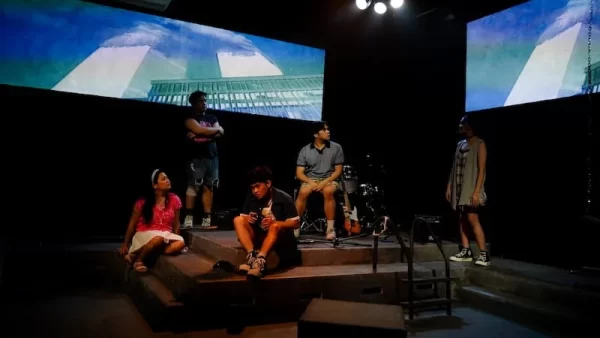
L-R: Jam Binay, Vino Mabalot, Zoë de Ocampo, Rafael Jimenez, Maliana Beran; Photo Credit: Myra Ho
Additionally, Jethro Nibaten’s lighting either plunges the entire space into the dreamlike respites provided by the pool, launches the boys on a mission to the sun, or gently nudges Nia between past and present through just the softest hint of white light. Teia Contreras and Julia Vaila’s video design also helps establish a more specific milieu through video game effects, humorous definitions of slang, or news reel footage of significant historical events—but only ever in fleeting doses.
Immediate closeness
Despite the empty stage, the cast of Mga Binago ng Araw really does fill it with life, moving around as if the emptiness is already a familiar, lived-in space. There’s an immediate closeness conveyed just in how the members of the ensemble sit around each other and spontaneously piggyback off of each other’s jokes. And just as in many great coming-of-age scripts, this closeness forged through common interests—in particular, alternative and “vintage” music (with original compositions by Michelle Cornejo)—intensifies the inevitable drifting apart that befalls any friend group going through vastly different changes at once.
As the show’s emotional center, Jam Binay is responsible for absorbing and reflecting the rest of the cast’s bigger outbursts, as her Nia struggles to make sense of where she belongs in this already established friend group. Her own realizations come much later in life—perhaps too late—but the kindness and wisdom with which Binay articulates them are shattering. And as Nia’s partner, Joms, Zoë de Ocampo captures the inner conflict of wanting to be seen as unique and cool while still having yet to unlearn traditionally masculine behavior that keeps him from being truly vulnerable.
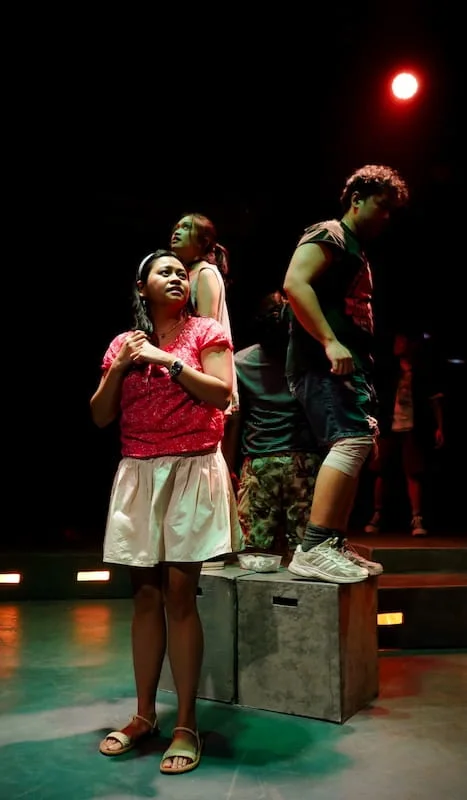
The cast of Mga Binago ng Araw; Photo Credit: Myra Ho
Vino Mabalot’s more brusko Rage proves to be an incredibly reliable source of comic relief, his bluntness very clearly acting as a defense mechanism for his own private disillusionment with the world. As Ferdie, Rafael Jimenez is the sensitive soul, entirely convincing as both a kid lashing out for all the traumatic experiences he’s been forced to deal with; while Maliana Beran crafts her own satisfying arc of claiming independence, positioning Jill as the closest to a full progressive awakening. And as Trisha, an outsider to the barkada, Francesca dela Cruz grounds the entire show in little more than two scenes, hinting at a world of narratives beyond the others’ class privilege.
True remembering
The class dimension of Mga Binago ng Araw isn’t necessarily front and center, but Varela-Luarca is perceptive enough to allow each character’s decisions and personality to be easily traced to their socioeconomic upbringing. To feel boredom in the Philippine “suburbs” is a privilege, but also—at least in the case of these characters—potentially an indicator of neglect, distance from their families, or a reminder of loss that’s kept them isolated. Even without ever seeing parental figures in the play, it feels as if these kids are bound to their respective family conflicts. And without the proper guidance to navigate complex ideas in a world that’s begun advancing into the digital age, these adolescents become sites of collision—left to determine their values all on their own against the hypocrisy of their parents’ generation. It’s no wonder one would rather be nostalgic for music, video games, and lazy days at the pool.
This isn’t to say that what we get here doesn’t succeed as a funny, colorful, and highly entertaining spin on a typical coming-of-age story. Even if taken at face value, the play makes for a surprisingly comfortable and comforting watch. But underneath the surface, Mga Binago ng Araw also depicts reminiscence as an act of coming to terms with the unstoppable flow of time. It acknowledges how time can turn our most pressing concerns into frivolous moments in hindsight, and how figures of the past who may have been reduced into small, idealized versions in our memories now beg to be remembered in their complete imperfection. As Nia looks back on that summer in 2005, she also risks reopening the wounds of the barkada of her youth. But as this production argues, to remember people as their messiest parts may be the greatest act of love.
This reviewer watched the 7:30 PM, August 12 press preview.
Tickets: P1,700–1,500
Show Dates: August 14–23, 2026
Venue: Fine Arts Black Box, Old Communications Building, Ateneo de Manila University, Quezon City
Running Time: approximately 2 hours and 30 minutes (with a 15-minute intermission)
Company: Mad Child Productions
Creatives: Guelan Varela-Luarca (Playwright), Monty Uy (Direction), Michelle Cornejo (Music Composition), John Lucing (Movement Design), Sarah Facuri (Set Design), Jethro Nibaten (Lighting Design), Perine Nyssa Bianzon (Associate Lighting Design), Uriel Tibayan (Sound Design), Teia Contreras (Video Design), Julia Vaila (Video Design), Sofia Santelices (Costume Design)
Cast: Jam Binay, Zoë de Ocampo, Vino Mabalot, Maliana Beran, Rafael Jimenez, Francesca dela Cruz

Comments