

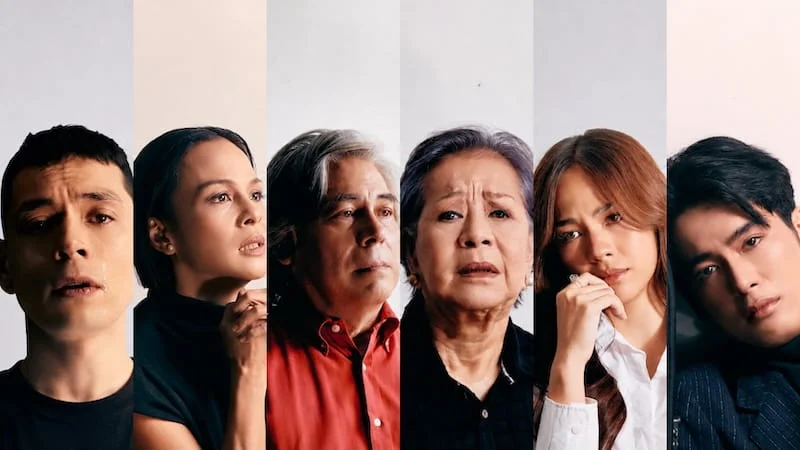
‘The Art of Breaking Up’ comes in many forms and cuts across entire generations
Breaking up, or the ending of a romantic relationship, is one of the most painful processes in the human experience, and yet unfortunately it is among the most common or frequent. This is probably why The Art of Breaking Up, the production being mounted by ABS-CBN Teatro Kapamilya and PETA Plus and which will run at the PETA Theater Center starting November, will resonate strongly with the audience. As seasoned actor and cast member Nikki Valdez summarized it in the press conference on July 30, breaking up “at some point has happened and maybe is happening now to each one of you.” Of the material, she said, “Makaka-relate ang lahat ng tao, of all ages, as you can see in our cast.”
Valdez alternates with Janella Salvador to play Lou, the lesbian daughter of Baby Boomer couple Ben (alternately played by Teroy Guzman and Carlitos Siguion-Reyna) and Anita (Bibeth Orteza, Ruby Ruiz). The other important family member who also has his own share of romantic problems is Lou’s brother, Dino (JC Alcantara, Jake Cuenca). While it is safe to assume that—based on the excerpt shown and the press materials released— the core of the show revolves around this family, the larger ensemble points to a greater community of friends, relatives, and other associates who are also experiencing their own heartaches.
The play’s cast is a mixture of veteran theater artists and show business performers who had either tried their hand at stage before or are just venturing into the craft in this play. Aside from the aforementioned performers, it includes AJ Sison and Brent Manalo alternating as Jake; Yen Santos (Gab); Anna Luna (Kat); Jet Tarun (Hector); Analain Salvador (Ina); Jude Hinumdum (Erwin); Yesh Burce (Carla); Dingdong Bahan (Ferdz); and Meann Espinosa who plays the enigmatic Everyman.
Aside from the huge cast who apparently play diverse roles, watching the play will require the audience’s focus as it is not linear, and ties several stories and scenes together as vignettes. Teraña admitted that explaining the narrative in the usual chronological style is difficult, and instead encouraged the audience to think of the play’s framework as “a web” which draws in and connects seemingly unrelated characters. “Iyung friend na ganito, na jowa ni ganito … kapag napanood mo, nag-u-unfold sa kanila.”
Espinosa’s character is the seamstress or the figurative spider who threads everything to make the plot and theme clearer to the audience. Everyman herself plays “different kinds of roles to connect the stories and to establish the space,” said Teraña.
“I am used as a device to transition the scenes,” said Espinosa of her character, “I’ll assist the audience in understanding where the characters are.”
View this post on Instagram
Different kinds
The play will portray the different kinds of break-ups that happen to the host of characters, ranging from the elderly couple who had been married for decades to the Gen-Z youth who can choose to cut off their ties with just a text message.
Teraña described a few of what the characters had to go through: “Minsan, may nag-break-up na walang usap. May nag-break-up na ang haba naman ng proseso. Mayroong nagkasundo na lang sila na break-up na nga sila, nagkaaminan na sila na gusto na nila mag-break-up. May nag-break-up na naging magkaibigan na lang.”
Those portrayals become a rollercoaster of emotions for the characters who will have to deal with the eventual fall-out. Cuenca described them, saying, “Kung ano ang pinagdadaanan ng isang tao to lose that love. To gain that love again. And at the same time, the grief, We don’t forget the people that we’ve lost. We just learn to live with it. And that’s what you’re going to see in this play.”
While break-ups may be familiar territory to many people in the audience, Teraña said that de Jesus’ material encourages them to probe beneath the surface. For example, a supposedly casual separation might actually be silently crushing to the two people who had decided on it. “It might be light to our eyes, pero kapag pinakiramdaman mo, mas masakit,” he said.
Sometimes, a break-up is initiated and done in the name of love. Orteza explained the complicated arrangement of her character, Anita, with her husband Ben: “He does not want to stop loving me. But he feels that the more we stay together, mas mawawala iyung pagmamahal. Kaya kailangang umalis siya para ma-save ang love.’
View this post on Instagram
Siguion-Reyna described the play as a journey to “explore the emotional truth among the characters. There are some relationships that are good when [the couple is] together. But there are some relationships that need to be broken. That’s what we’re exploring.”
He added that Ben and Anita, the senior-citizen parents of the younger protagonists, can be a mirror reflecting both the past and the future. “The stories of the younger people are, in a way, expressions of what happened to the older people. You think that [what is happening to the younger generation] is what happened to them. They’re all exploring. Because in relationships, some want to stay, some want to go.”
According to the production notes, The Art of Breaking Up was based on de Jesus’ original play Kung Paano Maghiwalay, which premiered in 2009. It has since been updated with new monologues that reflect modern times. Teraña said that de Jesus sent him his own updated script before he passed away in September 2025.
Intimate and realistic
View this post on Instagram
Yet while the reasons for the break-up might be shown, it is the various processes themselves that get center stage and are highlighted, affirming the play’s title. Teraña said, “Iyun ang ginawa ni George—hindi iyung bakit sila naghiwalay, kundi paano nila ginawa iyung break-up. It’s not so much as the why, but the how.”
The various separations will be shown during the first act—leaving the second act to reveal how the now-separated couples had become lovers in the first place. This approach makes the experience “more painful because na-witness mo kung paano sila naghiwalay, mas nauna ito,” he added.
The in-the-round staging, which will leave all sides of the stage open to the audience, will amplify the rawness of the emotions as the characters go through the experiences. There will be no proscenium that can shelter the cast or give them the proverbial break, in effect compelling them to stay in character for as long as they can. Teraña confirmed that one reason for his choice of the format was “to challenge the actors,” many of whom act in TV, to go beyond their comfort zone.
Another is to immerse the audience as the play unfolds. “I want the audience [to ask themselves]: nanonood pa ba ako ng play o nakikita ko na may naghihiwalay sa harapan ko? We wanted to make it as intimate and realistic as possible.”
One other aspect that the play will highlight is that the break-up process in the Philippines is unique and has its own psychology, making it different from the West. The cast—who themselves are Filipinos—had to undergo a workshop to grasp the Philippine psyche when it comes to the deterioration of a romantic relationship and its eventual fallout.
“A relationship in the West is transactional. Sa kanila, divorce na, tapos,” Teraña elaborated. “Pero sa Pinoy, mayroon tayong pakikipagkapwa. Ikaw at ako bilang isa. May usapan ng kapwa, damdamin, utang na loob, pagiging buo. Dito mahirap makipaghiwalay. Ang daming layers – kaibigan, tatay, magulang. Marami kang i-co-compromise.”
It is that intense interconnectedness that allows the play to leave a few nuggets of wisdom as takeaways for the audience.
To Siguion-Reyna, it’s “the need for empathy, the need to really feel each other and to feel ourselves through it. That’s what shines through all of this, whether the relationship is together or broken.”
To Espinosa, it is telling “the person we love why we love them. And communicate clearly what we really want to communicate so we don’t waste that opportunity of connecting with someone. Because life is short and the world is just so chaotic right now.”
Finally, for Cuenca, it’s all about speaking the “universal language when it comes to love, which cuts across every generation. In this piece, mapapanood niyo iyun, not just in my role but everyone’s roles.”
The Art of Breaking Up, written by the late George de Jesus III and directed by Dudz Teraña, will run from November 6 to December 6, 2026, at the PETA Theater Center. The production is mounted by ABS-CBN Teatro Kapamilya and PETA Plus,

Comments