

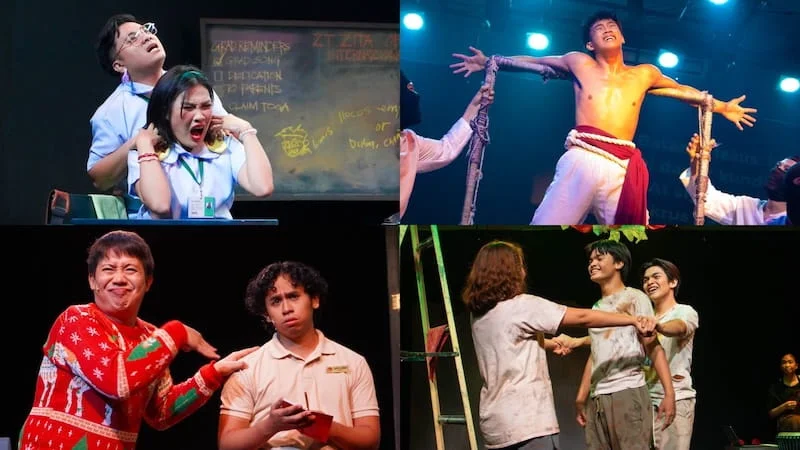
REVIEW: 4 ‘Control+Shift’ One-Act Shows from PETA
This set of works in PETA’s Control + Shift: Changing Narratives lab foregrounds experimentation both in form and in content. As a platform for developing new material, the lab creates space for emerging voices to test ideas that engage with pressing social realities, often privileging immediacy, accessibility, and audience engagement.
Across its two twin bills, the program brings together four one-acts that vary widely in tone and approach, from text-driven, comedic storytelling to more movement-based, interpretive pieces. Taken together, they reflect the lab’s interest not just in what stories are being told, but in how they are being told, offering a snapshot of works still in the process of finding their final shape.
SET A: When Power Falls Into Our Hands
This set brings together two works that explore how ordinary people respond when given agency within flawed systems. Both plays situate their characters in environments shaped by authority, peer pressure, and institutional norms, asking what happens when the responsibility to act or not act suddenly falls on individuals.
While distinct in tone and form, they share a common interest in tracing how power is exercised, negotiated, and, at times, quietly surrendered.
Cleaners
View this post on Instagram
Cleaners opens with a sharp, darkly comic premise that feels immediately legible, especially to younger audiences. Set in a classroom days before graduation, it follows a group of senior high students tasked with cleaning up—guided by a chilling mantra, “Ang hindi malinis, ililigpit.” as taught to them by their Sir.
Playwright Jhudiel Clare Sosa builds the first half of the one-act on recognizable teenage archetypes, letting their personalities bounce off each other in a rhythm that’s funny if mildly chaotic. Director Julio Garcia leans into this energy, staging the show with a lightness that keeps the material accessible even as the underlying themes grow darker. There’s also the particularly effective use of repetition in the mantra, with the cast snapping into synchronized, almost trance-like gestures that hint at how deeply control and conformity have been internalized.
When the narrative turns, the play doesn’t abandon its humor. Instead, it pushes further into absurdity, including a sequence that is grotesque but also playful. This tonal choice keeps the piece engaging, though it also rather softens the impact of its more serious ideas about violence, power, and institutional complicity.
There’s a sense that the piece hasn’t yet found its sharpest form, particularly in how it balances its comedic instincts with the weight of its themes. The performances too, while energetic, lean too heavily on their archetypes. But even in this rougher state, it’s an undeniably entertaining watch that gestures toward more complex truths beneath the surface.
Creatives: Jhudiel Clare Sosa (Playwriting), Julio Garcia (Direction, Production Design), Mikaundre Gozum Santos (Dramaturgy), Kabaitan Bautista (Musical Direction, Sound Design), Gio Gahol (Choreography), Rafa Sumilong (Lighting Design)
Cast: James Pe Lim, James Lanante, Eli Namoc, Nyla Festejo, Meg Guiang, Csairus Habla, Christy Lagapa
Monit-oh! Monit-ah!
View this post on Instagram
Monit-oh! Monit-ah! shifts the twin bill into more overtly didactic territory, staging its story through the framework of forum theater. This is a format that invites audiences to intervene in the action and propose alternative choices for its protagonist. In theory, it’s a natural fit for a narrative about ethical compromise. In practice, the execution proves more uneven.
The play follows Jaylord, a probationary worker navigating a workplace steeped in palakasan, where a seemingly harmless monito-monita exchange becomes a gateway into systemic corruption. Playwright Herlyn Alegre constructs a world that is both specific and widely recognizable, populated by characters whose moral concessions range from petty to deeply ingrained. Director Norbs Portales stages this with broad strokes, leaning into humor and heightened performances that land well with the audience.
What the piece does particularly well is articulate how compromise operates as a spectrum rather than a singular moral failing. Each character’s justification feels grounded in circumstance like financial need, social pressure, or survival. This allows the play to map out a system where wrongdoing is normalized, even rationalized. There’s a clarity to its world-building that makes its ethical questions easy to grasp.
However, the forum theater component complicates rather than deepens this engagement. The audience forum, while central to the format, stretches the show well beyond a reasonable run time, with an extended open discussion that disrupted the show’s momentum. More crucially, the structure reveals its limitations when audience suggestions are invited but not meaningfully integrated into the unfolding action. At key moments, Jaylord appears to respond to audience input only for the narrative to steer him back toward predetermined outcomes, undercutting the very premise of participatory storytelling.
This tension between intention and execution becomes the production’s defining challenge. The material itself is strong—thoughtful, nuanced, and attuned to the complexities of everyday ethical compromise. But the insistence on foregrounding audience discourse within the performance blurs the line between theater and facilitated discussion, to the detriment of both.
Creatives: Herlyn Alegre (Playwriting), Norbs Portales (Direction), Zoe Damag (Dramaturgy), Patrick Jusay (Production Design), Abigail Taniegra (Musical Direction, Sound Design), Gio Gahol (Choreography), Rafa Sumilong (Lighting Design)
Cast: Roi Calilong, Zoe Damag, Pia Viola, Reggie Ondevilla, Gino Ramirez, Ash Nicanor, Moi Gealogo
SET B: When Care Becomes Survival
This set leans into a more movement-driven mode of storytelling, with both works relying less on dialogue and more on physical expression, sound, and visual composition. In different ways, each piece examines how care whether rooted in faith, community, or sheer necessity emerges under conditions of hardship, framing survival not just as endurance, but as an ongoing act of holding on.
At Nagkatawang-Tao ang Verbo
View this post on Instagram
This one-act departs from conventional dialogue-driven storytelling, instead relying on movement, music, and religious imagery to convey its narrative. Set within a small urban fishing community, the piece draws heavily from Catholic iconography, staging a world where biblical figures and everyday people blur into one another in a shared struggle for dignity and survival.
Playwright Mikaela Regis and director Anthony Cruz construct the piece as a largely interpretive experience, with much of its meaning carried through choreography and visual composition rather than text. The staging, costumes, and lighting do much of the narrative work, often spelling out the parallels being drawn between the Jesus story and contemporary hardship as a performer sings verses with a pasyon-like cadence.
There are moments where the performers succeed in conveying emotion through movement, particularly in sequences that lean into collective action and shared suffering. However, the reliance on a near one-to-one allegory of the Christ narrative limits the piece’s interpretive openness. Rather than inviting audiences to arrive at meaning, the symbolism at times felt overly direct.
As a result, while the production is visually and atmospherically cohesive, its storytelling remains somewhat opaque in its intention that makes it less immediately accessible. The absence of dialogue places greater weight on its theatrical elements to communicate nuance, but these do not always fully bridge the gap between concept and clarity.
Creatives: Mikaela Regis (Playwriting), Anthony Cruz (Direction), Rafa Sumilong (Lighting Design)
Cast: Ernest Gillacanao, Ghillian Chavez, Jasmine Lulu, Jenelyn Malunes, John Solcruz, Johnmer Ursula, Nelson Cabuhat Jr, Wilman Tolda
Baga ng Gumuguhong Langit
View this post on Instagram
Baga ng Gumuguhong Langit continues the twin bill’s exploration of non-verbal storytelling, using movement, sound, and visual composition to depict the lives of children caught in the devastation of war. Where its companion piece leans on religious allegory, this one situates itself in a more immediate, human crisis, following young characters as they navigate loss, survival, and fleeting moments of relief amid destruction.
Playwright Anj Heruela and director Ian Segarra craft a production that is cohesive in its emotional arc, allowing the performers’ physicality to carry the weight of the narrative. The staging is assured, with clear shifts in tone that move between anguish and brief, fragile levity. The cast, in turn, rises to the demands of the material, delivering performances that are consistently expressive and even, at times, riveting.
What the piece does particularly well is render the emotional reality of its characters. Through gesture and movement, it communicates the immediacy of fear, grief, and resilience, creating moments that are both evocative and affecting. There is a discernible structure to the storytelling, with each character’s journey contributing to a broader sense of collective experience.
However, the decision to frame the narrative as representative of children across multiple war-torn contexts introduces a certain abstraction that weakens its specificity. While the intent may be to universalize the experience, the gestures toward multiple geographies risk flattening distinct realities into a singular, generalized portrayal of suffering.
Even so, Baga ng Gumuguhong Langit remains a well-executed and emotionally resonant piece. Its strength lies in its clarity of direction and the commitment of its performers, resulting in a production that, while thematically expansive, is consistently compelling in its moment-to-moment storytelling.
Creatives: Anj Heruela (Playwriting, Dramaturgy), Ian Segarra (Direction), Patrick Jusay (Production Design), Ada Tayao (Musical Direction, Sound Design), Rafa Sumilong (Lighting Design)
Cast: Ada Tayao, Rona Manio, Rei Millete, Wade Dizon
This reviewer watched the 2PM show of Set A and the 7PM show of Set B (both on April 12).
Tickets: Php 700.00
Show Dates: April 10 – April 19, 2026
Venue: PETA Theater Center, 5 Sunnyside Dr, Mariana, Quezon City
Running Time: approx. 2 hours and 30 mins (w/ 15 min intermission)
Producer: Philippine Educational Theater Association

Comments