

REVIEW: Ballet Manila’s ‘Sleeping Beauty’ is trimmed yet uneven
The Manila stage is currently proving that while a production can be polished to a high shine, there is no hiding the gap between technical mastery and the mere effort of getting through the night. In shows now running, as in the case of dance icon Lisa Macuja Elizalde’s editorial shears at Ballet Manila’s Sleeping Beauty, the local scene is undergoing an intensive, if uneven, structural audit.
A Princess Trimmed
Elizalde has been on a tweaking spree. Almost every classic in the Ballet Manila repertoire now bears her revisions, and her Sleeping Beauty—the finale of a “Princess Trilogy” that includes Snow White and Cinderella—has received a major overhaul. By trimming the original three-hour Russian marathon to a lean 105 minutes, Elizalde reshapes the narrative while clinging to the essential Marius Petipa choreography. Scenes are tightened, “inconsequential” characters are purged, several new moments are inserted to clarify the story. Tchaikovsky’s score is pruned and often draws from the fairy variations.
One major addition appears in the Prologue. King Stephen and Queen Leah cannot have children. During a walk they encounter the Lilac Fairy, who assures them a daughter will soon arrive.
The revised story also links the princes of Snow White, Cinderella, and Aurora to the royal household early in the ballet. At Aurora’s christening the King and Queen decide their daughter will one day be betrothed to Prince Désiré. The celebration is disrupted when the wicked fairy Caraboose storms in with a posse of creepy creatures. Furious at being snubbed, she places a curse that Aurora will prick her finger on a spindle and die. Elizalde introduces new figures such as the Keeper of the Golden Plates and the court emcee Catalabutte, who are blamed for the oversight. When Aurora turns 16, the curse takes hold and Prince Désiré must battle Carabosse, her army, and even a dragon before reaching the sleeping princess.
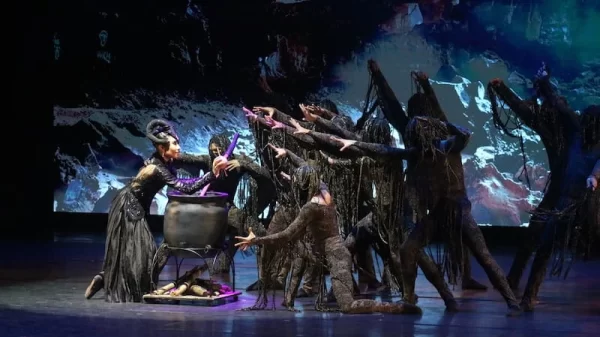
Carabosse (Stephanie Santiago) and her minions; Photo Credit: Erickson Dela Cruz
The staging unfolds inside Elizalde’s own fairy tale universe. In the finale, a digital sky erupts with fireworks straight out of a Disney movie, part of her effort to bring a nineteenth century court ballet closer to a contemporary audience.
Strong Technicians
Soloist Shamira Drapete is catapulted to the title role on gala night despite limited experience. Beautiful yet bland, the tall, long-limbed ballerina pairs well physically with Joshua Enciso’s Prince Désiré. Both belong to Ballet Manila’s “golden children,” though their performances come across as academic rather than emotionally vivid.
Drapete shows solid control and stability in her balances. Yet when a dancer concentrates intensely on the mechanics of difficult movements and the precision of the Vaganova style, the face can settle into a mask of effort rather than the delight of a 16-year-old princess presented to court. Her phrasing follows the music too rigidly and without breath, so the dancing reads as a technical display instead of a lyrical narrative.
In the Rose Adagio, Aurora greets her suitors with a chain of slow balances designed to display regal poise, and Drapete holds them with perfectly-arched feet and clean placement. What remains missing is a connection with her partners. The focus stays on the physical support rather than the emotional stakes. She looks more assured in the Wedding Grand Pas de Deux, where the audience responds to her resplendent lines. What she still needs is expressive detail that turns a sequence of steps into a living character.
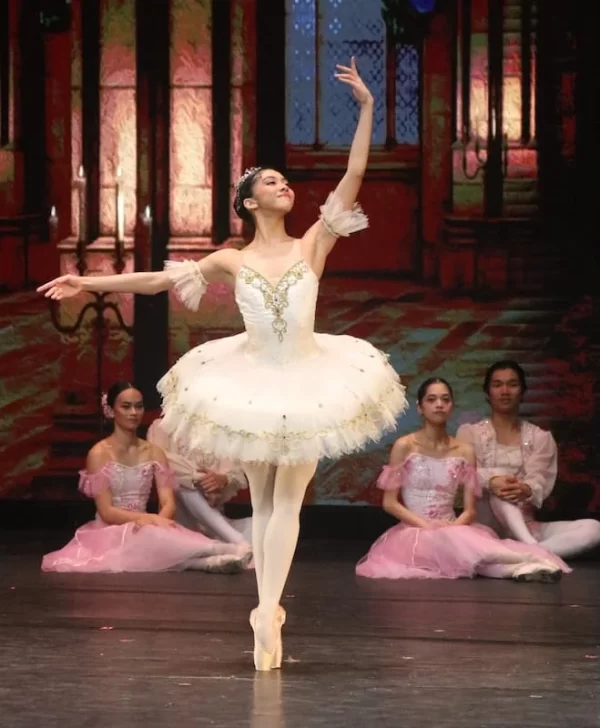
Shamira Drapete as Princess Aurora; Photo Credit: Erickson Dela Cruz
Enciso proves a solid partner, supporting Drapete in the signature fish dive and overhead lifts with seamless control that allows her to concentrate on her line. In his solo, his torso stays steady through complex legwork, a hallmark of strong classical training, and he carries the dignity expected of a prince. The jumps are cleanly landed, though not explosive. In virtuosic passages, he often takes a cautious approach and misses the daring spark that can electrify a male variation. At times, the shoulders and neck stiffen in the air. His phrasing would benefit from greater musical expansion.
This ‘bluebird’ flies
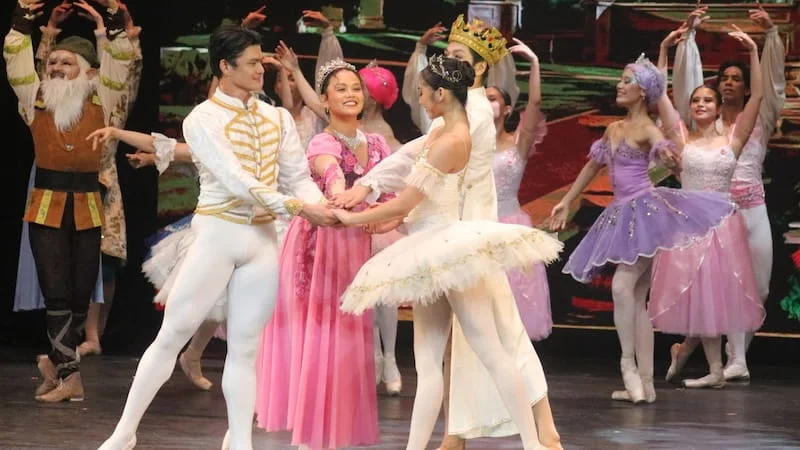
In Elizalde’s version, Cinderella and Prince Charming appear alongside Snow White and Prince Ferdinand as guests at Aurora’s wedding, stepping into the spotlight for the Bluebird variation. Their performance gleams as the jewels of the production.
While Drapete offers technical security, Jasmine Pia Dames as Cinderella and Shaira Comeros as Snow White capture the singing quality that defines classical ballet. They instinctively place the soul of the choreography ahead of mechanics. Their phrasing and sheer delight in dancing win the audience.
They move through the music instead of placing steps on top of it. Their performance breathes. Drapete’s dancing often reads as a chain of technical poses.
Dames and Comeros extend the line of the dance with their heads, shoulders, and arms. The Bluebird variation demands light springy jumps and they deliver that buoyancy. When they move in unison with the Manila Symphony Orchestra, the effect is vivid and immediate.
Noah Esplana as Prince Charming takes a formal approach in the Bluebird variation. His placement in the jumps is consistent and rooted in the Vaganova style. He manages the difficult brisé volé with careful control. However, his movements can feel calculated and reserved.
Jos David Andes as Prince Ferdinand brings an athletic presence. His ballon gives the jumps generous suspension and they travel across the stage with sweep. The upper body moves with fluid épaulement. He shapes the choreography into a clear character.
Anselmo Dictado as the Keeper of the Golden Plates and Rafael Perez as Catalabutte deliver lively comedy with buoyant jumps, quick turns, and flashes of gymnastic flair that keep the stage humming.
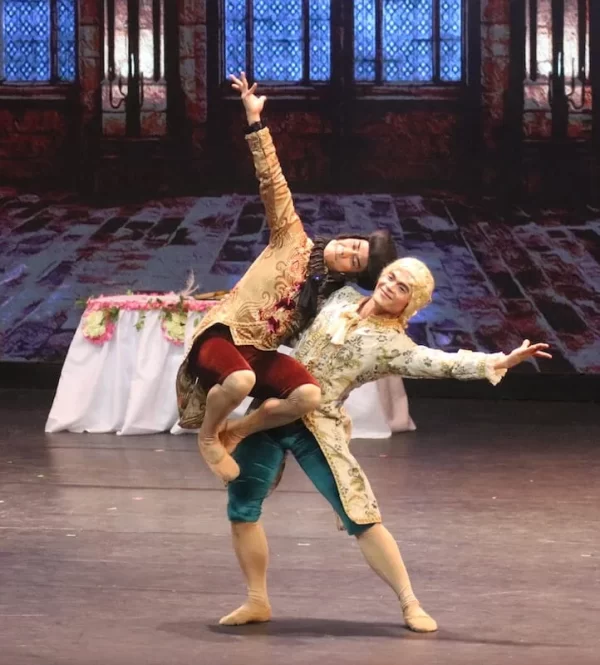
Anselmo Dictado and Rafael Perez provide comic relief; Photo Credit: Erickson Dela Cruz
Elizalde shows greater confidence as a choreographer. Her intentions are clear and she pushes the soloists, though the group dances fall into predictable patterns. She should take more advantage of the stronger corps dancers so she could go further.
Rushed and muddy
For all the hype, the production disappoints. Ballet Manila had just come from two successive productions in different styles and moved straight into an unforgiving classic such as Sleeping Beauty. The early scenes look under rehearsed. Movements appear rushed and muddy, and the balances lack suspension. The danseurs, normally sending their partners aloft with effortless grace, seemed drained. The partnering looked labored and heavy.
Abigail Oliveiro as the Lilac Fairy looks fatigued. A dancer who can deliver both a dramatic White Swan and a mean Black Swan in one evening now struggles through the climax of her variation. The sequence of quick jumps on pointe and triple pirouettes reduces to two turns and a cautious single turn in the end. Yet, the professional she is, Oliveiro acquits herself beautifully in the remaining scenes.
The digital LED backdrop creates a visual flatness that works against the dancers and even distorts their skin tones. The barrage of bright imagery pulls the eye away from the stage.
The ear, however, finds relief in the pit. Under the baton of Russian guest conductor Alexander Vikulov, the Manila Symphony Orchestra rises to the occasion. Vikulov keeps the tempos buoyant and dancer friendly, shaping the score with a firm rhythmic spine and a sense of theater. The orchestra responds with warm strings and a generous sweep that lets Pyotr Ilyich Tchaikovsky’s melodies bloom.
If rough edges appear now and then, it reflects the realities of ballet schedules. Orchestras and guest conductors seldom enjoy long rehearsal periods. Still, the MSO carries the evening with commitment and style. In the end, the music proves the production’s most persuasive storyteller.
In the end, despite sparks of magic and strong music, the uneven gala never quite lifts off the ground.
Tickets: P3,090 (center) and P1,545 (sides)
Show Dates: Mar 13-15 2026
Venue: Aliw Theater
Running Time: approximately 2 hours with a 15 minute intermission
Company: Ballet Manila
Creatives: Lisa Macuja Elizalde (direction and choreography), Pyotr Ilyich Tchaikovsky (music), Manila Symphony Orchestra (live orchestra), Alexander Vikulov (guest conductor), Natalia Radulgina (ballet mistress), Alexander Kurkov (ballet master), Gerardo Francisco Jr. (music master), GA Fallarme (visual projection designer), Carlo Reyes (lighting director)
Featured Cast: Shamira Drapete, Jasmine Pia Dames, Shaira Comeros (Princess Aurora), Joshua Enciso, Noah Esplana Jos David Andes (Prince Désiré), Stephanie Santiago, Abigail Oliveiro, (Carabosse), Abigail Oliveiro, Stephanie Santiago (Lilac Fairy), Shaira Comeros, Shamira Drapete (Snow White), Jos David Andes, Joshua Enciso (Prince Ferdinand), Jasmine Pia Dames, Shamira Drapete (Cinderella), Noah Esplana, Joshua Enciso (Prince Charming), Rissa Camaclang, (Queen Leah), Mark Sumaylo (King Stephan)

Comments