

REVIEW: Re-examining ’80s boyhood in ‘Bagets The Musical’
Bagets The Musical arrives at Newport Performing Arts Theater powered almost entirely by recognition. The name Bagets alone carries decades of memory and affection—enough to draw audiences in. The production understands this and leans into it, positioning itself as a return to a familiar coming-of-age story that stays as close to the source material as possible.
It quickly becomes clear that this 2026 musical is less interested in resurrecting the 1980s than in making Bagets emotionally legible and broadly agreeable to a present-day audience. Given how much of the original film’s appeal rested on attitudes and behaviors that now read as uncomfortable at best, it makes sense for this version to smooth over what it can—so we are not subjected to nearly three hours of unchecked “boys being boys” behavior.
The choices that update Bagets for today’s audiences are clearly well-intentioned, but they come at a cost. As the musical smooths over the roughness that once defined the property, it also loosens its grip on the historical texture that made Bagets a cultural touchstone in the first place.
Better boyhood
This adaptation is an attempt to rehabilitate the sort of boyhood we saw on screen. J-mee Katanyag’s adaptation systematically reframes the barkada away from the swaggering, objectifying energy that defined much of the 1984 film. The boys here are hormonal, impulsive, and emotionally clumsy, yet also conscientious in their own way. Desire is expressed with hesitation. Romantic pursuit is tempered by boundaries and restraint. Boyish jokes and mischief is never cruel.
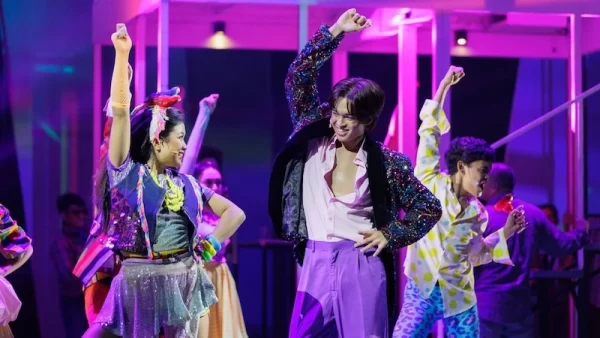
KD Estrada as Arnel; Photo Credit: Newport World Resorts
This recalibration reshapes the story’s moral landscape. Where the original film trafficked in bravado, the musical foregrounds emotional difficulty—how boys struggle to grow up, navigate family expectations, and make sense of first love without causing harm. It offers a gentler, more careful vision of adolescence, one that aligns comfortably with contemporary ideas of accountability and emotional awareness.
That gentleness, however, also narrows the material’s expressive range. The musical’s version of boyhood is earnest and reflective, shaped by an adult sensibility looking back rather than by the raw contradictions of male youth as lived in a specific moment.
’80s chic
Bagets still matters because it crystallized how urban Filipino youth imagined themselves in the 1980s. The film captured an aspirational fantasy shaped by imported tropes, consumer desire, and borrowed coolness. Its cinematic awkwardness was part of its specificity.
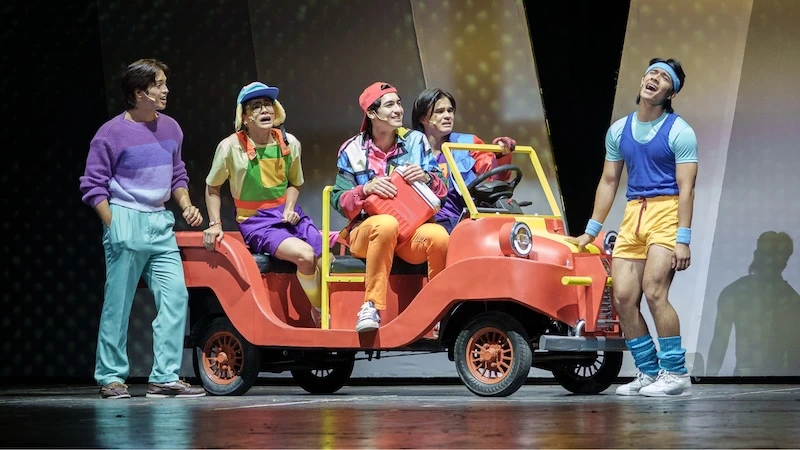
The musical, by contrast, never fully settles into the decade it invokes. The stage design by Ohm David is lively and attractive, with bold colors dominating the scenic elements and costumes by Hershee Tantiado. Jonjon Villareal’s lighting is bright and saturated, while Bene Manaois’s video projections add momentum and scale. Together, these elements create a consistently appealing theatrical environment.
What they do not consistently provide is historical texture. The aesthetic reads as theatrical vibrancy rather than a lived-in sense of time. The 1980s appear mostly as a collection of signifiers—retro music, familiar slang, suggestive styling—without a clear sense of how the period shaped behavior, aspiration, or consequence.
Its world operates according to contemporary emotional logic, even as it borrows surface markers from another era. We’re shown a present-day coming-of-age story dressed in retro cues, inviting recognition of the ’80s without asking the audience to inhabit a different social moment.
Not a man’s world
One of the musical’s most striking features is how little it resembles a traditionally male-dominated environment. The boys’ lives are shaped primarily by women—especially their mothers—who exert emotional, moral, and practical influence at every turn. These maternal figures are vividly drawn and given space to articulate their own desires, frustrations, and compromises.
It’s also no surprise that these women, played by theater stalwarts Carla Guevara Laforteza, Mayen Cadd, Ring Antonio, Kakai Bautista, and Neomi Gonzales, are the show’s most compelling, lived-in characters, so much so that this Bagets adaptation is a hair’s breadth close to being ‘Boy Moms: The Musical.’
Male authority, by contrast, is muted. The composite “Erpats” (all played by Gie Onida) barely registers, and paternal power rarely structures the boys’ choices. In the original film, patriarchy functioned as an ambient condition; male dominance did not need to be visibly shown on screen because it was assumed. Here, that background structure is largely absent, leaving the narrative operating within a far more contemporary understanding of family and authority.
This shift gives the mothers some of the musical’s richest material, particularly in moments that explore breadwinning, ambition, and emotional labor. At the same time, the show treats gender roles as emotionally resonant constants, flattening what might once have felt progressive or radical in the 1980s.
The recalibration away from toxic masculinity extends to its romantic subplots. Ivy Christine (Ava Santos)’s relationship with Adie is rewritten with clearer boundaries, softening the discomfort of the original’s age-disparate dynamic. Janice (Sam Marasigan) remains headstrong and self-possessed, now shaded with hints of activism. Even so, the musical maintains the film’s pointedly apolitical stance.
New Adie-tion
Although Bagets The Musical presents itself as an ensemble piece, Adie is clearly foregrounded. Andres Muhlach—much discussed as he steps into the role made famous by his father, Aga Muhlach—is positioned as the primary draw, making the character functionally central even as the story purports to be about the entire barkada.
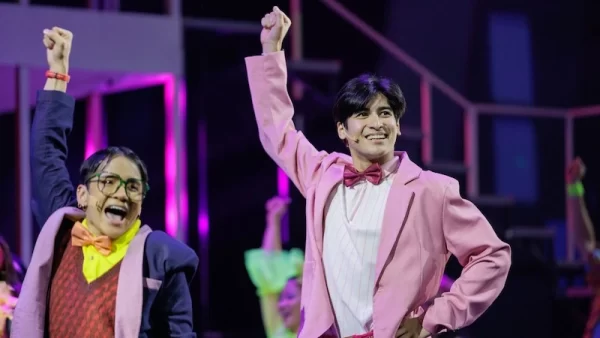
L-R: Tomas Rodriguez (Gilbert), Andres Muhlach (Adie); Photo Credit: Newport World Resorts
This heightened visibility exposes a problem. In the gala performance I saw, Muhlach’s work struggles to meet the technical and interpretive demands of live musical theater. Vocally, his singing leans closer to television-pop conventions than to stage-calibrated musical work. In ensemble choreography, his movement reads tentative beside the precision of the rest of the cast.
More critically, his acting remains broadly signposted. Emotional beats are communicated through surface cues—smiles, pouts, exaggerated reactions—rather than sustained intention. Adie’s pursuit of Ivy, his confusion, and his supposed growth never cohere into a specific character journey. In a narrative that asks the audience to invest in emotional maturation, this leaves its most visible character oddly underdeveloped.
Surrounded by performers with stronger command of character authorship, the limitations of his stage debut become more pronounced.
Boys club
The rest of the barkada fares more evenly.
KD Estrada’s Arnel is played with notable restraint; his inward, measured approach gives the character a clear emotional center and distinctiveness especially as the show devolves into juggling five different subplots at once. Jeff Moses, as Topee, also offers a steady and likable presence despite having the least to work with among the Bagets.
Tomas Rodriguez embraces Gilbert’s function as comic relief with confidence. His performance skews deliberately juvenile, supported by broad physicality and heightened energy. While Gilbert is written to be the zany little brother of the group, Rodriguez understands exactly how to make him entertaining.
Milo Cruz delivers the most consistently grounded work as Tonton. The role carries the musical’s heaviest dramatic load, and Cruz meets it with control and credibility. When the narrative darkens, his performance deepens, lending weight to moments that demand it.
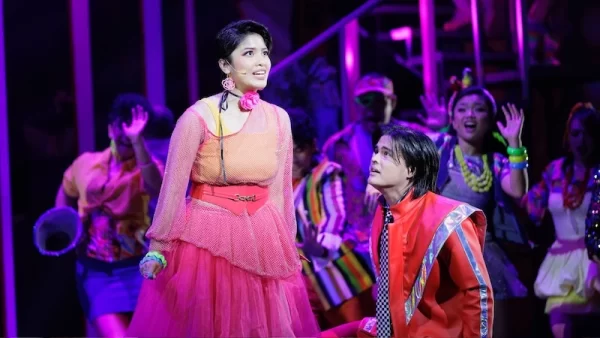
Yani Lopez as Rose, Milo Cruz as Tonton; Photo Credit: Newport World Resorts
Take on music
The score, under musical director Vince Lim, draws from a mix of familiar 1980s tracks—some directly associated with the original film, others broadly era-adjacent—and treats them with varying degrees of reinterpretation.
There are moments of real playfulness. “Just Got Lucky” is cheekily staged over the boys’ circumcision sequence, its irony sharpened by a linguistic pivot that lands on a pun of lalaki. “Build Me Up Buttercup,” meanwhile, is slowed down and recontextualized into a tender second-act number about mothers and sons finding their way back to one another.
These flashes suggest a willingness to bend familiar material toward new meanings. Taken as a whole, however, the score never quite coheres into a musical identity of its own. Unlike jukebox musicals built around a single catalog, Bagets assembles its songs primarily through association with the film or with the decade.
The result is music that functions scene by scene rather than cumulatively. Beyond recognizability, the arrangements do little to evoke the 1980s as a sonic world with its own tensions or contradictions. The songs are competently staged and often pleasant, but they rarely deepen the show’s engagement with the era.
JM Cabling’s choreography follows a similar pattern: energetic and cleanly executed, it supports momentum without asserting a distinct movement vocabulary that might further anchor the piece in time.
‘Bagito’ indeed
Bagets The Musical feels less like a return to the 1980s than a carefully edited memory of it. It takes a property once defined by awkwardness, bravado, and contradiction, and reshapes it into something gentler, cleaner, and easier to sit with.
What remains is a coming-of-age story that is designed to work well enough in the present, buoyed by nostalgia and moments of hilarity and some drama. In smoothing over the messiness of its source, the musical stops short of fully inhabiting the past it invokes. It remembers boyhood without fully reckoning with the conditions that shaped it in the 1980s.
Perhaps that is fitting. Bagets was always a story about young boys trying on versions of themselves—following pursuits, attitudes, and desires they did not yet fully understand. Like its protagonists, the show is still figuring itself out.
This reviewer watched the 7:30 PM, Jan 29 gala show.
Tickets: Php 1,000 – Php 4,000
Show Dates: Jan 30, 2026 – March 2026
Venue: Newport Performing Arts Theater, L2, Newport Mall, 1309 Newport Blvd, Newport City, Pasay City
Running Time: approx. 2 hours and 50 mins (w/ 15 min intermission)
Producer: Newport World Resorts, The Philippine Star, Viva Communications Inc., PETA Plus
Creatives: J-mee Katanyag (playwright), Maribel Legarda (director), Vince Lim (musical director & arranger), JM Cabling (choreographer), Ohm David (scenic & props designer), Jonjon Villareal (lights designer), Bene Manaois (video projection designer), Happy Constantino (sound designer), CJ Laudato (sound engineer), Hershee Tantiado (costume designer), Johann dela Fuente (hair & make-up designer), Norbs Portales (assistant director), Michael Que (assistant choreographer), Tofie Falcon (assistant video projection designer), Mickey Jacinto (conductor)
Cast: Andres Muhlach, KD Estrada, Milo Cruz, Jeff Moses, Natasha Cabrera, Carla Guevara Laforteza, Brigitta Marilla, Andrea Babierra, Mia Bella, Ada Tayao, Jon Abella, Carlos Canlas, Gerald Magallanes, Vyen Villanueva, Mico Hendrix Chua, Tomas Rodriguez, Migo Valid, Neomi Gonzales, Mayen Cadd, Ava Santos, Yani Lopez, Jana Baniasia, Air Paz-Pablico, Abegail Turiano, Ivan Arboladura, Jay Cortez, John Moran, Dan Wesley, Ethan David, Noel Comia Jr., Sam Shoaf, Kakai Bautista, Ring Antonio, Sam Marasigan, Yna Arbiol, Misha Fabian, Abi Sulit-Racho, Gie Onida, Roi Calilong, Moi Gealogo, Arnel Sablas

Comments