

‘Saglit Lang’ Asks Hard Questions About the True Nature of Theater
Infinite Cantina’s Saglit Lang just might run approximately an hour and a half when it opens at the Mirror Studio Theater on April 17—but it promises to challenge the audience’s current perspective of the dramatic arts, or at least encourage them to return to its less glamorous theatrical roots.
During the question-and-answer (Q&A) session on the special preview on March 25, director Anton Juan asked the audience to think beyond their current preconceptions or understanding of the art form. As he put it, “I have only one question to all of us. This is what I always ask all the actors and students in the theater or dance, ‘What was your face before you were born?’”
At the same time, according to BJ Crisostomo, playwright and the founder of Infinite Cantina which is producing the play, Saglit Lang is “basically a love letter to the theater in many forms. How students grow inside the theater. How we come to love it. Dinadakila [nito] ang tanghalan.”
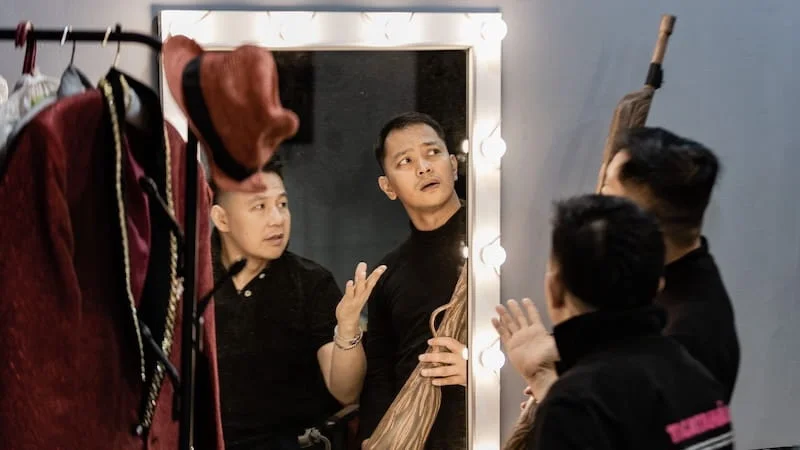
The centerpiece of the material revolves around an ongoing conversation between the Maestro played by Ron Capinding and the Bata alternately played by Crisostomo and Rico del Rosario. The Bata questions the meaning of drama, the relevance of his own role in the proceedings, and the level of competence of his own artistic skills. Answering him point by point, Capinding does a deep dive into why theater exists in the first place, who it serves or should serve, and what any artist can truly bring into the production.
The creative team said that this conversation reflects another integral part of theater: mentorship, where both teacher and student are engaged in a continuous learning scuffle where they learn from each other. Crisostomo said that the material tracks “the primordial, central relationship between the maestro and the student. What does the student need to learn? What can the maestro teach at this moment?”
Crisostomo admitted that his script was inspired by his late mentor, Dr. Ricardo G. Abad, the former artistic director of Tanghalang Ateneo (TA), who passed away in 2023. “A lot of [the play] comes from my experience in Ateneo.”
Crisostomo and Capinding, an actor, director, playwright, and educator in his own right, are both alumni of TA and have kept in close contact with it. Capinding is also the founder and artistic director of Teatro Meron which, according to its website, “is dedicated to reviving and reimagining classic works—in both English and Filipino—not merely as heritage texts, but as living conversations with our time.” Teatro Meron was likewise established to honor Abad.
Democratic and inclusive
Juan also knew Abad from their Ateneo college days, and the two would work in other productions through the decades. He acknowledged Abad’s contribution to theater, along with that of another late great colleague, Behn Cervantes. “There are other circles of mentors in our lives … many others who are past their lives,” he said. He added that mentorship that goes from one generation to the next is similar to “cubistic services that move into one another.” He said that the play will depict the “transformational idea of theater, [and] the continuous chain of movement is a transformation of signs.”
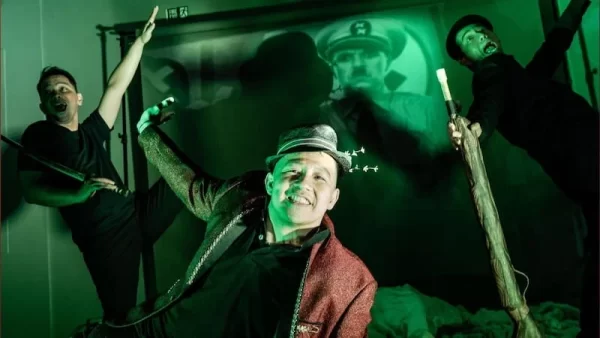
L-R: Rico del Rosario, Ron Capinding, BJ Crisostomo; Photo Credit: Infinite Cantina
Crisostomo said that the selection of the three plays with excerpts that were performed on the preview night was an homage to mentorship. They were all classics which Abad and TA have been fond of producing and performing: William Shakespeare’s A Midsummer Night’s Dream, Sophocles’ Antigone, and Samuel Beckett’s Waiting for Godot. They also comprise only “30% of the script,” said Crisostomo. Four more excerpts from four different plays are included in the script and will be shown during the actual performance. During the Q-and-A, one audience member, who identified himself as a mentor of an independent theater group, said that the selection might be a wise choice because “people are hungry for classics. I think this is a good revisiting of it.”
The democratic and inclusive nature of theater is another theme of the play. Capinding emphasized this by repeating some of the play’s more poignant lines during the Q-and-A: “Ang teatro ay karapatang pang-tao!” If it becomes increasingly difficult to watch a production, “Paano matitikman ang katotohanan na ako ay ikaw at ikaw ay ako?”
However, the creative team believes that more has to be done to realize these truths—with and for a great number of people, possibly not just the mainstream ‘paying audience.’
Juan questioned whether more people were truly watching theater these days, given the high price of tickets, or if access to the art had been limited to a certain affluent socio-economic demographic. “I don’t go anymore to the theater unless I’m invited,” he admitted candidly. “I can’t afford to pay P2,500 to P4,000 a ticket. Who is watching the theater now? What demography in this city (the National Capital Region) alone?” (Writer’s Note: “Saglit Lang,” according to its publicity materials, charges P800 a ticket.)
Juan then put forward as an example an outsider of that group: “Paano iyong matatandang nagtitinda ng fishball na 65 years old?”
To give her and her contemporaries access to theater, he suggested a return to no-frills, low-maintenance material like the kind of street theater he used to do in places in Tondo. He gave an example to make a point: “There were theater actors, basketball players, jeepney drivers, out-of-school youth, and so on,” all huddled at the basketball court. “All the people were watching. Even though they were near the estero, at least they were watching the actors.”
Asked if he was reacting to the current state of Metro Manila-based theater today, which many journalists and content creators are describing as having another Renaissance, Juan replied, “I’m not a reactor because I’m not reactionary. I’m progressive. I think those students of mine know that I like broadly doing workshops [because] I want [them] to experience all kinds of theater styles.”
Saglit Lang will have a limited two-weekend run on April 17–19 and 24–26, 2026, at the 5F The Mirror Studio Theater in Makati. Shows will be staged at 8 PM on Fridays and Saturdays and 2 PM on Sundays.
Update, April 10, 2026, 8:57 AM: The running time of the show has been updated from “approximately an hour, give or take” to “approximately an hour and a half.”

Comments