

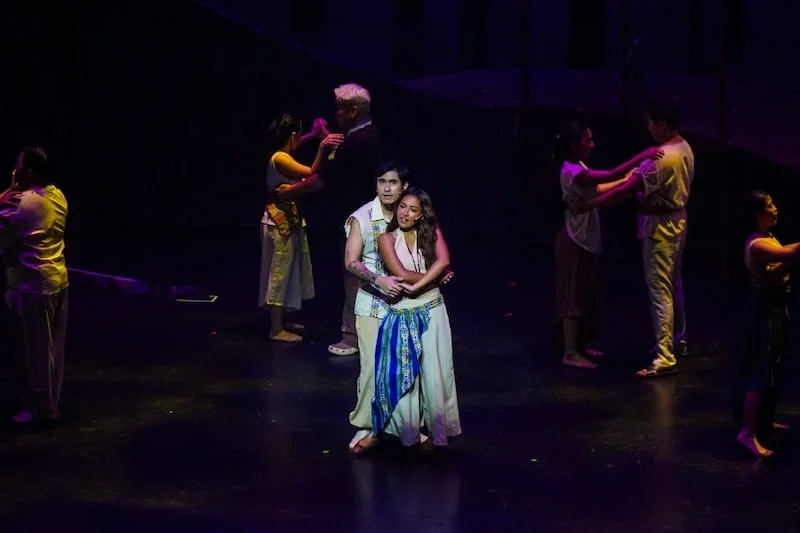
REVIEW: ‘Ambon, Ulan, Baha’ drowns its vital message in overwrought melodrama
“The Metropolitan Theater revisits a musical that still has something important to say about environmental conservation, but perhaps needs a better way to say it.”
In a year that has seen 17 tropical cyclones so far that have caused severe flooding and widespread devastation to lives and livelihood, a decades-old show like Ambon, Ulan, Baha still feels painfully timely. It is almost disheartening to see how little has changed since this show was last staged 34 years ago. The Metropolitan Theater may have been restored, but the issues that were depicted on its stage remain as insidious as ever.
Frank G. Rivera’s ethno-pop-rock modern zarzuela follows Nonoy (CJ Navato) and Inday (Thea Astley), two young lovers from the fictional Barrio Magubat, as their small community is shaken up by the arrival of the wealthy and corrupt Don Calixto (Anton Juan) and his son Doctor Anton (Rendell Sanchez) who seek to set up a logging concession in the area. What initially seems like a path to progress and prosperity for the inhabitants of Barrio Magubat soon reveals itself to be a nightmare borne of human greed and disregard for Mother Nature.
The corrupt capitalists reap the rewards while the impoverished members of the community pay the heavy price of dealing with nature’s wrath through droughts, floods, and landslides. They struggle to survive in a world plagued by both the climate crisis and the human elements who have deprived them of the essential infrastructure that should have kept them afloat during disasters.
Educational interludes
Given the musical’s subject matter, its purpose is ostensibly to educate its audience about the importance of environmental conservation. With this in mind, and given that the show follows the tradition of a modern zarzuela, certain stylistic choices are to be expected in terms of the cadence of the characters’ speech, the type of music, and the choreography.
Every now and then, characters interrupt the flow of the story to discuss with the audience the dangers of such things as deforestation, illegal logging, and other forms of environmental destruction. They also provide helpful tips on trash segregation and conserving water, to give the audience an idea of how they can play a part in protecting the environment.
The characters are thinly sketched and without much nuance, to push the show’s advocacy forward even more. The villains are unequivocally evil, and the heroes are without fault. It is very easy to choose who to root for.
Deluge of drama
While the themes of environmental conservation are compelling, the show is bogged down by a script that spends most of its time with human melodrama. Earlier scenes focus on the budding romance between childhood sweethearts Nonoy and Inday and then on the love triangle between them and Doctor Anton. This rivalry leads to tragic consequences and more clichéd romance tropes that take time away from the more serious circumstances facing their community.
Navato and Astley are a charming pair with palpable chemistry, who make the most of their scenes together. They manage to make repetitive love duets engaging enough to watch and they are able to form a believable bond in a short time. Navato has more to do as Nonoy’s character moves to the big city to study forestry and brings back progressive ideas to his community and helps them rebuild after the logging concession leaves them in the lurch.
Sanchez dazzles the naïve villagers with his wealth and good looks while hiding a more sinister nature. Juan plays an almost cartoonish villain, who cackles maniacally when he gets his way, and lacks only a mustache to twirl to fit the stereotype.
Shallow updates, mired in misogyny
This staging (directed by CJ Andaluz) updates the script by adding references to recent events such as flood control ghost projects, suitcases filled with cash, and even naming the controversial Pax Silica. But the script does little beyond name-dropping these modern developments and for the most part seems to stick to the way it was originally written. This becomes a crutch for the production as the story progresses since it makes the story beats dated while not ostensibly being a period piece, and rehashes tired tropes that should no longer be done on a stage in 2026.
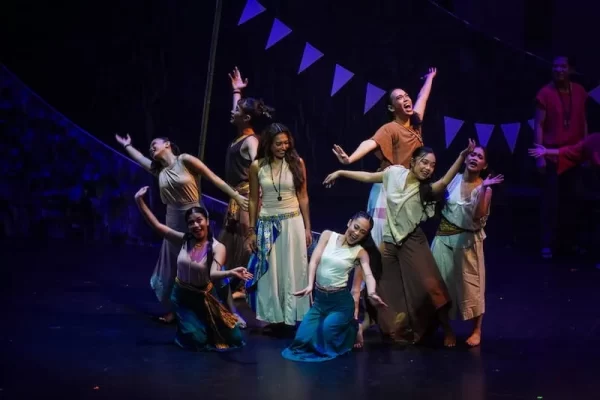
Thea Astley as Inday and the ensemble of Ambon, Ulan, Baha; Photo Credit: NCCA
Particularly egregious is the treatment of all the female characters in the piece. Despite being the second lead of the story, Inday’s role is mainly to be a prize to be won by either Nonoy or Anton, a love interest with little to no agency in her own story. Later in the story, she falls prey to Anton’s advances in a gruesome depiction of sexual violence that feels gratuitous and unnecessary. Even if this scene’s purpose is to further highlight the exploitation of the people of Barangay Magubat by the corrupt capitalists, it is not a compelling enough reason to portray sexual violence on stage. The themes of the play are already made abundantly clear without having to resort to including such a horrible scene.
The only other notable female characters are Nonoy’s mother (Shermaine Santiago) and Inday’s mother (Sweet Buchanan), both reduced to watching their husbands decide their children’s fate for them. The female members of the ensemble are poorly drawn caricatures of flirts and gossips, while the male characters seem more involved in the action.
If there was room to update the material by including references to recent events, it would have been more substantive to have made improvements to the writing of the characters, particularly the female characters. Tightening the pacing of the story and reducing the emphasis on the melodrama might have also made the show even more effective in conveying its message.
A richly rendered world
Where the show does succeed is when it allows the audience to immerse themselves in the world it has created as opposed to being spoon-fed what to think or feel. Ohm David’s beautiful set shows a circular frame where the silhouettes of either trees or industrial buildings are projected to show changes in scenery. At one point, a giant tree trunk with gnarled, leafless branches is placed at the center of the stage during the drought that plagues Barrio Magubat.
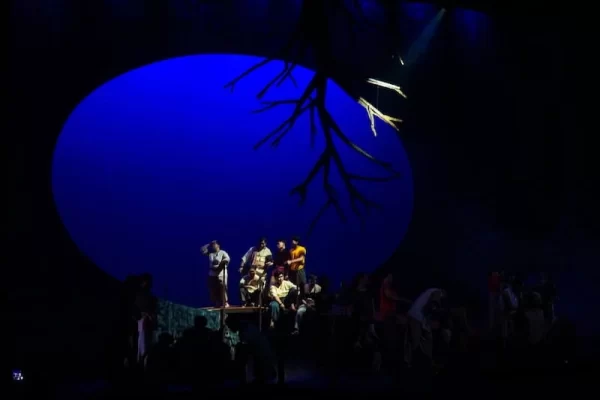
the ensemble of Ambon, Ulan, Baha; Photo Credit: NCCA
Elaborate and energetic dance numbers, including impressive aerial sequences, (choreography by Anthony Cruz) bring a certain magic to the proceedings, and haunting T’Boli chants by Manlilikha ng Bayan (National Living Treasure) Rosie Sula enrich the whole experience. The songs provide some subtlety that the script sorely lacks, and when these musical numbers are capably performed by the leads, they leave a lasting impression. A particularly memorable moment comes when the flood waters rage over Barrio Magubat in the form of large fabric swaths that extend all the way into the first few rows of the audience, creating an immersive effect.
Undoubtedly, Ambon, Ulan, Baha still speaks to today’s reality of a world facing the consequences of a climate crisis, exacerbated by human greed and corruption. It is always the small, struggling communities who must bear the brunt of these terrible circumstances and who must build their resilience in the face of adversity.
Relevant, and even urgent, as this message may be, the way in which it is delivered can and must be improved. Revisiting old material can be an opportunity for it to become more impactful, if certain adjustments are made. Otherwise, it risks sinking into the depths of obscurity, irrelevance, and mediocrity.
This reviewer watched the 2:00 PM, September 26 show.
Tickets: PHP 1,500 (Reserved Seats), PHP 1000 (General Admission/Students)
Show Dates: September 26 and 27 2026
Venue: The Metropolitan Theater
Running Time: approx. 2 hours and 30 minutes (with a 15-minute intermission)
Producer: Pixel Art Media Production Co., in partnership with the National Commission for Culture and the Arts (NCCA) and the Metropolitan Theater
Creatives: Frank G. Rivera (book, music and lyrics), CJ Andaluz (direction), Pipo Cifra (musical arrangement and direction), Anthony Cruz (choreography), Ohm David (production design), Raqs Regalado (costume design), Charlotte Despuez (lighting design), and Roman Cruz (technical direction).
Cast: CJ Navato, Thea Astley, Anton Juan, Rendell Sanchez, Nazer Salcedo, Onyl Torres, Shermaine Santiago, Sweet Buchanan, Vladimir Manio, Beng Jordan, Jerome Ferguson, Joseph Sy, Jonathan Montes, Lian Silverio, Peachy Dumaya, Phil Panganiban, members of Tanghalang Bagong Sibol, with lead dancers JM Ursula and Joch Bucacao, Manlilikha ng Bayan (National Living Treasure) Rosie Sula.

Comments