


“Master Class” brings Maria Callas’ inner life to the stage
Master Class, the Philippine Opera Company’s forthcoming production about the legendary opera singer Maria Callas, who died in 1977, should not be seen as a biographical play. Neither should the audiences expect Menchu Lauchengco-Yulo to sing Callas’ signature high notes. What the viewers can expect is a deeper dive into the controversial diva’s psyche and inner state of mind at a time when her star was losing its lustre. As seen through the eyes of playwright Terence McNally, all this soul-searching becomes the bridge by which her passion for art, as well as the discipline required to make it excellent, is passed on to the younger generation.
“Don’t get the impression that it’s a documentary,” said Master Class director Jaime del Mundo during the press conference on April 21. “It’s a theater piece written by someone who admired what Callas stood for. Master Class is about the desire to communicate to the younger generation of singers from the experience of the older generation of singers that art is beautiful and necessary.”
He added that the students who learn the lessons “grow and become better persons for life. It’s not about reinventing the wheel, but about standing on the shoulders of their mentors to see further to new horizons. That is what Master Class is about.”
The play, which won the Tony Award for Best Play and the Drama Desk Award for Outstanding New Play in 1996, is set in the 1970s in a fictional master class that Callas is giving her admiring, if intimidated, students. As McNally framed it, the opera star’s classes in the New-York-based Juilliard School were again calling public attention to her work — but this time, not as one of the world’s best singers but as a perfectionist teacher who “harshly critiques each of her young students auditioning for her master classes” while demanding “excellence from [them]” to “guide and inspire them,” according to the production notes.
Lauchengco-Yulo shared some of her insights and research on the character she plays. Callas in the play acts like a tough taskmaster on the outside but is bleeding on the inside, especially because the voice that has been her source of glory is fading. Her longtime partner Greek tycoon Aristotle Onassis had dumped her to be with American former first lady Jacqueline Kennedy. Distraught, Callas was taking sleeping pills during the time of her master classes.
“We get a glimpse of the real, insecure Callas. Ang tapang-tapang niya kapag nagbe-berate,” Lauchengco-Yulo said. “But when you go into her head, we’re going to see that vulnerability … She talks about her success and how everybody is out there wanting her to fail.”
Ultimately, though, regardless of the inner demons in her life that she confronts, what comes through the play is “about being the best you can be in your particular craft,” said Lauchengco-Yulo. “She brings that to the table. … An artist will connect because it is about passion.”
Del Mundo seconded this, saying, “That’s one of the things that this play shows: it’s literally blood and guts that an artist gives. Callas tries to verbalize what it’s like to share her art.”
The students speak
Yet, Master Class is not a one-woman show with the leading character performing all the monologues. The younger generation of artists is represented by Louie Angelo Oca, who plays the accompanist Manny Weinstock; soprano and practicing physician Alexandra Bernas who appears as student Sophie de Palma; and classically-trained musical theater artist Arman Ferrer who takes on the role of another student, Anthony Candolini.
Bernas, whose character gets her fair share of admonition from Callas in the production, said she could empathize with her stage teacher’s vulnerability. “We also have to wear our hearts on our sleeves in the theater—but that’s precisely what she demands of my character in the play, and of any singer: to allow themselves to be vulnerable, and just communicate that universal human experience.”
Speaking for the younger generation of artists, Bernas said that while acknowledging the lessons derived from experiences from her theatrical elders “who had lived through a lot, you’ll be surprised how intuitive the youth is when it comes to feelings.”
When it comes to sharing opera, theater, or any form of art with other generations and communities, Ferrer said that he believes that “art should not be exclusive or just for the older people or educated ones. We should encourage art even for young people. Even if they are young, there’s more depth and more humanity.”
Today’s younger audiences, though, can regard Callas’ onstage treatment of her charge as totalitarian, brutal, demeaning, and perhaps even abusive. During the press con, the two senior artists in the production – Del Mundo and Lauchengco-Yulo – were asked how they would interpret or explain this behavior to Millennial and Gen-Z viewers. Both described themselves as “old guard” or coming from the “old school.” As young theater artists themselves, they had cut their teeth in the pioneering Repertory Philippines more than 40 years ago.
Back then, theatrical training in the Philippines, as well as in the United States and the United Kingdom, was led by highly creative directors and playwrights, often recognized as geniuses, but were also seen to be disciplinarian, exacting, brutally honest, and demanding nothing less than the best from themselves and their ensemble. Many of their mentoring methods would probably be questioned today.
Callas’ domineering way of teaching might be reflective of her times. Still, according to Del Mundo, it might give today’s audiences one important takeaway: “That life is hard. That art is hard.”
Del Mundo replied that he has not yet been in a place or production where a younger audience would confront him with those questions. At the same time, he is familiar with their discomfort about the more violent scenes in Shakespearean classics like the titular star-crossed lovers Romeo and Juliet committing suicide, or again the titular jealously insane Othello murdering his innocent wife Desdemona.
Safe spaces in the theater
However, Del Mundo asked them to regard the theater as “a place where the director, the actors, and the writer say to the audience, ‘Trust us. We are going to take you to a different place. It may be dangerous or fun, but you have the safety of your chair.’” He paused, before elaborating further, “If [the play] is an adult-only thing, it’s for adults. If it’s a kid’s thing, then we won’t have decapitations.”
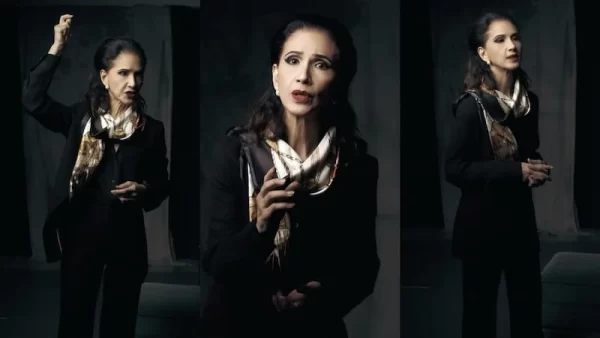
Menchu Lauchengco-Yulo as Maria Callas; Photo Credit: Paw Castillo
Lauchengco-Yulo, who has directed plays like West Side Story, Jekyll and Hyde, I Love You, You’re Perfect, Now Change, and Little Women, described how she balances artistic requirements with a modern audience’s sensibilities. First, definitely gone are the days when directors would scream at their cast and crew. “I’m very nurturing, and I always create very safe spaces in the rehearsal hall,” she said.
Second, she emphasized that the script or text has to be respected, and any young artist should study the role and the material first before auditioning. If they don’t agree with the material, then perhaps they’d best not apply. She described one possible atypical conversation: “You [the young artist] know what you’re going into. You know the show and come here ready to work. We’re going to do Romeo and Juliet, and you know you have to kill yourself. Don’t give me this—‘Oh, I cannot, [because there is a] mental health [issue].’ Then, don’t do it.”
Over the years, Maria Callas had been played by other theater and opera icons in previous Philippine productions of Master Class: Jay Valencia-Glorioso, the late Cherie Gil, and the late Baby Barredo.
Lauchengco-Yulo said that in this particular iteration, her approach would be to “get an essence of [Callas] and not try to copy her because I could never copy her. But [her] passion that goes into it is already me and how I feel about my craft, which is what I try to teach when I do teach or direct.”
There is one Callas quote taken from the play that Lauchengco-Yulo wants to leave, especially for artists and students. The diva was pushing her students not to simply speak the lyrics of their songs but to convey the feelings and emotions they require: “Try isn’t good enough. Do. The theatre isn’t about trying. People don’t leave their homes to watch us try. They come to see us do.”
Master Class, produced by the Philippine Opera Company, will open on May 15 and run until May 30 at the Carlos P. Romulo Auditorium, RCBC Plaza, Makati, with Friday and Saturday evening performances and weekend matinees.

Comments