

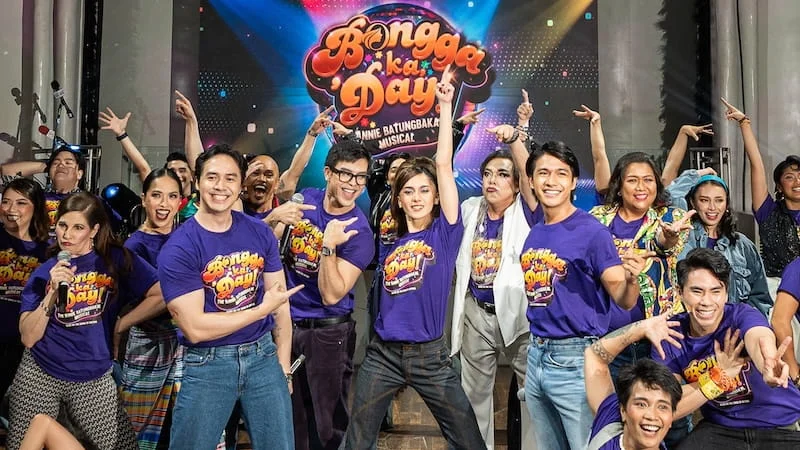
‘Bongga Ka, ’Day!: The Annie Batungbakal Musical’ Bridges the ‘70s and the Gen-Zs
The fear of missing out. The desire to stand out among the crowd, while being accepted by their peers. Finding out and living their authentic selves, despite the pressures of parental expectations and societal pressures. The challenges that today’s Millennials and Gen-Z generations are wrestling with now are the same that their elders—the youth of the 1970s’—faced almost 50 years ago. So while disco music and elevator shoes had gone the way of the vinyl and the handheld radio, that similarity is what will make Bongga Ka, ’Day!: The Annie Batungbakal Musical relatable to the modern theater audience.
At the same time, expect the journey to be dazzling, exciting, and enjoyable, said the creative team during the press con on July 7; the production, which is being staged by PETA Plus in partnership with VIVA Communications, will open at the Newport Performing Arts Theater this September 18. The core of the music as well as the storyline is based on the songs of the legendary Hotdog band, which pioneered the ‘Manila Sound’ in the 1970s. The dance numbers promise to reflect the heart, soul, glitz, and glamor of the era, known for its illuminated disco floors and sparkling glitter balls.
Director Chris Millado said that the show will go beyond mere nostalgia. To begin with, “musical theater ang approach” to Hotdog’s iconic songs. Musical director Vince Lim said that, while the original music will be respected and the Manila sound will be heard, “there are some things we will also need to vary – where the story is bringing the music […] We plan to give you a plate of different things to partake.”
Ultimately, the most important transformation is “redefining [the concept] of ‘bongga,’” said Millado. “‘Bongga’ is not just about flashiness and sparkling things, but the real ‘bongga’ comes from inside, the whole.”
He explained why that message and the dramatic journey of the lead character will resonate with many of the twenty-to-thirtysomething crowd: “What does it cost to be visible and validated? That is very much the question of a lot of the generation today. They always want to feel seen on social media. During the late 70s to early 80s, disco was the first public expression of mass youth culture.”
Super individualistic
Millado and Magtoto’s research revealed that the kind of disco dancing described in the Hotdog songs and which will be shown in the musical is individualistic and highly personal. The more creative and original the clothes and choreography of the dancer, the more they shone. “They didn’t follow trends even sa dancing,” Millado said. “Walang line dancing, maski individual ka mag-isa, pwede ka sumayaw.”
In the two movies made from Hotdog’s music—Bongga Ka, Day! (1979) and Annie Batungbakal (1980)—the late superstar Nora Aunor played the humble dispatcher who transformed into the disco queen every night to escape her humdrum existence. In this 2026 musical, the titular Annie is a simple employee of the fashion design firm House of Pasion. She wants to make a change: both in her place of work and on the dance floor.
Atasha Muhlach, who plays the lead character, said that she looks forward to playing Annie fighting for her dreams: “I want her to not be afraid, just like myself, to just try things and do them to the best of your abilities. Don’t be afraid to be high energy. Just show it because at the end of the day, it’s passion.”
Getting to dance on that floor, though, is easier said than done, making it a central point of drama in the show. The location she chooses to make her star shine is none other than Coco Banana, known as the premier dance club in Asia. Founded by the late famous couturier Ernest Santiago, Coco Banana was Manila at its most elite in the 1970s. It was frequented by socialites, journalists, diplomats, showbusiness celebrities, and what would be known now as the country’s ten percent. It was also the sanctuary where bohemian artists, drag queens, and gays and lesbians could safely come out and actually be themselves.
As Millado described it, Coco Banana promised “liberation. It’s a place where you can express yourself and then nandoon yung individuality mo.”
View this post on Instagram
The barred door
But its stature and free-spirited nature made Coco Banana also exclusive. No one could just pay for a ticket and walk in. Millado said that Santiago himself would be guarding the doorway, sizing up any wanna-be who dared to enter. “Nakabantay daw siya sa door,” he said, “Naka-all white shirt. Titingnan ka from head to foot. Kung mayaman ka o maganda ka, baka papasukin ka.” For those who are not wealthy, famous, or attractive, Santiago has one condition: “ [Dapat] there’s something in you na kakaiba.”
Magtoto added that, to the unfortunate souls who were rejected, Santiago would give this parting shot: “It’s not your year. Go home.”
Instead of Santiago, it is Tarurit, the larger-than-life proprietor of the musical’s Coco Banana, who would block Annie’s every attempt to enter the club. John Lapus, who alternates with Dindo Divinagracia in the role, said the meanness of his character—”maldita, suplada, laitera”—might just make Muhlach’s many fans cancel him. If they do, he said he would consider his performance “a job well done.”
The entrance to Coco Banana “represents being in and seen,” said Millado, describing Annie’s struggle. “She can’t get past it because of the way she looks, the way she behaves. So, she keeps on putting on things until she loses herself. And then she finds herself inside that world and begins to buy into [it].”
Annie faces a different front in her workplace: encouraging her beloved boss and mother figure, Aurora (played alternately by Jackie Lou Blanco and Ring Antonio), to adapt to the changing style and fashion of the times. The production notes describe Aurora as “an old-school yet influential fashion designer whose signature clothing line defines the house she built.”
View this post on Instagram
A changing world
“Iyung House of Pasion may pagka traditional idea,” said Magtoto, “may uniformity. May certain look ang mga suits. High-level modista [si Aurora]. Pero pagpasok ni Annie, nagbabago [na].”
The creative team pointed out that Manila in the 1970s was on the brink of a change that was being embraced by its youth, while resisted by its elders. New ideas and trends were being brought in by the beginnings of globalization. The first Overseas Filipino Workers—then known as Overseas Contract Workers—were making their fortune in Hong Kong and Japan. The Philippine government was positioning Manila as a major hub in Asia. The rise of OPM was countering the popularity of the American Top 40 hit songs.
“May ganun klase yung tension,” Millado gave the overview, “We wanted to show these adults who also had their own pressures in terms of finding themselves during that period.”
Blanco elaborated on her character’s predicament: “A hard worker pero medyo stuck in the past. Parang ayaw niyang buksan yung isip niya at yung damdamin niya sa mga pagbabago…”
Helping Annie in this venture to open Aurora’s mind to change is the latter’s own son Romer (alternately played by Sam Concepcion, Jeff Moses, and Anthony Rosaldo), a flight attendant who has actually explored the wider world around them. If Annie is attracted to Romer’s character and the kind of flashy life he represents, Romer finds himself inspired by Annie. “Romer is a dreamer,” said Moses. “Sinasabi ng mga tao, ‘Follow your dreams.’ Doon niya nakita kay Annie, the inspiration to be himself.”
View this post on Instagram
Hidden dreams
There is more to Romer than just jetsetting around the globe or managing his mother’s business one day. Concepcion spoke of the issues his character has to deal with: “May similarity sila ni Annie. He also has dreams. He wants to be a photographer. He has pressures from his family and the society around him wanting him to be something else from what he wants to be.”
During the 1970s, parents had a bigger and stronger role in the choice of careers of their children. Magtoto gave Annie herself as an example, and the hurdle she had to jump over to work in the fashion business and then dance in the disco. “Hindi [gusto ng magulang ni Annie] iyong fashion design [na kinuha niya]. ‘Pinag-home-economics ka namin.’ Doon palang iyong time na medyo nag-bre-break din ‘yung women from how society views what women should be doing. [Si Annie] kasi, mayroon siyang sarili niyang [gusto].”
At the end, the journeys of the characters, especially Annie’s, boil down to staying true to oneself despite the pursuit of dreams and the pressures that come with it. Millado said it is a predicament that the audience can identify with. “Although disco offers this four minutes of fame under the glitter ball, it also requires a lot of performance and pressure from that person,” he said. “That kind of tension between performing before adoring eyes and the pressure of keeping up a facade is represented by Annie.”
Muhlach, though, promised that her character will have the last word because she “encompasses the value that you don’t need to change yourself … to be successful or accepted in society. No matter the situation, we can all do it just as long as we maintain and continue to be our pure selves.”
Newport World Resorts, in association with VIVA Communications and The Philippine STAR, reunites for Bongga Ka, ’Day!: The Annie Batungbakal Musical featuring Hotdog’s timeless hits. The show, staged with PETA Plus, is set to open on September 18 at the Newport Performing Arts Theater. The creative team is led by director Chris Millado, playwright Liza Magtoto, and musical director Vince Lim.

Comments