

‘About Us But Not About Us’: Self-discovery, the confrontation of trauma, and liberation in very confining spaces
Being literally confined together in small spaces with very little room for maneuver for a long time can force people to finally confront the long-festering issues they have been avoiding. It can be a very unsettling process where their discoveries about themselves and their loved ones can shake them to their core.
This is the journey that is travelled by the three main characters in Jun Robles Lana’s two-act play, About Us But Not About Us. The time and place is set just a few months after the COVID-19 restrictions are finally being lifted.
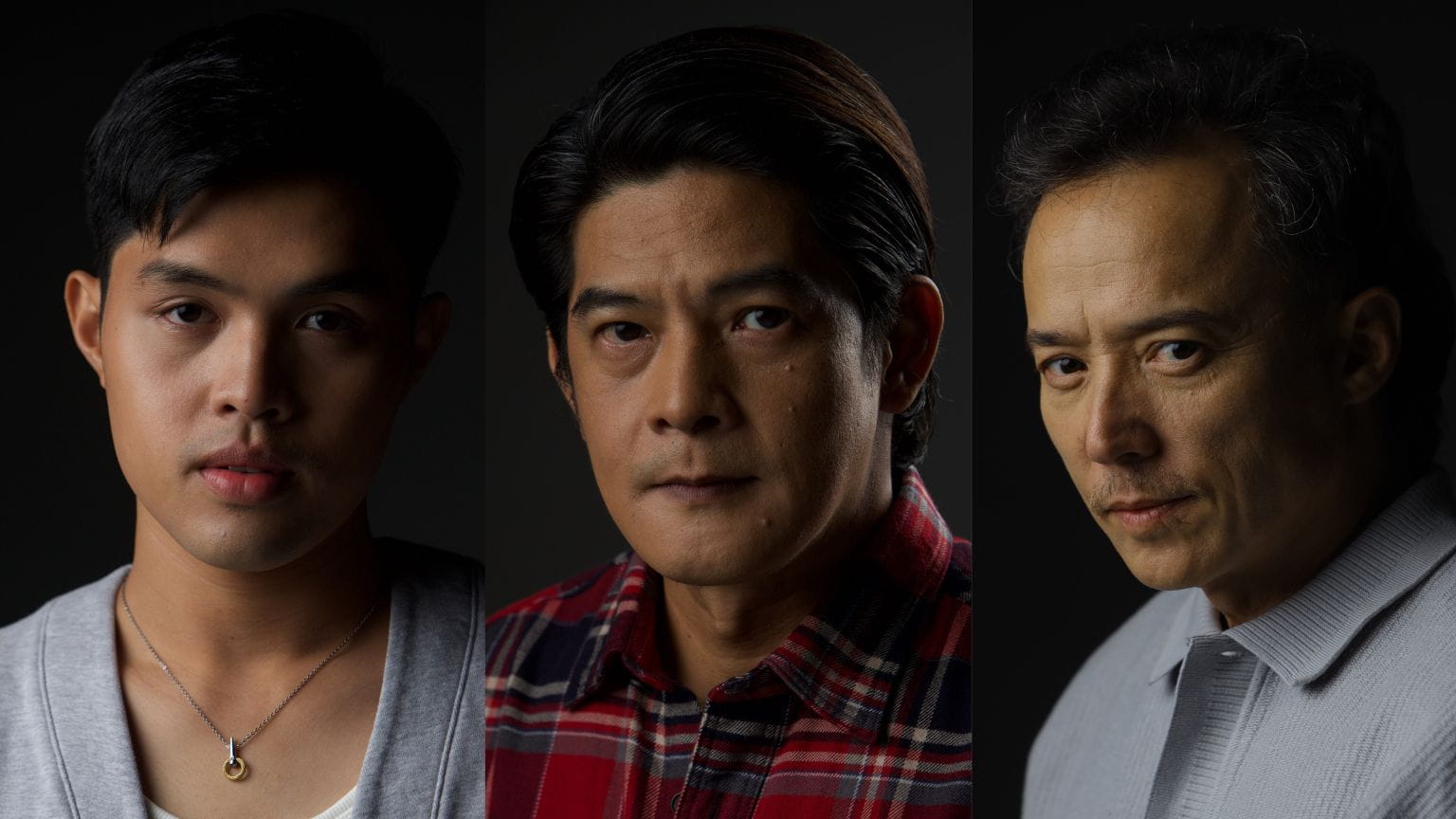
A forty-something university professor, Eric (Romnick Sarmenta, occasionally played by cover Noel Rayos), and his student Lance (Elijah Canlas, understudied by Jack Denzel) meet in a cozy cafe around the time that the pandemic restrictions are being lifted. The third character is the center of their discussion: Marcus (Epy Quizon, alternating with Andoy Ranay), who is also Lance’s professor and Eric’s co-teacher and partner for 17 years, until he commits suicide.
View this post on Instagram
Without going into spoiler material, it is this death and the grief that the two survivors apparently share that draw them again together.
At its heart, according to the creative team and actors of Jun Lana’s About Us But Not About Us, the material digs deeply into trauma, its suppression and expression, and how one person’s experience can affect others, even throughout several decades. The COVID-19 setting also adds to the intensity of the experience. Reports during and after that claustrophobic era indicate that cases of mental health have increased, and many relationships deteriorated.
Lana gave one example that surfaces in the play, “Marcus was talking about the continuing intergenerational trauma of writers, and then of writers using their youth to manipulate older writers until they themselves become old.”
Epy Quizon, who plays Marcus (alternating with Andoy Ranay), described to TFM that within “the very complex script” is Marcus, who he believes is “bipolar” and “wrestling with the monster inside him.”
SHAPING LIVES
Romnick Sarmenta, who plays Eric, added that each character’s trauma affects the other, creating a mirror that can shape their individual and inextricably tied lives. “Whenever we are in a relationship, those two people who are going through the same things are not exactly experiencing the same things,” he said. “That’s the beauty of this narrative. It’s trying to put our feelings in front of the other person. That, I think, is also very important in real life—that we are able to express exactly how we experience our life together.”
Elijah Canlas said that portraying Lance’s particular trauma was important to him. “Showing a character that is so flawed but also damaged is something that I want people to connect with, understand, and choose to empathize with, no matter what.”
View this post on Instagram
Lana, who first wrote the main material as a film script, said in an interview with TFM that the three main characters “are all me”, and that “eighty percent of what you hear…come from my memories.” His writing happened during the pandemic, the same setting of the play. Like his characters, he had a relationship that “was coming to an end. I was facing that situation at that time. I was ashamed to ask for help. I’m not the kind of person who asks for help. That was difficult for me.”
Without someone to talk to, Lana poured his heart out into a journal. His sole objective was just to vent and air out his pain and anguish. But as the journal pages started filling up, his storytelling persona kicked in—and he finished a screenplay based on the entries in just three days.
That screenplay was eventually produced into a 2022 movie that won Best Film in the Estonia-based Tallinn Black Nights Film Festival, as well as 10 major awards, including Best Picture, in the 2023 Summer Metro Manila Film Festival. Critics lauded it as a highly engaging psychological drama with twists and turns that kept the audience guessing. Other international reviewers noted the way it addressed issues of identity, gender, power, and loss.
Yet as structured by Lana and director Tuxqs Rutaquio, and based on the preview performance, this 2026 play can stand on its own. The theatergoer can dive into its world without needing to have seen the movie previously.
CINEMATIC ROOTS
Interestingly, when he first read the screenplay years ago, Sarmenta told Lana that it would make for a good theatrical production. Lana revealed that he chose to write the material for a movie because it was just too personal. “I did not want to write it as a play primarily, because it is not the kind of drama I want to go back [to],” he said. “I wrote about it to vent.”
View this post on Instagram
Yet, even the cinematic version hit too close to home. Lana continued, “In Tallinn, the first time it had its world premiere there, it was so difficult to sit through the entire screening.”
What overcame his reluctance a year later was repeated viewings of the movie in the Metro Manila Film Festival. The subsequent epiphany enabled him to distance himself from the story and characters.
“I had an entirely different experience. I realized the material was really different. When you watch [the movie] over and over, suddenly the words have no power over you,” he looked back, reminiscing. “When I was able to look at [the material] with that kind of objectivity, that was the time I was ready to write [the play]. Because I can already see the characters as characters. It’s not about me anymore.”
Despite his own sentiments that the material was very personal, Lana also realized that it could be universal as well. Calling the film’s popularity and critical acclaim surprising and “surreal,” Lana recalled, “When we decided to turn it into a film and produce it, it was just for myself. I didn’t think the film would go anywhere. But when I was in San Francisco, I was surprised when this guy came to me after the screening and said, ‘It’s my story too.’”
Lana’s months-long “recalibration” of the play from its cinematic roots incorporated many changes into the stage version. Even the filmgoers who had seen the movie and know its ending can still expect a few surprises.
SURPRISES
The biggest one is finally making Marcus a living, breathing character who interacts with Eric and Lance; the play tells his story in flashback while the movie just alludes to him in the two-person conversation. Lana admitted that Marcus’ presence in the play is a game-changer: “It makes the story entirely different.”
View this post on Instagram
Second, the other actors were given more room and freedom to bring a more layered interpretation to their roles, different from the film. Sarmenta said that playing the stage Eric as totally identical to the film Eric “would be a disservice to the people who have seen the film and are coming to pay for the theatrical performance. So I wanted it to be different.”
Stage Eric has “a better understanding of what he is going through and a better hand in what he is manipulating,” continued Sarmenta. He contrasted that with “Eric in the film who was a lot more suppressed, more lost.”
Meanwhile Canlas said that his stage Lance is more conniving and darker than cinematic Lance. The film version wanted to control people, but the stage one is into “feeding Eric different devils so he can get him on Lance’s side.”
Third, Lana said that the stage ending will be more definitive than the ambiguous one that concluded the film.
Fourth, without giving away spoilers, Marcus’ milestone novel—the crux of one major conflict—will be presented in the lobby, possibly for audience purchase. Lana said it is one way for the audience to further understand the relationships in the play.
Finally, another thing that Lana wants to change is the impact that the play will have on the audience. Trauma may be overwhelming, but it does not necessarily have to be overpowering. “When we project our pain on screen and it comes back to us, we tend to ask ourselves, ‘You got all this. What are you gonna do?’” he said. “ I hope that’s going to be the experience of audiences, despite the pain and trauma. We realize that we have no choice but to go on. There are simply problems that we have no choice with but to struggle on until the struggle works itself into something else.”
“About Us But Not About Us,” produced by IdeaFirst Live, is set to run from February 14 to March 8, 2026 at the Power Mac Center Spotlight Blackbox Theater in Makati City.


Comments