
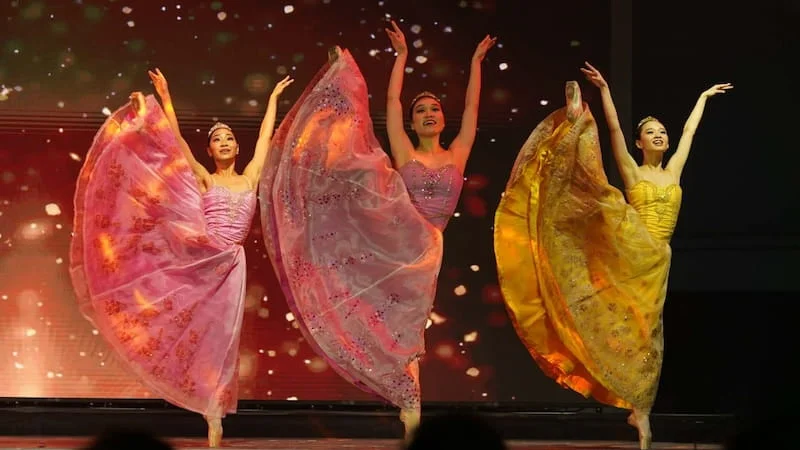
REVIEW: ‘On the Wings of Songs’ by PBT dances to the songs we love
With government funding for the arts, sports, and health care sharply reduced, the Philippine Ballet Theatre (PBT) continues to fight for its place in the local dance scene. The company has kept its season going with the support of its board and a partnership with Foro de Intramuros for its remaining performances. The venue’s no-frills setup, exposed posts, and prominent sound system were less than theatrical, but the dancers’ efforts were appreciated by the audience.
On the Wings of Songs, comprising Serye at Sayaw and Jose Mari Chan Suite, draws on OPM songs to bring ballet to a wider audience. The two suites have become staples of PBT’s repertoire. Serye at Sayaw, a collection of eight dances set to songs performed by leading Filipino singers, explores unconditional devotion, unrequited love, and heartbreak. The songs are already winners, with their heartfelt lyrics. In this earlier work, artistic director Ronilo Jaynario created movements that respond to the lyrics without illustrating them too literally. With 22 dances in all, the program is lengthy. These are the performances that stand out:
Love and Loss
The suite opens with Tuwing Umuulan, sung by Regine Velasquez. The group dance begins with the girls dancing playfully onstage before the boys enter to partner them. The highlight is PBT principal Matthew Davo supporting Gabrielle Jaynario through 12 smooth pirouettes, drawing applause from the audience.
Set to Basil Valdez’s classic Ngayon at Kailanman, the duet pairs seasoned performer Dom Delmo with Joanne Tangalin, who is quite green in a portrayal of enduring devotion through life’s ups and downs. The pas de deux calls for technical control and emotional depth which Joanne has to develop. The contrast between the performers’ different styles makes some transitions and timing uneven. The partner work, floor drops, turns, and lifts aim to capture the ballad’s romantic swell, although the emotional shifts do not always connect seamlessly.
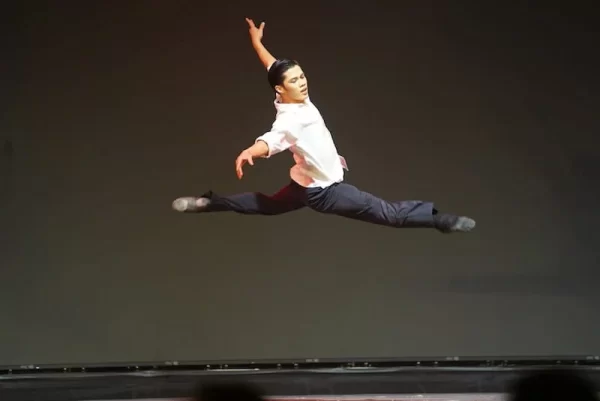
Justine Orande in “Anong Nangyari Sa Ating Dalawa”; Photo Credit: Paolo Prado
Anong Nangyari Sa Ating Dalawa, popularized by Ice Seguerra, captures the song’s progression from shock and self-questioning to heartbreak. The choreography uses extensive movements, sudden falls to the floor, turns, and expressive upper-body movements to follow the melody’s changing intensity. It also combines contemporary dance release with grand leaps and floor recoveries. Justine Orande genuinely conveys the bewilderment and heartbreak of a relationship that has fallen apart, as expressed in the lyrics, “Anong nangyari sa ating dalawa? / Akala ko noon tayo ay iisa…” The shifts between upward extensions and leaps and low, grounded movements give physical form to hope turning into disappointment which Justine performs with deep concentration.
Martin Nievera’s Ikaw is a ballad about devotion, gratitude, and finding completeness in another person’s presence. Gabrielle Jaynario is the soloist, dressed in white and occasionally joined by male dancers in contrasting colors. Their appearances create a visual motif of companionship and shared focus, fitting a song centered on someone who has become the heart of another person’s world.
The choreography uses expressive upper-body inclinations and polite partnering to convey warmth and affection. Gabrielle moves through connected sequences of steps, turns, and arm sweeps, with each gesture moving towards a couple in an embrace. Between wide extensions and high reaches, the movement often folds inward, drawing her hands and arms toward her chest, face, or head. These gestures give the dance a tender, reflective quality.
While most of the dances in the suite are lyrical, Hanggang sa Dulo ng Walang Hanggan, another Basil Valdez song, takes a more acrobatic approach that runs counter to the sentiment of the music. Jimmy Lumba, Matthew Davo, and Jessa Tangalin portray a love triangle in which the woman is passed between two lovers through athletic partnering. The sequences include the famous throw turn, a move that has also become a feature of Ronilo Jaynario’s other works.
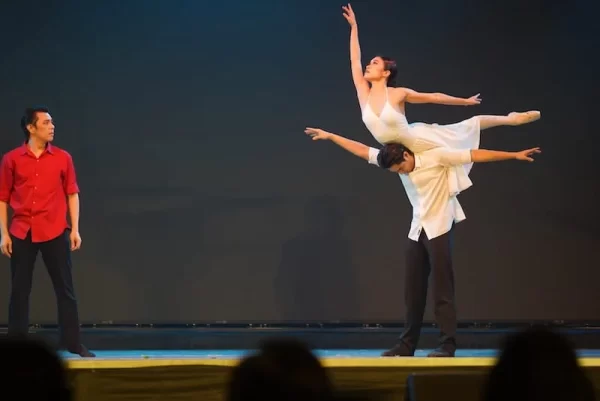
L-R: Jimmy Lumba, Matthew Davo, and Jessa Tangalin in “Hanggang sa Dulo ng Walang Hanggan”; Photo Credit: Paolo Prado
Julafer Fegarido and Gladys Baybayan give a satisfactory interpretation of Kailangan Kita, but their performance last Sunday lacked the flow and full commitment they had shown in the past. Nevertheless, the audience cheered at the moment when she sat on his lap and hooked her leg over his shoulder as he performed a deep backbend, reaching all the way to the floor.
The OPM suite ends with Kay Ganda ng Ating Musika, sung by Hajji Alejandro. This 48-year-old classic by National Artist Ryan Cayabyab remains relevant because it celebrates the richness and vitality of Filipino music. Its melody and upbeat rhythm capture the pride of having a musical tradition of our own. PBT, however, could have done the song greater justice. The movement lacks the buoyancy, sharpness, and jazzy attack that the music calls for. The dancers’ soft approach weakens the choreography instead of bringing out the song’s lively character.
Joe Mari’s Classics
The Jose Mari Chan Suite consists of 14 pieces, built around his famous songs, with the French as an exception. Yet this Francophile number, performed by Jessa Tangalin and Matthew Davo, was among the most applauded. With a glowing café as a backdrop, the duet features lively theatrical rapport, flirtatious footwork, and crisp partnering. A daring inverted lift and release is followed by Jessa’s light-hearted solo and Matthew’s leap into an open-armed pose. Despite a low, speaker-framed sightline that obscures some of the footwork and a slightly abrupt landing from the lift, the dancers move easily between tender exchanges and spirited showmanship.
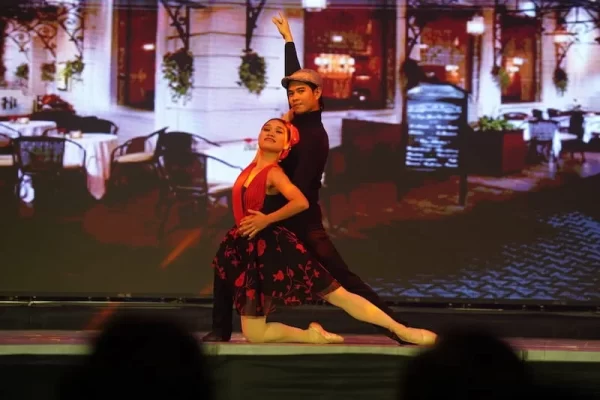
Jessa Tangalin, Matthew Davo in “Sous la Pluie de Paris”; Photo Credit: Paolo Prado
By this point, however, the audience was beginning to experience mild fatigue from the sheer number of dances. Still, the familiar Filipino hits still struck a chord. In Mamang Sorbetero, Dexter and Ramon Igares and Carmela Diokno bring the street setting to life through lively exchanges, expressive movements, and flexed feet. Carmela adds to the playful mood with a handstand that ends in a shoulder lift. The Igares brothers take turns lifting her from one end of the stage to the other before breaking into little jumps and supported turns. Carmela moves in and out of their exchanges, adding variety to the choreography, which leans more toward theatrical performance. The three dancers show good energy, but the number needs more rehearsal to achieve a smoother flow.
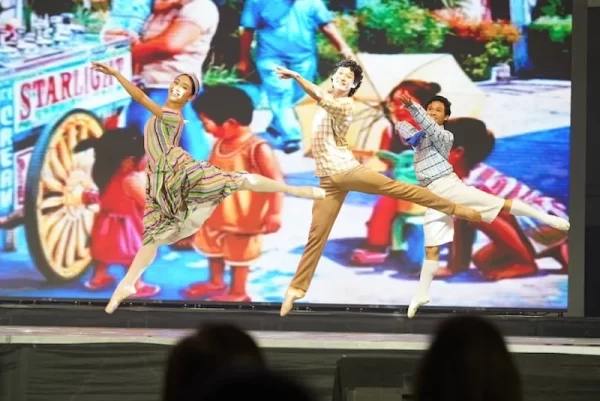
L-R: Carmela Diokno, Ramon Igares, Dexter Igares in “Mamang Sorbetero”; Photo Credit: Paolo Prado
Please Be Careful with My Heart, featuring Jimmy Lumba and Jessa Tangalin, and Can We Stop and Talk a While, with Matthew Davo and Gabrielle Jaynario, rely on the familiar acrobatic partnering that has become a feature of Ronilo Jaynario’s choreography.
Beautiful Girl, performed by seven female dancers, has a repetitive but hypnotic quality. The girls appear to float across the stage, performing high kicks and arabesques, interspersed with rather schmaltzy arm movements. The number might be more at home on a fashion runway.
Julafer Fegarido and Sophie Tiangco bring classical poise and gentle romance in Walking in the Moonlight, performed against a starlit blue backdrop. Their pas de deux weaves together supported extensions, turns, a brief floor drop, and light lifts. The choreography stays within familiar pas de deux vocabulary rather than pushing into high-risk acrobatics. The pair’s attentive partnering and clear, open lines give the excerpt a lyrical charm. The song recalls the romantic ballads of the mid-20th century, but the dancers needed more rehearsal to develop the steps into a fully realized dance rather than a series of performed movements.
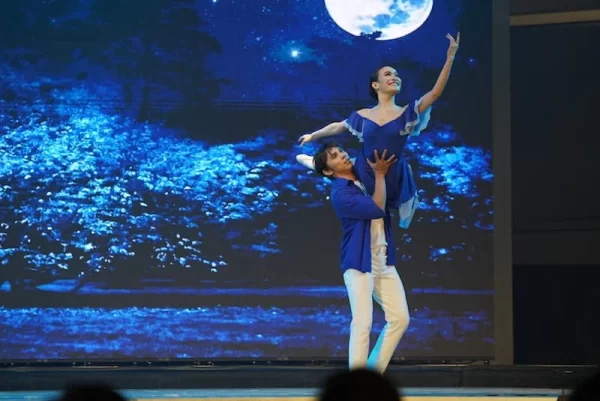
Julafer Fegarido and Sophie Tiangco in “Walking in the Moonlight”; Photo Credit: Paolo Prado
Verdict
The show also introduces Ronilo Jaynario’s new works. Candle Glow is a neoclassical quartet featuring Matthew Davo, Jimmy Lumba, Gabrielle Jaynario, and Jessa Tangalin.
Since these dances are performed frequently, one would expect the dancers to grow more comfortable with them over time. Some veterans understood the assignment. Justine Orande’s gut-wrenching solo in Anong Nangyari Sa Ating Dalawa showed a strong grasp of both the choreography and the song’s emotional content. He conveyed its disbelief, self-questioning and lingering heartache through his expressive movements. While the other dancers seemed to be still warming up, Justine was on fire.
Jessa Tangalin and Matthew Davo also brought lively energy and well-timed partnering to Sous la Pluie de Paris. Their theatrical flair carried the number, despite a slightly abrupt landing from the lift.
Since some of the dancers look like students, the quality of the dancing is uneven. There is an old adage that there is no such thing as bad choreography, although some may disagree. Dancers with artistry and emotional intelligence can bring out a choreographer’s intentions while adding their individuality. But that was not always evident here. Both Serye at Sayaw and the Jose Mari Chan Suite looked under-rehearsed. The dancers did not seem to connect with the lyrics, and their movements needed fuller expression, greater length, and more breath to give them dramatic weight. Too many remained upright, relying on their arms and legs rather than allowing the movement to ripple through the body. The result was a lack of reach and full-body expression.
There were also too many dances, and the group numbers tended to look alike apart from their costumes. The pacing was too uniform, with little variation to sustain interest. The repeated, even counts made some sections drag. This could have been a more enjoyable show with tighter editing and dancers who had put in more rehearsal.
This reviewer watched the 3 PM, November 22 show.
Tickets: P500, P1,000
Show Dates: November 22, 3 PM and 6 PM
Venue: Foro de Intramuros, Calle Arzobispo, Intramuros
Running Time: approximately 1.5 hours (with a 15-minute intermission)
Company: Philippine Ballet Theatre
Creatives: Ronilo Jaynario (choreographer), Jose Mari chan and various OPM artists (music)
Comments