

REVIEW: The innovative ‘Whatcha Saying?’ lets a Deaf character speak his truth
“Apothecary Productions’ stage adaptation of CJ Reynaldo’s comic book breaks the silence on the lived experience of the Deaf community through moving performances and multilayered storytelling.”
There are over 1 million deaf Filipinos, but we do not often see their stories told. Many Filipinos’ most common exposure to sign language is watching interpreters on the corner of their screen during news broadcasts. While members of the Deaf community are sometimes able to experience live theater through sign-interpreted performances of certain musicals, it is rare for them to see themselves portrayed on stage. Whatcha Saying? seeks to address this gap of representation by shining a spotlight on a Deaf character’s story.
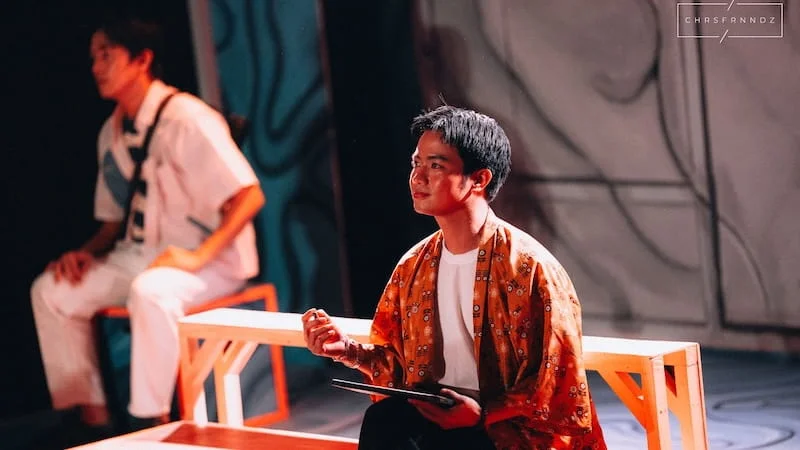
Adapted from Deaf Filipino artist CJ Reynaldo’s comic book, the show follows CJ (Juner “Cocoy” Quiambao), a Deaf college freshman and artist as he navigates daily life in a hearing world. While he initially struggles to communicate with the people around him, he meets new friends: Sarah (Onix Valerio), a lively woman who knows sign language and Liam (Nathan Molina), a fellow artist. Through Sarah’s help, CJ and Liam find ways to better communicate with one another and develop a romantic relationship.
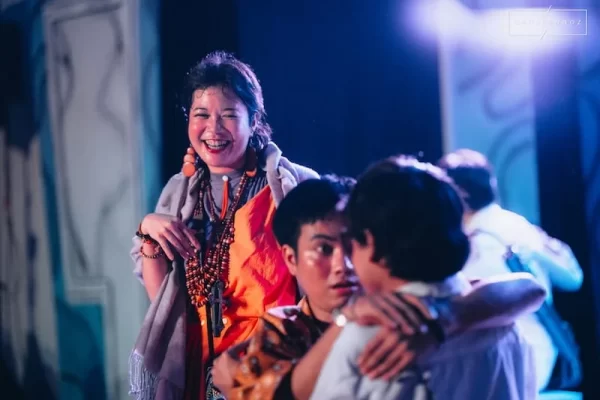
L-R: Onix Valerio (Sarah), Cocoy Quiambao (CJ), Nathan Molina (Liam); Photo Credit: Chris Fernandez
Quiambao is a timid presence who grows in confidence as his character is given more opportunities to express himself. He is patient when trying to explain his circumstances to new people but he is also unafraid to assert his independence. There is a sweet chemistry between him and Molina as their romance blossoms even through small gestures like eating street food together or more personal moments like sharing their art with each other.
Valerio’s energy is electric from the moment she appears and she is the show’s biggest source of comic relief. While her characterization at times comes across as over-the-top, she does eventually reveal hidden depths, particularly through her genuine friendship with CJ and the lengths to which she goes to help him find love and acceptance.
Multilingual and multilayered
The play is performed in three languages: English, Filipino, and Filipino Sign Language (FSL). FSL was legally recognized as the national sign language of the Philippines in 2018 through Republic Act 11106 and is distinct from American Sign Language.
The original comic book was an artistic reference material for FSL and the stage adaptation creatively integrates the FSL lessons into the performance. Before the show even begins, the director teaches the audience how to sign their applause so that they can show their appreciation properly to the deaf performers. During the play, both Sarah and CJ teach Liam some basic FSL while subtitles with additional context are projected on the wall above the stage. At times, however, some of these projections were not clearly visible on the walls of the auditorium in which the preview show took place.
One unique aspect of this production is how most of the scenes are portrayed simultaneously by two sets of actors, performing in different languages. When the main characters are speaking to each other or exchanging texts through projections (sometimes featuring CJ Reynaldo’s original artwork) above the stage (projection design by Mark Rosadeño), another set of actors, dressed in similar clothing are performing the same scene in FSL. On the other hand, when the characters are signing to each other, the other actors will recite the same lines aloud. The few instances when there is only one set of characters on stage are when Sarah is interpreting for CJ and Liam.
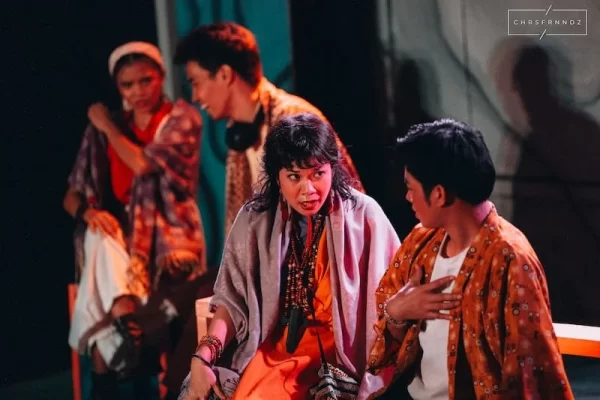
The ensemble with Onix Valerio (Sarah), Cocoy Quiambao (CJ); Photo Credit: Chris Fernandez
Given how FSL relies on facial expressions and body movements, this enables the scenes to come to life more vividly for the deaf audience as opposed to simply reading subtitles above the stage. These multiple performances ensure that the portrayal of simple interactions is inclusive and accessible and is also a way of showing how FSL is used in various contexts.
Beyond language lessons
Heart Romero’s script and clear direction ensure that the show avoids becoming a mere language class but instead is driven by nuanced characters and realistic dynamics. The show strikes a balance between the struggles CJ endures with moments of connection, and even humor. The misinterpretation of certain FSL signs leads to some innocently hilarious moments such as when the sign for “thank you” is mistaken for blowing a kiss, when the sign for “I love you” is mistaken for “rock on,” or when Liam clumsily makes the sign for “there’s a bomb!” instead of “how much?” when he and CJ are sharing a meal together. These amusing interactions become more than just teachable moments because they also build on the characters’ relationships and feel like reflections of realistic experiences.
Some FSL lessons are also particularly profound. CJ explains that the sign for “sorry” represents “cleansing one’s muddy heart after making a mistake.” There is also the moment when CJ gives Liam his own sign name, which has its own cultural significance in the Deaf community and which indicates that one has been accepted by them.
Small changes, big impact
The show’s themes of diversity and inclusion never feel forced because these are grounded in the characters’ lived experiences. All three characters simply want to be free to be themselves and to be accepted by the people around them.
While running for less than an hour, Whatcha Saying? effectively depicts CJ’s rich inner life, as he encounters challenges to communicate his thoughts and feelings that would not be familiar to people in the hearing world. The simplest interactions can be fraught with misunderstandings: introducing himself to new people is not always straightforward and some people think he is ignoring them because he cannot hear them talking to him.
But the show also makes it clear that the solutions to such difficulties are quite simple. One does not even need to know FSL to be able to communicate with a deaf person. CJ and Liam manage by exchanging written messages on their tablets or notepads. Sarah mentions that some deaf people are more comfortable conversing in English than Filipino. One can call a deaf person’s attention by gently tapping them on the shoulder.
What the show is saying is that it truly does not take much to help make someone feel included and accepted.
This reviewer watched the 1:00 PM, October 24 preview show.
Tickets: PHP 800 (Quezon City), PHP 500 (La Union)
Show Dates: November 4-7, 14-16, 2026
Venue: Thames International Auditorium, Quezon City (November 4-7); Lorma Colleges AVR, San Fernando, La Union (November 14-16)
Running Time: approx. 45 minutes
Producer: Apothecary Productions
Creatives: CJ Reynaldo (comic book creator), Heart Romero (playwright, director), Ae Formadero (technical director), Jigger Sementilla (lighting designer), Styze Genodia (production designer), Zak Capinding (sound designer), Mark Rosadeño (projection designer)
Cast: Juner “Cocoy” Quiambao (CJ); Nathan Molina and Raymond Lance Aguilar (Liam); Onix Valerio (Sarah); Aura Payawan, Beverly “Bev” Palileo, Lucky Charles Historia, and Wayne San Juan (ensemble)
Comments