

REVIEW: ‘The Flames of Paris’ brings back the flames in full force
In 1989, Tetsuya Kumakawa, then a 16-year-old student at the Royal Ballet School, stunned the jury with his solo from Don Quixote at the Prix de Lausanne, the Olympics for young dancers. His leaps spanned the stage, while his body was on a precise axis on all the quick-fire pirouettes. The performance earned him the competition’s grand prize. He went on to become the Royal Ballet’s first Asian principal dancer before founding K-Ballet Tokyo in 1999. His explosive jumps, featherlight landings, rapid changes of speed in his turns and instinct for theatrical flair became hallmarks of his dancing.
Now 54, Kumakawa, the company’s general director, appears in a video teaching dance to men. His advice is disarmingly direct. Dancing begins with “how the music moves your heart, not the form. It’s okay to get it wrong, just start creating,” says the salt-and-pepper-haired danseur in Nihongo.
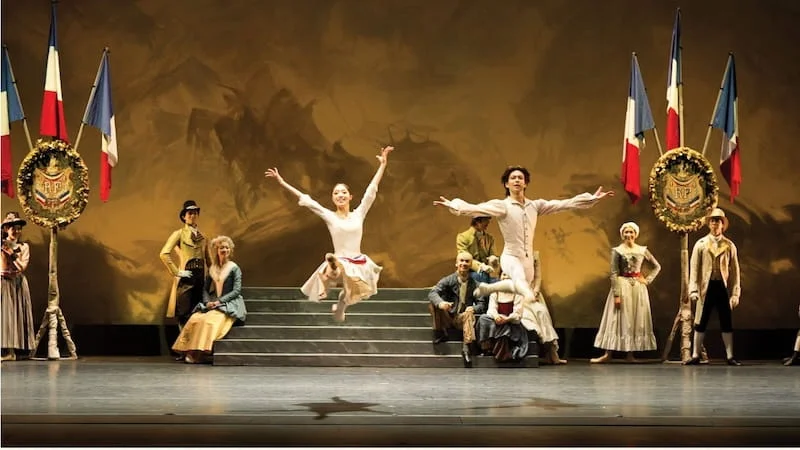
Though the ballet superstar was absent from K-Ballet Tokyo’s Manila debut on October 24, his approach to movement and theatricality was evident in the company’s new generation. The Philippine premiere of The Flames of Paris at the Samsung Performing Arts Theater was among the highlights of the year-long celebration of 70 years of diplomatic relations between Japan and the Philippines. It also marked the ballet’s Southeast Asian premiere and the first Philippine appearance of a Japanese ballet company.
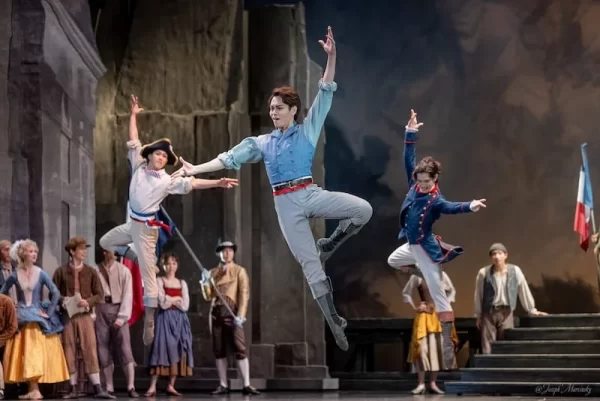
Hirotake Yamada as Philippe; Photo Credit: Joseph Marcinsky for K-Ballet Tokyo
Choreographed by Vasily Vainonen in 1932 to music by Boris Asafiev, The Flames of Paris was created to mark the 15th anniversary of Russia’s October Revolution. It used the French Revolution of 1789 as its subject, following peasants and workers from Marseille as they marched on Paris and stormed the Tuileries Palace. The revolt unfolds alongside two romances– one between revolutionary leader Philippe and Jeanne, a peasant girl, and another between Jeanne’s brother Jérôme and Adeline, the daughter of the aristocratic Marquis de Beauregard. The romance between Jérôme and Adeline, whose aristocratic family stands on the opposite side of the uprising, turns the class conflict into a personal tragedy.
CLASS DIVIDE
Known for its interpretations of classical works, K-Ballet Tokyo chose The Flames of Paris for the first full-length ballet staged and choreographed by its newly-appointed artistic director, Shuntaro Miyao. At the gala, Miyao spoke about being in Paris during a week of street unrest.
“The feelings and aspirations of the people and the struggles within society depicted throughout history are by no means things of the past alone,” he said at the gala. “One of the important roles of art is to continue expressing human joy, sorrow, hope and inner conflict.”
The comparison links two different periods of French unrest. The French Revolution was driven by resentment over feudal privilege, royal excess and food shortages. Recent protests in France have raised concerns over the cost of living, purchasing power, government and education policies. The historical circumstances are different, but both bring collective grievances into public view.
In the full-length production, Miyao uses post-revolution leader Napoleon Bonaparte to frame The Flames of Paris, looking back on that popular rebellion that transformed France from monarchy to republic. He tightens the first act around the class divide that fueled the uprising, contrasting the vigorous, earthy dancing of peasants with the refined elegance of a royal court oblivious to the social unrest.
Bringing K-Ballet Tokyo to Manila under the auspices of the Embassy of Japan, the Japan Foundation and Ayala Land Inc. was an achievement in itself. The preview retained many of its bravura dances. In the Dance of the Uprising, the male corps de ballet astonishes with its elevation, suspending itself in midair as the masses surge through the streets of Marseille. The choreography captures the force of a crowd moving with a common purpose.
Miyao once said in a YouTube interview that he chose principal dancers with such overwhelming charisma that their mere presence could lead the masses. Hirotaka Yamada as Philippe and Yuka Iwai as Jeanne make a commanding pair.
The royal court scene offers a sharp contrast. Two solos by bewigged servants and the appearances of Marie Antoinette and Louis XVI evoke the opulence of the fading Ancien Régime. As Marie Antoinette, Noi Kinoshita conveys the queen’s aristocratic poise through crisp pointe work, articulated fan gestures and smooth pirouettes with a gracefully curved leg, evoking the stylized elegance of the royal court.
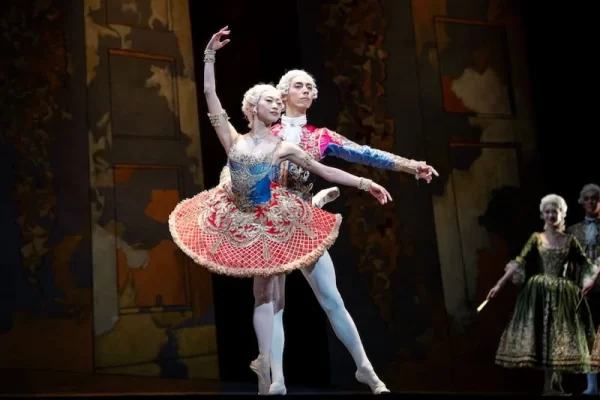
Marie Antoinette and King Louis XVI Pas de Deux; Photo Credit: Joseph Marcinsky for K-Ballet Tokyo
FIERCE CHARACTERIZATION
Shoya Ishibashi as Jerome and Misaki Hara as Adeline enact the profound conflict of the latter torn between devotion to her aristocratic family and the political tide of the. Their partnering features close-contact holds, sweeping lifts, and supported promenades that shift into sharp physical recoils, visible distress, and reaching gestures.
As Napoleon, Shu Kurihara brings a different kind of energy. Napoleon’s straddle jumps split the air like a jackknife snapping open, followed by frog jumps with his knees turned out and heels drawn up, each landing and takeoff sharply defined. In the batterie, his feet strike together with the crisp precision of a mechanism locking into place.
In his officer’s coat, he spins through a series of turns, the coattails flashing around him like brushstrokes across the stage.
Aya Shimamura portrays the political activist and feminist Olympe. Her expansive, subtly sensual movements and sustained turns give her a fluidity that contrasts with the character’s resoluteness.
The dances of the Parisian citizens and the Basques are among the highlights. Vigorous circles, heavy foot stamping, foot strikes, and broad leaps mix with recognizable Russian folk steps, from fast squats followed by a rise and an extended leg to stylized polka steps and gliding sequences. The dancers stamp out the rhythm as the circles gather force, giving the crowd scenes a physical charge.
While the corps’ fierce movement attack reveals the company’s strength, the Grand Pas de Deux by Iwai and Yamada offers the evening’s most demanding display of technique. In Philippe’s solo, Yamada launches into a scissors jump, his legs stretched wide as he hangs for an instant above the stage. He follows with a triple grand assemblé en tournant, turning three times in the air with his legs held tightly together. Then come the revoltades, his legs crossing and beating against each other in a blur of airborne footwork, as if the jumps themselves were striking sparks. He was like a whirlwind with his pirouettes beginning with the working leg extended to the side before drawing it inward.
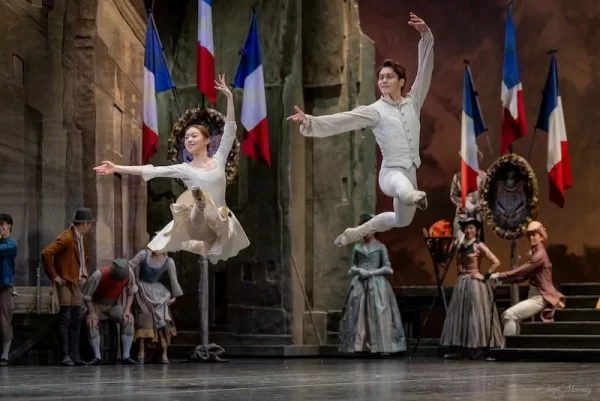
The signature betrothal Grand Pas de Deux between Jeanne and Philippe; Photo Credit: Joseph Marcinsky for K-Ballet Tokyo
Iwai is coquettish, her ankles working hard through light, springing ballonnés, the working leg flicking out and drawing back in like a fan opening and closing. She travels in a circle around the stage through a musical sequence of turns.
K-Ballet pairs high-voltage technique with vivid characterization, reshaping classical ballets into gripping theatrical experiences. Its dancers dazzle, but the storytelling keeps the audience hooked.
Now that Ayala Land’s arts and culture director Chris Mohnani has worked his magic to bring K-Ballet Tokyo to Manila, perhaps he can pull off one more miracle and bring back the full-length The Flames of Paris.
This reviewer watched the one-night-only 7:30 PM performance on October 24.

Comments